

Indian Slide GuitarPrepared by KalaSudha
Advanced Indian Slide Guitar
Advanced Indian slide guitar develops full raga presentation, composition and supervised teaching across 36 path topics, ending in a judged concert with tabla.
- Your path
- 36 path topics across three modules
- Module
- 3A–3C
- Lessons
- One-to-one or in a group
- Ends in
- Sanchari Advanced Diploma

Übersicht
About Advanced
Advanced Indian slide guitar develops a full presentation of a Hindustani raga, a melodic framework. You enter after Intermediate or a placement session that confirms the same skills. You need control of pitch and rhythm before extending the music into a concert programme.
Module 3A studies ragas at depth, with gats, compositions within a rhythmic cycle, and faster taans, melodic runs. You compare how players pace a raga and rehearse a full presentation. Rhythmic work develops phrases at different speeds within the cycle.
Read the full overviewWeniger anzeigen
Module 3B adds named ornaments and tihais, phrases repeated three times to land on the first beat. You develop drut jhala, the fast alternation of melody and drone strings, and study morning and evening raga forms. Rehearsal with tabla prepares you to sustain a longer set.
In module 3C you compose and notate a gat and teach a Foundation topic under supervision. You plan the order and timings of a thirty-minute programme, then perform it with tabla to an audience for judging. Completion leads to KalaSudha's Sanchari Advanced Diploma.
Your path contains 36 topics across modules 3A, 3B and 3C. Each module has 14 available topics: eight core topics and six electives. Your teacher fills four open slots from electives, their own topics or both. This KalaSudha-prepared programme keeps a common core without a single lineage, while teacher-set choices carry style. Learn live online one-to-one or in a group; each topic closes after teacher review.
Module
The three Advanced modules
Develop a full raga presentation and refine ornament and rhythm. The final module brings composition and supervised teaching together with planning, rehearsal and a judged concert performance.
-
3A
Module 3A: Raga development at depth
8 core + 4 teacher-setfrom 14 topics
Study your first two ragas at depth and develop a gat with faster melodic runs. Compare how different players pace a full raga presentation. Practise rhythmic divisions in the suggested Teentaal cycle, then rehearse a complete rendering while keeping both hands controlled.
-
How to Render a Raga: Lines ComparedKernsystem
The order of a full rendering (alaap, jod, jhala, gat) and how two slide lines pace it differently.
-
Advance Learning in the First RagaKernsystem
Take the first raga (suggested: Yaman) to full depth: rare phrases, the upper register, the vistar order.
-
Composition and Taan Patterns in the First RagaKernsystem
A gat in the first raga with six taans at fast laya.
-
Alankar at SpeedKernsystem
The alankar set at drut laya, both hands clean.
-
The Intricacies of Teentaal: Divisions and LaykariKernsystem
Teentaal's vibhags as places to start and end phrases, and phrases in tigun and chaugun.
-
Advance Learning in the Second RagaKernsystem
The second raga (suggested: Bhupali) at full depth.
-
Guided Rendering RehearsalKernsystem
A full fifteen-minute rendering of one raga to your teacher, stopped and corrected.
-
Module 3A Review: Rendering and Hand Under LoadKernsystem
Present a rendering, and check that posture and bar contact hold at speed.
-
Composition and Taan Patterns in the Second RagaWahlthema
A gat in the second raga with six taans.
-
Advance Learning in a Third RagaWahlthema
A third raga (suggested: Durga) at full depth.
-
Double Strings TogetherWahlthema
Two main strings sounded together under the bar, both in tune.
-
Style: Maihar Drills at Drut LayaWahlthema
The Allauddin Khan palta set at drut laya.
-
Style: Da-Ra Coordination While SlidingWahlthema
Right-hand strokes kept even while the bar moves, as the Kabra instrument asks.
-
Style: Mohan veena taansWahlthema
Play taan shapes on the Mohan veena, with its harmonic strings sounding underneath.
Your teacher fills 4 slots from the electives, their own topics or both.
-
-
3B
Module 3B: Ornament and rhythmic control
8 core + 4 teacher-setfrom 14 topics
Study morning and evening raga forms, then develop a morning raga chosen with your teacher. Place named ornaments in phrases and practise tihais, repeated phrases that land on the first beat. Build fast jhala and rehearse a longer set with tabla.
-
Morning and Evening FormsKernsystem
How morning and evening ragas differ in swara, movement and mood.
-
Advance Learning in a Morning RagaKernsystem
A morning raga (suggested: Ahir Bhairav) at full depth.
-
Composition and Taan Patterns in the Morning RagaKernsystem
A gat in the morning raga with six taans.
-
Ornament Drills: Gamak, Murki and KrintanKernsystem
Gamak, murki and krintan as named drills, then placed on request in a phrase.
-
Laykari and Tihai PlacementKernsystem
A tihai is a phrase played three times to land on sam. Place tihais at the end of phrases.
-
Drut JhalaKernsystem
Jhala at fast laya, building to a close.
-
Performance Simulation with TablaKernsystem
A twenty-minute set with a tabla player, run as if to an audience.
-
Module 3B ReviewKernsystem
Present a morning-raga rendering with ornaments, tihais and jhala.
-
Advance Learning in an Evening RagaWahlthema
An evening raga (suggested: Bihag) at full depth.
-
Ektaal: a Vilambit Gat FrameWahlthema
Count Ektaal at slow laya and fit a gat line into it.
-
Listening: One Raga, Three RenditionsWahlthema
Three renditions of one raga by different instrumentalists, compared for structure and pacing.
-
Style: Ravi Shankar, Barun Kumar Pal and the Sitar LineWahlthema
Pandit Ravi Shankar on sitar and Pandit Barun Kumar Pal on Hansa veena in one raga.
-
Style: vocal-led taansWahlthema
Build taans from sung phrases in vocal music.
-
Style: Gamak Taans of the Sarod LineWahlthema
Taans with gamak on every swara, from the Maihar sarod repertoire.
Your teacher fills 4 slots from the electives, their own topics or both.
-
-
3C
Module 3C: Preparing the concert
8 core + 4 teacher-setfrom 14 topics
Refine your concert raga and practise pitch control through ornament. Compose and notate a gat, then teach a Foundation topic under supervision. Plan the programme and rehearse with tabla before presenting a judged thirty-minute concert to an audience.
-
Review of Advanced Repertoire and Weak LinksKernsystem
Find the weakest raga or technique from 3A and 3B and work on it.
-
Advance Learning in a Concert RagaKernsystem
The raga you will present (suggested: Charukeshi), taken to full depth with its gat and taans.
-
Andolan and Pitch Under OrnamentKernsystem
A slow swing on a swara (andolan), with the pitch kept true under every ornament.
-
Tihai ArithmeticKernsystem
Build tihais by counting: the phrase, the gaps and the landing, across three cycles.
-
Composing a GatKernsystem
Compose a gat in a raga you play, notate it, and play it.
-
Teaching a Foundation Topic Under SupervisionKernsystem
Teach one Foundation topic to a learner with your teacher watching.
-
Concert Rehearsal: Programme and Running OrderKernsystem
Set the thirty-minute programme, the order and the timings, and run it with tabla.
-
The Concert: Judged Stage PerformanceKernsystem
A thirty-minute programme with tabla to an audience, judged.
-
Vistar: Extended ElaborationWahlthema
Twenty minutes of vistar that keeps building without repeating itself.
-
Advance Learning in a Seasonal RagaWahlthema
A monsoon raga (suggested: Megh) at full depth.
-
Jhaptaal: a Gat in Ten BeatsWahlthema
Count Jhaptaal and play a gat in it.
-
Style: A Dhun to Close the SetWahlthema
A light-classical dhun of the kind the Kabra line closes a programme with.
-
Style: light-classical slide with accompanimentWahlthema
Play a light-classical piece on the Mohan veena with an accompanist.
-
Style: A Sarod-Line Gat with TaansWahlthema
A gat from the Maihar sarod repertoire, played with taans on the slide.
Your teacher fills 4 slots from the electives, their own topics or both.
-
Why Advanced
What Advanced builds
-
Raga development at depth
Build a full raga presentation and compare how players shape its pace. Your teacher reviews the phrasing and the control of both hands under faster playing.
-
Composition and supervised teaching
Write and play your own gat, then teach a Foundation topic with your teacher watching. Both are core outcomes that every Advanced learner works towards.
-
Concert work with tabla
Plan the programme and its timings, then rehearse with tabla. The final judged performance brings the level's musical work into a thirty-minute set for an audience.
Lessons
Ways to learn
One-to-one
Learn at your own pace. You book online lessons through KalaSudha in your own time zone.
Register interest in 1:1 lessonsIn a group
Learn in a group on a timetable.
Ask about group lessonsTeachers
Teachers for Advanced
-
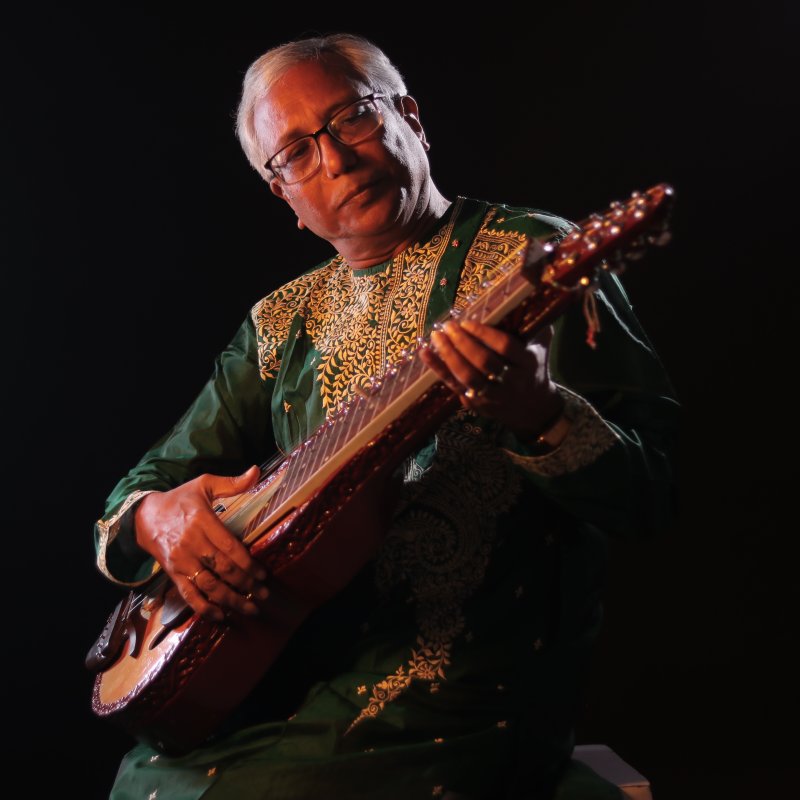
<p>Debasis Chakroborty ist ein bekannter indischer klassischer Slide-Gitarrenvirtuose. Er ist bei zahlreichen großen internationalen Musikfestivals in Südostasien, Australien, den USA und Europa aufgetreten.</p>
Teaches
Indian Slide Guitar

Fragen
Questions about Advanced
Entry, pace, assessment and what you show to finish the level.
Advanced Indian slide guitar starts after Intermediate or a placement session showing the same skills. Control meend glides and gamak oscillations in tune, and play jod with a steady pulse.
You should also be able to play a gat, a composition within a cycle, with melodic elaboration and slow runs. Your teacher checks recognition of three ragas by ear and rhythmic work with tabla before placing you.
On KalaSudha's online Indian classical music courses, teachers assess students topic by topic. Each topic credits named skills, and the teacher closes it only after reviewing the student's work. Foundation assessment uses practical work and spoken questions. Intermediate adds written theory, and Advanced adds theory papers and a judged stage performance. A module certificate follows each module, and KalaSudha issues an award at the end of each level.
A KalaSudha certificate shows the discipline and the skills the learner attained. A certificate earned on a KalaSudha course also records the learning hours. It names the teacher and tradition the learner studied under, as a record of where they learned. KalaSudha issues every award itself. The taught levels lead to the Sthayi Certificate at Foundation, the Antara Diploma at Intermediate and the Sanchari Advanced Diploma at Advanced.
Advanced Indian slide guitar completion includes a judged thirty-minute programme with tabla to an audience. You also compose, notate and play a gat, a composition within a rhythmic cycle, and teach a Foundation topic under supervision.
Your teacher reviews full raga presentation, ornaments and rhythmic control across your topic path. Each topic closes after review.
Nächste Schritte
Bereit für Advanced?
Tell us what you want to learn and where you are today. An academy advisor will help you find a good next step.