

Indian Slide GuitarPrepared by KalaSudha
Foundation Indian Slide Guitar
Foundation Indian slide guitar lessons for beginners: tuning, bar control, rhythm and first raga phrases, with 36 path topics across modules 1A, 1B and 1C.
- Your path
- 36 path topics across three modules
- Module
- 1A–1C
- Lessons
- One-to-one or in a group
- Ends in
- Sthayi Certificate

Übersicht
About Foundation
Foundation Indian slide guitar lessons introduce Hindustani raga, a melodic framework, through a guitar held flat across your lap and played with a slide bar. You need no previous guitar experience or knowledge of notation. Foundation is the first level of the programme prepared by KalaSudha.
Modules 1A, 1B and 1C give you a path of 36 topics. Each module has 14 available topics: eight core topics and six electives. Your teacher fills four open slots from the electives, their own topics or both, alongside the eight core topics. Guided rehearsal and a review close each module.
Read the full overviewWeniger anzeigen
You begin by tuning and sounding clean notes with the bar still. You find Sa and Pa, the tonic and fifth, by ear and learn Da and Ra, the two plucking strokes. Melodic exercises then develop pitch and rhythm. In the final module you learn phrases in one raga and a short alap, its unmetered opening.
Use an instrument your teacher approves; a lap steel guitar can suit Foundation. Your teacher sets the tuning for your instrument. You learn common core skills, while their playing style comes through the electives and their own topics. Set aside time for daily practice and record your work for feedback.
You can learn live online one-to-one or in a group. A topic stays open until your teacher reviews and closes it, so 36 topics need not mean 36 lessons. Foundation ends with your raga presentation and leads to KalaSudha's Sthayi Certificate. The Intermediate level builds on these skills.
Module
The three Foundation modules
Start with the instrument and your ear, then put melodic exercises into a rhythmic cycle. The final module joins these skills in short raga phrases and a reviewed presentation.
-
1A
Module 1A: Instrument and bar control
8 core + 4 teacher-setfrom 14 topics
Set up and tune your instrument, then learn to hold the bar for clean notes. Practise Da and Ra, the inward and outward plucking strokes, at equal volume. Find Sa and Pa by ear and play the seven notes of the middle octave.
-
The Instrument, Seating and SetupKernsystem
Meet the slide guitar your teacher plays, sit with it flat on the lap, and learn its string groups: main strings, chikari and tarab where the instrument has them.
-
Tuning the String GroupsKernsystem
Tune the main strings to the tuning your teacher sets for your instrument, set the chikari to Sa, and hear what the tarab add.
-
Bar Hold and Clean ContactKernsystem
Hold the bar so it touches the strings with no buzz and no pressure past the point of clarity.
-
The Right Hand and the Two Strokes, Da and RaKernsystem
Set the right hand on the strings, then play the inward stroke Da and the outward stroke Ra at equal volume.
-
Finding Sa and PaKernsystem
Find Sa and Pa on the main string by ear against the tanpura, then confirm them with the tuner.
-
Mapping the First SaptakKernsystem
Play the seven shuddha swaras of the middle octave up and down, landing each one rather than sliding into it.
-
Intonation Under Guided CorrectionKernsystem
A guided rehearsal: play the module's material to your teacher and fix the swaras that drift, one at a time.
-
Module 1A Review and PresentationKernsystem
Present setup, tuning, clean notes, Da and Ra and the saptak in one short sitting.
-
Straight Bar Movement Between NotesWahlthema
Move the bar from one swara to the next and stop it there, with no slide heard between them.
-
Tone Across Repeated NotesWahlthema
Play one swara many times and keep its tone, length and volume the same each time.
-
First Paltas in Slow LayaWahlthema
Play the first three paltas (alankar patterns) your teacher sets, in slow laya, up and down the octave.
-
Style: the Kabra Instrument and HandWahlthema
The instrument as Pandit Brij Bhushan Kabra set it for raga, with chikari and tarab, and his hand: the thumb on the chikari, index and middle on the main strings.
-
Style: the Mohan veena setupWahlthema
The Mohan veena: its string groups, how it sits, and how its tuning differs from other slide instruments.
-
Sing Sa to Pa Before Playing ItWahlthema
Sing Sa, Re, Ga, Ma, Pa against the tanpura, then play what you sang, so the ear leads the bar.
Your teacher fills 4 slots from the electives, their own topics or both.
-
-
1B
Module 1B: Melodic exercises and rhythm
8 core + 4 teacher-setfrom 14 topics
Carry melodic exercises into the lower and upper octaves and keep both plucking strokes even as the pace rises. Count Teentaal, the suggested 16-beat cycle, and read and write note patterns. Compare recordings, then rehearse your exercises with a rhythmic accompaniment.
-
Review of 1A and Hand ResetKernsystem
Check the seating, bar and right hand set in 1A and correct what has slipped since.
-
Paltas Across the Full RangeKernsystem
Carry the paltas from 1A into the lower and upper octaves.
-
Da-Ra Evenness at SpeedKernsystem
Raise the Da-Ra pair from slow to medium laya without the Ra stroke going weak.
-
Teentaal: Theka, Sam and CountingKernsystem
Count the sixteen-beat cycle with claps and waves, find sam and khali, and follow a lehra.
-
Reading and Writing Swara and Tala NotationKernsystem
Read and write sargam and tala in the notation the course uses, with Da and Ra marked.
-
Listening: how the slide guitar came to ragaKernsystem
Hear short recordings from the Kabra and Barun Kumar Pal slide lines and from a Maihar sarod. Describe differences in tone, ornament and stroke.
-
Guided Rehearsal: Paltas Against the CycleKernsystem
Play the module's paltas over a Teentaal lehra with your teacher correcting laya and landing.
-
Module 1B Review and Rhythm StudiesKernsystem
Present the paltas across the range, Da-Ra at medium laya and the counted cycle.
-
Keherwa and the Eight-Beat CycleWahlthema
Count Keherwa and play a palta inside it.
-
Crossing Strings Without NoiseWahlthema
Move between main strings with the bar and right hand so no open string or bar noise sounds.
-
Position Recall on the Fretless BoardWahlthema
Find any swara your teacher names, from a cold start, without sliding to search for it.
-
Paltas in DugunWahlthema
Play paltas at double speed against the same lehra, two swaras to each beat.
-
Style: Maihar Paltas and the Chikari Between PhrasesWahlthema
The alankar and palta drills of Ustad Allauddin Khan's Maihar teaching, with the chikari struck between phrases the sarod way.
-
Style: Sitar-Ang Phrasing on the SlideWahlthema
Phrasing from the sitar line, as Pandit Barun Kumar Pal carried it from Pandit Ravi Shankar onto the Hansa veena: how a phrase is struck and shaped.
Your teacher fills 4 slots from the electives, their own topics or both.
-
-
1C
Module 1C: First raga phrases
8 core + 4 teacher-setfrom 14 topics
Learn the first raga your teacher chooses, its ascent and descent, and the phrases that identify it. Begin an alap, the unmetered opening, and practise short glides between notes. Play phrases with tabla, then present your work for Foundation review.
-
Foundation Review and Intonation FixesKernsystem
Play back the 1A and 1B material and fix the swaras and strokes that still slip.
-
The First Raga: Aroha, Avaroha, Pakad, Vadi and SamvadiKernsystem
Learn the ascent, descent and catch phrase of the first raga (suggested: Yaman), and which two swaras carry its weight.
-
Phrase Shapes and Their ContourKernsystem
Play three phrases of the raga and keep their contour under repetition.
-
Early Alaap: Expanding from SaKernsystem
Open the raga slowly from Sa, adding one swara at a time and returning to Sa.
-
Meend as Pitch Discipline: Short GlidesKernsystem
Glide between two neighbouring swaras and arrive exactly on the second.
-
Playing with TablaKernsystem
Play the raga's phrases over live or recorded tabla and keep them landing on sam.
-
Guided Mock PresentationKernsystem
Rehearse the Foundation presentation with your teacher: alaap, phrases, and phrases with tabla.
-
Foundation Completion and ReviewKernsystem
Present alaap and phrases in the first raga in one sitting.
-
The Raga's Altered Swara and Where It SitsWahlthema
Place the raga's altered swara (tivra Ma, if the first raga is Yaman) and hear the moment it drifts.
-
Pauses and Phrase EndingsWahlthema
End a phrase on a resting swara and let it ring before the next one starts.
-
Keeping a Phrase Set on Sam with a LehraWahlthema
Fit a short fixed set of the raga's phrases into the cycle so it starts and ends on sam.
-
Style: Listening to Call of the ValleyWahlthema
Pandit Brij Bhushan Kabra's 1967 recording with Shivkumar Sharma and Hariprasad Chaurasia: how the guitar first carried raga phrases.
-
Style: gayaki phrasing on the Mohan veenaWahlthema
How a phrase sings on the Mohan veena: long held swaras and soft entries.
-
Gayaki: the voice behind the slideWahlthema
Sing each phrase of the raga first, then play it so the slide follows the voice.
Your teacher fills 4 slots from the electives, their own topics or both.
-
Why Foundation
What Foundation builds
-
A start for beginners
Begin without prior guitar experience or notation skills. Your teacher introduces the instrument and builds the habits you need through practice and review.
-
Control in both hands
Learn clean bar contact and even plucking from the start. Practise holding a note in tune before you move between notes and shape phrases.
-
Let your ear guide you
Find notes against a reference drone and listen for pitch drift. Your teacher uses that listening work to guide your bar control and tone.
Lessons
Ways to learn
One-to-one
Learn at your own pace. You book online lessons through KalaSudha in your own time zone.
Register interest in 1:1 lessonsIn a group
Learn in a group on a timetable.
Ask about group lessonsTeachers
Teachers for Foundation
-
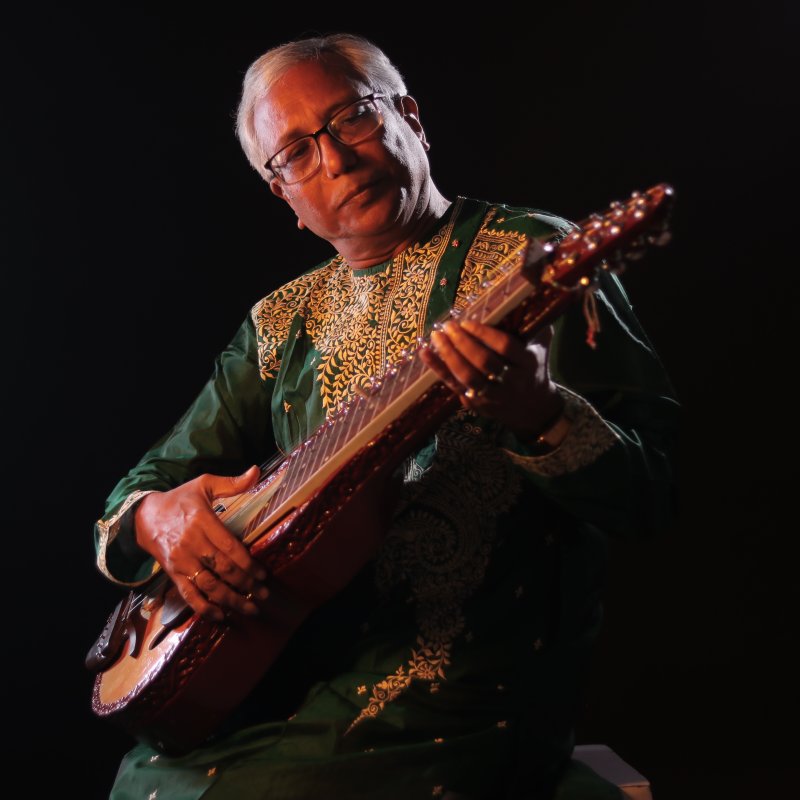
<p>Debasis Chakroborty ist ein bekannter indischer klassischer Slide-Gitarrenvirtuose. Er ist bei zahlreichen großen internationalen Musikfestivals in Südostasien, Australien, den USA und Europa aufgetreten.</p>
Teaches
Indian Slide Guitar

Fragen
Questions about Foundation
Entry, pace, assessment and what you show to finish the level.
Beginners learn Indian slide guitar with KalaSudha online and in workshops, starting at Foundation level. The first stage sets your posture, with the guitar flat across your lap, and teaches the slide in an open tuning. We teach children as well as adults; ask us about a starting age and about a size for a younger learner.
Players returning after a long break start again where they left off. Our courses run in levels, and your teacher first checks where you stand.
Foundation Indian slide guitar learners need an instrument their teacher approves; a lap steel guitar can suit this level. Bring a suitable bar and finger picks, a tuner and a tanpura or drone app.
You also need a way to record both hands and a notebook for notation. Ask your teacher to confirm the setup and tuning before you begin.
How quickly you learn Indian slide guitar depends on regular practice and on your ear, because a slide bar sets each pitch. At Foundation, with the guitar across your lap, you hold the bar still at one position and pluck one melody string until your teacher hears a clean attack.
Later stages add meend, a glide made by moving the bar after the pluck. Each level you complete on KalaSudha's courses earns an award, and the award records your learning hours. You learn live and one-to-one online, with workshops and summer camps where enough learners sign up.
Foundation Indian slide guitar completion requires setup and tuning, clean bar contact and even Da and Ra plucking strokes. Find Sa and Pa, the tonic and fifth, by ear and play melodic exercises in tune within a counted cycle.
Present an early alap, the unmetered opening, and short phrases in one raga, including phrases with tabla. Your teacher reviews your work and closes the topics on your path.
Nächste Schritte
Bereit für Foundation?
Tell us what you want to learn and where you are today. An academy advisor will help you find a good next step.