

Bageshri
बागेश्री
.n S g M D n S' | S' n D M P D m G R S
Ursprünge und Kontext
In der tiefen Stille des zweiten prahar der Nacht, wenn die Welt zur Ruhe gekommen ist, taucht Raag Bageshri auf wie ein Gespräch zwischen der Seele und ihrer Geliebten. Es ist ein Raga von "Viraha" (Sehnsucht) und "Shringar" (Romantik), traditionell beschrieben als eine Frau, die auf die Rückkehr ihres Geliebten wartet.
Eine Kafi Thaat-Komposition, Bageshri, ist ein emotionales Meisterwerk, dessen Kraft in seiner "Vakra" (krummen) Geometrie liegt. Es bewegt sich nicht in geraden Linien; stattdessen mäandert es durch die unteren und mittleren Oktaven und kreist um das Madhyama (M) mit einer zarten, fast schmerzhaften Zartheit. Seine Schönheit liegt nicht in großer Geschwindigkeit, sondern in seiner Fähigkeit zu "verweilen". Es ist eine Melodie von Schatten und sanftem Mondlicht, in der jede Note mit zarter, fast schmerzhafter Zartheit behandelt wird.
Mehr anzeigenWeniger anzeigen
Wie Raag Bangala legt Bageshri immenses Gewicht auf das Madhyama (Ma). Wo jedoch Bangala Ma verwendet, um ein "luftiges" Morgengebet zu erzeugen, verwendet Bageshri es, um eine tiefgreifende emotionale Tiefe hervorzurufen. Die Art und Weise, wie ein Sänger das Ma vom Komal Ni angeht, erzeugt einen charakteristischen "Hook", der die romantische Klanglandschaft der indischen Musik seit Jahrhunderten definiert hat.
Bei KalaSudha betrachten wir Bageshri als das ultimative "Nachtgedicht". Es ist ein Raga, der vom Interpreten ein hohes Maß an Reife verlangt. Es geht nicht um die Noten, die Sie spielen, sondern um die Stille, die Sie zwischen ihnen lassen. Es ist der Klang eines Herzens, das voll ist und doch wartet.
Technische Details
Melodische Struktur und Bewegungsmuster
Aroha (Aufstieg)
.n S g M D n S.
Avroh (Abstieg)
S. n d , M P D , M g R S
Pakad (charakteristische Phrase)
S .n .D S , M g , M D n D , M g , M g R S
Chalan (Movement)
.n .D S M
Tanpura Tuning
M — S — S — Sa
Additional Notes
Phraseologies
Bageshri wird durch eine "Vakra"-(Gekrümmte-)Grammatik definiert, die lineare Wege vermeidet. Die Bewegung ist ein diagonales Erreichen vom unteren Register zum Madhyama (M). Es lässt R und P im Aufstieg weg, um Spannung zu erzeugen, und löst sie durch schwere, gefühlvolle Glissandi (Meends) im Abstieg auf. Die Melodie ist "schwebend", setzt sich nie zu schnell auf der Tonika fest.
Common Phrases
- .n .D S m
Aufnahmen und Auftritte
Hören Sie große Meister diesen Raga spielen

Tracks
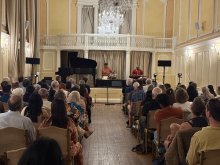
Raag Bageshri - Alap - Live from Kala Festival 2025
Debasis Chakroborty
Raag Bageshri - Drut Gat - Teental (with Akram Khan) - Live from Kala Festival 2025
Debasis Chakroborty
Raag Bageshri - Madhyalaya Gat - Teental (with Akram Khan) - Live from Kala Festival 2025
Debasis Chakroborty
Raag Bageshri - Vilambit Gat - Teental (with Akram Khan) - Live from Kala Festival 2025
Debasis Chakroborty
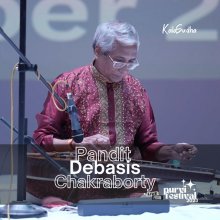
Raag Bageshwari – Jhala
Debasis Chakroborty
Raag Bageshwari – Madhya Laya
Debasis Chakroborty
Master Performers
Artists renowned for their renditions of Bageshri

Debasis Chakroborty
Indian Slide Guitar

Sandipan Mukherjee
Tabla
Classifiers
Swara geometries, relationships, and classifications
Swara Geometries
Struktur
Around the World
Global connections and equivalent scales
Bageshri passt zu den "Moll-Dur"-Hybriden des Westens, perfekt für Spätabend-Jazz.
Dorian Mode
C−D−Eb−F−G−A−Bb−C
A "minor" mode with a "major" 6th; evokes soulful, non-melancholic depth.
Häufig gestellte Fragen
Where can I hear Raag Bageshri played live in concert?
You can hear Raag Bageshri live at KalaSudha's concerts in the UK, Europe and India, and Pandit Debasis Chakroborty has played it at Kala Festival, a touring festival. He has also played it on Indian slide guitar at Purvi Festival in Motihari, Bihar. The AUTRIM project of the National Centre for the Performing Arts and the University of Amsterdam places Bageshri in the late night. Coming concerts are on the events page.
Which recordings of Raag Bageshri should I listen to first?
KalaSudha's recordings of Raag Bageshri include a solo alap recorded live at Kala Festival, where Pandit Debasis Chakroborty sets out the raga on Indian slide guitar with no tabla and no fixed beat. On the album Norwich Ragas, gats in Tintal with the tabla player Ustad Akram Khan follow it, each faster than the last. Pandit Debasis Chakroborty's Purvi Festival performance, with the tabla player Sandipan Mukherjee, is also out as a video release.
What is the difference between Raag Bageshri and Raag Rageshri?
Raag Bageshri uses komal Ga, the lowered form, and keeps Pa, while Raag Rageshri takes shuddha Ga, the natural form, and leaves Pa out. The AUTRIM project gives Bageshri seven notes, with komal Ga and komal Ni, and writes that Pa is left out going up and used sparingly. It finds their upper halves alike apart from Pa. Turns such as Ma, Dha, komal Ni, Dha, Ma belong to both, but Bageshri's oscillated komal Ni makes it very distinct.
What is the Carnatic equivalent of Raag Bageshri?
Carnatic music has its own Raag Bageshri, which George Howlett describes as imported from Hindustani music and retaining many of its original features; he gives the era as unclear. He lists it under Kharaharapriya, the 22nd melakarta, or parent scale. Among other Carnatic ragas, Howlett pairs Bageshri with Sriranjani, which he sums up as Bageshri with no Pa.
Which bandishes are sung in Raag Bageshri?
Bandishes, or set compositions, in Raag Bageshri include Gunde Lavo Ri Malaniya, a chhota khayal sung by Padma Talwalkar for the AUTRIM project of the National Centre for the Performing Arts. A chhota khayal is a shorter khayal composition, and this one is set in Tintal at a fast tempo. In its words a woman asks the flower girl for garlands as she prepares to welcome her loved one. She wonders how the night will pass without him.
How can I learn a raga online?
You can learn a raga online with the KalaSudha Academy, in live one-to-one lessons with a teacher or in a structured course, from foundation to advanced. Learners book lessons in their own time zone, and teachers teach live in their own language. Instructors and touring artists also lead in-person workshops and summer camps where enough learners register interest.
Is Raag Bageshri a good raga for a beginner to learn?
Raag Bageshri is a Class XII raga in the Hindustani vocal course that India's Central Board of Secondary Education (CBSE) sets for schools, the last class the course covers. Before it, students learn ragas such as Yaman and Kafi in Class IX, Bhupali in Class X and Bhairavi in Class XI. In Class XII, students sing Bageshri as a drut, or fast, khayal beside Bhairav and Malkauns.
Which film songs are based on Raag Bageshri?
Hindi film songs that David Courtney lists in Raag Bageshri include Aja Re, Paradesi, from Madhumati, and Bedardi Dagabaz Ja Tu Nahin Balma Mora, from Bluff Master. Courtney calls the Bluff Master song a "pretty good example" of the raga, and Bolo Na, from Chittagong, "quite a good approach to Bageshri".
Have more questions? Contact our support team and we'll be happy to help!