

Madhuvanti
मधुवंती
.N S g M# P N S' | S' N D P M# g M# g R S .N S
Ursprünge und Kontext
Raag Madhuvanti ist ein Hindustani-Raga außerhalb der zehn Thaats, der am späten Nachmittag aufgeführt wird und neben shuddha Re, Pa, Dha und Ni komal Ga und tivra Ma verwendet. Komal bedeutet erniedrigt, tivra erhöht und shuddha natürlich. Ein Thaat ist eine Grundskala. Der Raga wird auch Raag Madhuwanti oder Raga Madhuvanti geschrieben; zu seinen älteren Namen gehört Ambika.
In der Notation hier markiert ein Kleinbuchstabe einen Komal-Ton, M# steht für tivra Ma, ein Punkt für die tiefere und ein Apostroph für die höhere Oktave. Der Aroha, der Aufstieg, lautet .N S g M# P N S'. Er lässt Re und Dha aus, die im Abstieg zurückkehren. Der Avaroha, der Abstieg, lautet S' N D P M# g M# g R S .N S. Der Vadi, der markanteste Ton, ist Pa, und der Samvadi, sein Partner, ist Sa. Andere Darstellungen paaren Pa stattdessen mit Re und fügen hinzu, dass manche tivra Ma als Vadi ansehen, mit Sa als Samvadi. Das AUTRIM-Projekt des National Centre for the Performing Arts und der Universität Amsterdam ordnet ihn außerhalb des Thaat-Systems ein. Er wird auch unter Todi geführt.
Mehr anzeigenWeniger anzeigen
Madhuvanti steht Multani nahe. AUTRIM findet in beiden ähnliche Bewegungen, doch Multani erniedrigt Re und Dha, wo Madhuvanti sie natürlich lässt. George Howlett nennt den karnatischen Melakarta Dharmavati, den 59., als ungefähres Gegenstück; er hat dieselben sieben Töne.
KalaSudha versteht Madhuvanti als Brücke zwischen intellektueller Komplexität und melodischer Schönheit, als Raga, der präzise Meend, also Gleittöne, und ein volles, gehaltenes Pa verlangt. KalaSudha veröffentlicht Aufnahmen von Madhuvanti, etwa Madhuvanti, Pt. 1. Die Akademie von KalaSudha unterrichtet Ragas online und in Workshops vor Ort.
Wann Madhuvanti entstand und wer ihn schuf, darüber gehen die Darstellungen auseinander. Das AUTRIM-Projekt schreibt ihn Wamanrao Padhye zu, einem Schüler von V. D. Paluskar. George Howlett zitiert Rajan Parrikar zu einer geteilten Urheberschaft: Vilayat Khan soll ihn in den 1940er-Jahren erdacht haben, während Padhye einen ähnlichen Raga entwickelte, den er Ambika nannte. Es gibt zwei Sichtweisen: ein alter Raga unter neuem Namen oder ein Raga, der um die 1930er-Jahre zum ersten Mal zu hören war.
Howlett verbindet den Namen mit Honig oder Nektar, und AUTRIM nennt Ambika und Madhumalati als weitere Namen.
Das AUTRIM-Projekt präsentiert einen Chhota Khyal im Sitarkhani-Tala, gesungen von Ashwini Bhide, und einen Bada Khyal im langsamen Ektal, gesungen von Aslam Khan, beide über die Sehnsucht nach der geliebten Person.
Technische Details
Melodische Struktur und Bewegungsmuster
Aroha (Aufstieg)
.N S g M# P N S'
Avroh (Abstieg)
S' N D P M# g M# g R S .N S
Pakad (charakteristische Phrase)
.N S M# g M# P, M# g S R S
Chalan (Movement)
N(o)SgM#P ∣ gM#PNS′ ∣ S′NDPM#gRS
Tanpura Tuning
P - S - S - .S
Additional Notes
Phraseologies
Schlüssel zu diesen Phrasen: g ist komal Ga, M# ist tivra Ma, und ein Punkt setzt einen Ton in die tiefere Oktave.
Die Erkennungsphrase .N S M# g M# P steigt vom tiefen Ni auf und pendelt zwischen tivra Ma und komal Ga, bevor sie Pa erreicht. M# g S R S kehrt über Re zu Sa zurück. Pa ist ein Ruhepunkt, Ga und Ni tragen Gewicht, mit einem leichten Andol, einer Schwingung, auf Ga.
Das AUTRIM-Projekt hält fest, dass manche Musikerinnen und Musiker neben shuddha Ni auch komal Ni verwenden. Es hört außerdem Anklänge an Patdeep und Bhimpalasi, von denen ein starkes tivra Ma den Raga abgrenzt.
Common Phrases
- g M# P N S'
Aufnahmen und Auftritte
Hören Sie große Meister diesen Raga spielen
Videos

Raag Madhuvanti Alaap | Debasis Chakroborty & Giuliano Modarelli
Debasis Chakroborty
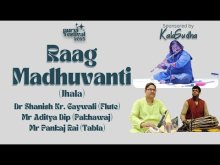
Raag Madhuvanti Jhala | Flute | Tabla | Pakhawaj | Music of India | Purvi Festival 2023
Shanish Kumar

Raag Madhuvanti | Flute | Pakhawaj | Tabla | Music of India | Purvi Festival 2023

Raag Madhuvanti Alap | Flute | Music of India | Shanish Kumar Gaywali | Purvi Festival 2023
Shanish Kumar
Tracks
Master Performers
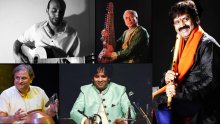
Artists renowned for their renditions of Madhuvanti

Deepak Shah
Piano

Shanish Kumar
Bansuri (Flute)

Debasis Chakroborty
Indian Slide Guitar

Giuliano Modarelli
Guitar
Classifiers
Swara geometries, relationships, and classifications
Swara Geometries
Struktur
Around the World
Global connections and equivalent scales
Mit Sa auf C lauten die Töne von Madhuvanti C D Es Fis G A H, die Tonleiter, die George Howlett Lydisch mit kleiner Terz nennt. Aufstieg und Abstieg verwenden dieselben westlichen Töne.
Lydisch mit kleiner Terz
C D Eb F# G A B
George Howlett nennt die Tonleiter von Madhuvanti Lydisch mit kleiner Terz. Mit Sa auf C stimmt sie Ton für Ton mit Madhuvanti überein.
Häufig gestellte Fragen
Where can I hear Raag Madhuvanti played live in concert?
You can hear Raag Madhuvanti at KalaSudha's concerts in the UK, Europe and India. Pandit Debasis Chakroborty and the guitarist Giuliano Modarelli opened their set with it at the Raga Unison concert in the Assembly Rooms, Edinburgh, with the tabla player Ustad Shahbaz Hussain. The AUTRIM project calls Madhuvanti popular among musicians, especially instrumentalists. Coming concerts are on the events page.
Which recordings of Raag Madhuvanti should I listen to first?
KalaSudha's recordings of Raag Madhuvanti include Madhuvanti, Pt. 1, a live performance by the raga pianist Deepak Shah with the tabla player Durjay Bhaumik. Deepak Shah also plays the alap, the unmetered opening, and a gat in Tintal on piano in KalaSudha studio recordings. Dr Shanish Kumar's bansuri performance at Purvi Festival in Motihari and the Edinburgh alap of Pandit Debasis Chakroborty and Giuliano Modarelli are out as video releases.
What is the difference between Raag Madhuvanti and Raag Multani?
Raag Madhuvanti and Raag Multani move in similar phrases, but Multani lowers Re and Dha, where Madhuvanti keeps them shuddha, or natural. Both use komal Ga and tivra Ma, the raised fourth, with shuddha Ni. In Multani, the AUTRIM project writes, Re and Dha are weak and left out going up, and most movements start from the lower Ni.
What is the Carnatic equivalent of Raag Madhuvanti?
The Carnatic counterpart of Raag Madhuvanti's scale is Dharmavati, the 59th melakarta, or parent scale, with the same seven notes, in George Howlett's table. Howlett adds that Madhuvanti itself was taken into Carnatic music over the past half-century, keeping its shape, with Re and Dha left out going up.
Which film songs are based on Raag Madhuvanti?
George Howlett names two film settings of Raag Madhuvanti: Rasm-E-Ulfat, sung by Lata Mangeshkar, and Muskurahat, sung by Arijit Singh. Madhuvanti is a modern raga: the AUTRIM project credits its creation to Wamanrao Padhye, a disciple of V. D. Paluskar.
Which bandishes are sung in Raag Madhuvanti?
Bandishes, or set compositions, in Raag Madhuvanti include Main Aavun Tore Mandarva, a chhota khayal in Sitarkhani tala sung by Ashwini Bhide for the AUTRIM project. A chhota khayal is a shorter khayal composition, and in this one a lover promises to come to the beloved's home. AUTRIM also presents E Ho More Sai, a bada khayal in slow Ektal sung by Aslam Khan, a song of longing, day and night.
How can I learn a raga online?
You can learn a raga online with the KalaSudha Academy, in live one-to-one lessons with a teacher or in a structured course, from foundation to advanced. Learners book lessons in their own time zone, and teachers teach live in their own language. Instructors and touring artists also lead in-person workshops and summer camps where enough learners register interest.
Have more questions? Contact our support team and we'll be happy to help!