

Bageshri
बागेश्री
.n S g M D n S' | S' n D M P D m G R S
Orígenes y contexto
En el profundo silencio del segundo prahar de la noche, cuando el mundo ha caído en la quietud, Raag Bageshri emerge como una conversación entre el alma y su amado. Es un raga de « Viraha » (anhelo) y « Shringar » (romance), tradicionalmente descrito como una mujer esperando el regreso de su amante.
Una composición del Kafi Thaat, Bageshri es una obra maestra emocional, cuyo poder reside en su geometría « Vakra » (torcida). No se mueve en líneas rectas; en su lugar, serpentea a través de las octavas baja y media, rodeando el Madhyama (M) con una delicadeza tierna, casi dolorosa. Su belleza no reside en una gran velocidad, sino en su capacidad de « permanecer ». Es una melodía de sombras y suave luz de luna, donde cada nota se trata con una delicadeza tierna, casi dolorosa.
Mostrar másMostrar menos
Como Raag Bangala, Bageshri coloca un peso inmenso en el Madhyama (Ma). Sin embargo, donde Bangala usa Ma para crear una oración matutina « aérea », Bageshri lo usa para evocar una profunda profundidad emocional. La forma en que un cantante se acerca al Ma desde el Komal Ni crea un « gancho » característico que ha definido el paisaje sonoro romántico de la música india durante siglos.
En KalaSudha, vemos a Bageshri como el « Poema Nocturno » definitivo. Es un raga que exige un alto grado de madurez del intérprete. No se trata de las notas que tocas, sino del silencio que dejas entre ellas. Es el sonido de un corazón que está lleno, pero esperando.
Detalles técnicos
Estructura melódica y patrones de movimiento
Aroha (ascenso)
.n S g M D n S.
Avroh (descenso)
S. n d , M P D , M g R S
Pakad (frase característica)
S .n .D S , M g , M D n D , M g , M g R S
Chalan (Movement)
.n .D S M
Tanpura Tuning
M — S — S — Sa
Additional Notes
Phraseologies
Bageshri is defined by a "Vakra" (Crooked) grammar that avoids linear paths. The movement is a diagonal reach from the lower register to the Madhyama (M). It omits R and P in the ascent to create tension, resolving them through heavy, soulful glides (Meends) in the descent. The melody is "suspended," never settling too quickly on the tonic.
Common Phrases
- .n .D S m
Grabaciones y actuaciones
Escucha a grandes músicos interpretar este raga

Tracks
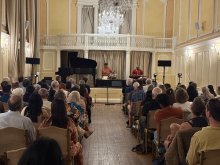
Raag Bageshri - Alap - Live from Kala Festival 2025
Debasis Chakroborty
Raag Bageshri - Drut Gat - Teental (with Akram Khan) - Live from Kala Festival 2025
Debasis Chakroborty
Raag Bageshri - Madhyalaya Gat - Teental (with Akram Khan) - Live from Kala Festival 2025
Debasis Chakroborty
Raag Bageshri - Vilambit Gat - Teental (with Akram Khan) - Live from Kala Festival 2025
Debasis Chakroborty
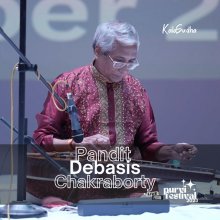
Raag Bageshwari – Jhala
Debasis Chakroborty
Raag Bageshwari – Madhya Laya
Debasis Chakroborty
Master Performers
Artists renowned for their renditions of Bageshri

Debasis Chakroborty
Indian Slide Guitar

Sandipan Mukherjee
Tabla
Classifiers
Swara geometries, relationships, and classifications
Swara Geometries
Estructura
Around the World
Global connections and equivalent scales
Bageshri aligns with the "minor-major" hybrids of the West, perfect for late-night jazz.
Dorian Mode
C−D−Eb−F−G−A−Bb−C
A "minor" mode with a "major" 6th; evokes soulful, non-melancholic depth.
Preguntas frecuentes
Where can I hear Raag Bageshri played live in concert?
You can hear Raag Bageshri live at KalaSudha's concerts in the UK, Europe and India, and Pandit Debasis Chakroborty has played it at Kala Festival, a touring festival. He has also played it on Indian slide guitar at Purvi Festival in Motihari, Bihar. The AUTRIM project of the National Centre for the Performing Arts and the University of Amsterdam places Bageshri in the late night. Coming concerts are on the events page.
Which recordings of Raag Bageshri should I listen to first?
KalaSudha's recordings of Raag Bageshri include a solo alap recorded live at Kala Festival, where Pandit Debasis Chakroborty sets out the raga on Indian slide guitar with no tabla and no fixed beat. On the album Norwich Ragas, gats in Tintal with the tabla player Ustad Akram Khan follow it, each faster than the last. Pandit Debasis Chakroborty's Purvi Festival performance, with the tabla player Sandipan Mukherjee, is also out as a video release.
What is the difference between Raag Bageshri and Raag Rageshri?
Raag Bageshri uses komal Ga, the lowered form, and keeps Pa, while Raag Rageshri takes shuddha Ga, the natural form, and leaves Pa out. The AUTRIM project gives Bageshri seven notes, with komal Ga and komal Ni, and writes that Pa is left out going up and used sparingly. It finds their upper halves alike apart from Pa. Turns such as Ma, Dha, komal Ni, Dha, Ma belong to both, but Bageshri's oscillated komal Ni makes it very distinct.
What is the Carnatic equivalent of Raag Bageshri?
Carnatic music has its own Raag Bageshri, which George Howlett describes as imported from Hindustani music and retaining many of its original features; he gives the era as unclear. He lists it under Kharaharapriya, the 22nd melakarta, or parent scale. Among other Carnatic ragas, Howlett pairs Bageshri with Sriranjani, which he sums up as Bageshri with no Pa.
Which bandishes are sung in Raag Bageshri?
Bandishes, or set compositions, in Raag Bageshri include Gunde Lavo Ri Malaniya, a chhota khayal sung by Padma Talwalkar for the AUTRIM project of the National Centre for the Performing Arts. A chhota khayal is a shorter khayal composition, and this one is set in Tintal at a fast tempo. In its words a woman asks the flower girl for garlands as she prepares to welcome her loved one. She wonders how the night will pass without him.
How can I learn a raga online?
You can learn a raga online with the KalaSudha Academy, in live one-to-one lessons with a teacher or in a structured course, from foundation to advanced. Learners book lessons in their own time zone, and teachers teach live in their own language. Instructors and touring artists also lead in-person workshops and summer camps where enough learners register interest.
Is Raag Bageshri a good raga for a beginner to learn?
Raag Bageshri is a Class XII raga in the Hindustani vocal course that India's Central Board of Secondary Education (CBSE) sets for schools, the last class the course covers. Before it, students learn ragas such as Yaman and Kafi in Class IX, Bhupali in Class X and Bhairavi in Class XI. In Class XII, students sing Bageshri as a drut, or fast, khayal beside Bhairav and Malkauns.
Which film songs are based on Raag Bageshri?
Hindi film songs that David Courtney lists in Raag Bageshri include Aja Re, Paradesi, from Madhumati, and Bedardi Dagabaz Ja Tu Nahin Balma Mora, from Bluff Master. Courtney calls the Bluff Master song a "pretty good example" of the raga, and Bolo Na, from Chittagong, "quite a good approach to Bageshri".
Have more questions? Contact our support team and we'll be happy to help!