

Kirwani
किरवानी
S R g m P d N S' | S' N d P m g R S
Orígenes y contexto
Raag Kirwani muestra cómo la música india puede fluir entre tradiciones. Comenzó como una escala parental importante en la música carnática del sur de la India. Más tarde, los músicos del norte de la India también comenzaron a usarlo, agregando nuevos matices y profundidad al raga. Kirwani generalmente se toca tarde en la noche, alrededor de la medianoche, porque su sonido hace que las personas piensen en silencio y sientan una tristeza gentil. Este raga es un recordatorio para nosotros de que la música puede cruzar fronteras y tocar corazones en todas partes. Como dice un dicho bien conocido, "Donde las palabras fallan, la música habla".
Kirwani es notable por su simetría, ya que ambas mitades de la escala se reflejan entre sí con precisión matemática. Este equilibrio le da un carácter occidental y lo hace popular en colaboraciones interculturales. En KalaSudha, consideramos a Kirwani como un raga de emoción pura, que se basa en la calidad expresiva de sus intervalos menores en lugar de movimientos complejos.
Detalles técnicos
Estructura melódica y patrones de movimiento
Aroha (ascenso)
S R g m P d N S'
Avroh (descenso)
S' N d P m g R S
Pakad (frase característica)
g m P, d P, m g R S, .N R S
Tanpura Tuning
P—S—S—Sa
Additional Notes
Phraseologies
The movement is fluid and lyrical, moving smoothly across octaves without crooked turns.
- The Melancholic Hook: g m P, d P, m g R S
- The Ascending Reach: m P d N S'
- The Signature Resolution: .N R S (The leading note N resolving to S).
- Chalan: S R g m P, d P, m P d N S', S' N d P m g R S, .N R S
Grabaciones y actuaciones
Escucha a grandes músicos interpretar este raga
Vídeos


Master Performers
Artists renowned for their renditions of Kirwani

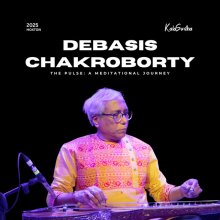
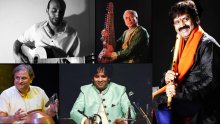
Debasis Chakroborty
Indian Slide Guitar

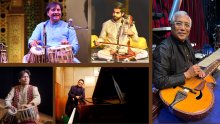
Deepak Shah
Piano

Giuliano Modarelli
Guitar

Hanif Khan
Tabla

Shahbaz Hussain
Tabla
Classifiers
Swara geometries, relationships, and classifications
Swara Geometries
Estructura
Around the World
Global connections and equivalent scales
Kirwani is arguably the most recognisable Indian raga to Western ears.
Harmonic Minor
C−D−Eb−F−G−Ab−B
The quintessential scale for drama and tension in Western classical music.
Preguntas frecuentes
Where can I hear Raag Kirwani played live in concert?
You can hear Raag Kirwani at KalaSudha's concerts in the UK, Europe and India. The raga pianist Deepak Shah played it at Kala Festival, a touring festival, at The Great Hall of the University of Reading, with the tabla player Hanif Khan. Pandit Debasis Chakroborty and the guitarist Giuliano Modarelli played it at the Assembly Rooms in Edinburgh, with Ustad Shahbaz Hussain on tabla. Coming concerts are on the events page.
Which recordings of Raag Kirwani should I listen to first?
KalaSudha's recordings of Raag Kirwani include Meditative Vibe, on which Pandit Debasis Chakroborty plays the raga on solo Indian slide guitar. Video releases show the raga pianist Deepak Shah's Kirwani at Kala Festival in Reading and Pandit Debasis Chakroborty's duet with the guitarist Giuliano Modarelli in Edinburgh.
What is the difference between Raag Kirwani and Raag Charukesi?
Raag Kirwani and Raag Charukesi both use all seven notes with komal, or lowered, Dha, but they swap two notes. Kirwani takes komal Ga with shuddha, or natural, Ni, while Charukesi takes shuddha Ga with komal Ni. Both came from Carnatic music: George Howlett traces Kirwani to Keeravani, the 21st melakarta, or parent scale, and Charukesi to the 26th.
What is the Carnatic equivalent of Raag Kirwani?
Raag Kirwani comes from the Carnatic raga Kiravani, also written Keeravani, the 21st melakarta, or parent scale, with the same seven notes. George Howlett writes that Kirwani was popularised in Hindustani music chiefly through Pandit Ravi Shankar's borrowings from the South. With Sa on C, the scale is the Western harmonic minor, which Howlett notes as congruent with Kirwani.
Which film songs are based on Raag Kirwani?
Hindi film songs that David Courtney lists in Raag Kirwani include Ankhon Se Jo Utari, from Phir Wohi Dil Laaya Hoon, which he calls "a surprisingly good example". His list also includes Anewala Pal, Janewala Hai, from Golmaal, and Ek Radha Ek Meera, from Ram Teri Ganga Maili.
How can I learn a raga online?
You can learn a raga online with the KalaSudha Academy, in live one-to-one lessons with a teacher or in a structured course, from foundation to advanced. Learners book lessons in their own time zone, and teachers teach live in their own language. Instructors and touring artists also lead in-person workshops and summer camps where enough learners register interest.
Have more questions? Contact our support team and we'll be happy to help!