

Madhuvanti
मधुवंती
.N S g M# P N S' | S' N D P M# g M# g R S .N S
Orígenes y contexto
El raga Madhuvanti es un raga indostánico ajeno a los diez thaats, que se interpreta a última hora de la tarde y que usa Ga komal y Ma tivra con Re, Pa, Dha y Ni shuddha. Komal significa rebajado y tivra elevado, mientras que shuddha significa natural. Un thaat es una escala madre. También se escribe Raag Madhuwanti o Raga Madhuvanti, y entre sus nombres más antiguos figura Ambika.
En la notación que se usa aquí, la minúscula indica una nota komal, M# es Ma tivra, un punto indica la octava grave y un apóstrofo la aguda. El aroha, o ascenso, es .N S g M# P N S'. Omite Re y Dha, que vuelven en el descenso. El avaroha, o descenso, es S' N D P M# g M# g R S .N S. El vadi, la nota más destacada, es Pa, y el samvadi, su pareja, es Sa. Otras fuentes emparejan en cambio Pa con Re, y añaden que hay quien toma Ma tivra como vadi, con Sa como samvadi. El proyecto AUTRIM del National Centre for the Performing Arts y de la Universidad de Ámsterdam lo sitúa fuera del sistema de thaats. También se clasifica bajo Todi.
Mostrar másMostrar menos
Madhuvanti está cerca de Multani. AUTRIM encuentra movimientos parecidos en ambos, pero Multani rebaja Re y Dha, mientras que Madhuvanti los mantiene naturales. George Howlett señala como equivalente aproximado el melakarta carnático Dharmavati, el 59.º, que tiene las mismas siete notas.
KalaSudha ve en Madhuvanti un puente entre la complejidad intelectual y la belleza melódica, un raga que pide meends precisos, es decir, deslizamientos, y un Pa pleno y prolongado. KalaSudha publica grabaciones de Madhuvanti, como Madhuvanti, Pt. 1. Su academia enseña ragas en línea y en talleres locales.
Las fuentes difieren sobre cuándo apareció Madhuvanti y quién lo creó. El proyecto AUTRIM lo atribuye a Wamanrao Padhye, discípulo de V. D. Paluskar. George Howlett cita a Rajan Parrikar sobre una autoría compartida: se dice que Vilayat Khan lo concibió en la década de 1940, mientras que Padhye desarrolló un raga parecido al que llamó Ambika. Hay dos tesis: un raga antiguo con un nombre nuevo, o un raga que se oyó por primera vez hacia la década de 1930.
Howlett relaciona el nombre con la miel o el néctar, y AUTRIM da Ambika y Madhumalati como otros nombres.
El proyecto AUTRIM presenta un chhota khayal en tala Sitarkhani, cantado por Ashwini Bhide, y un bada khayal en ektal lento, cantado por Aslam Khan, ambos sobre el anhelo de la persona amada.
Detalles técnicos
Estructura melódica y patrones de movimiento
Aroha (ascenso)
.N S g M# P N S'
Avroh (descenso)
S' N D P M# g M# g R S .N S
Pakad (frase característica)
.N S M# g M# P, M# g S R S
Chalan (Movement)
N(o)SgM#P ∣ gM#PNS′ ∣ S′NDPM#gRS
Tanpura Tuning
P - S - S - .S
Additional Notes
Phraseologies
Clave de estas frases: g indica Ga komal, M# Ma tivra, y un punto sitúa una nota en la octava grave.
La frase característica .N S M# g M# P parte del Ni grave y oscila entre Ma tivra y Ga komal antes de llegar a Pa. M# g S R S vuelve a Sa pasando por Re. Pa es una nota de reposo, y Ga y Ni tienen peso, con un ligero andol, es decir, una oscilación, sobre Ga.
El proyecto AUTRIM observa que hay quien añade Ni komal junto a Ni shuddha. También percibe matices de Patdeep y Bhimpalasi, de los que lo distingue un Ma tivra marcado.
Common Phrases
- g M# P N S'
Grabaciones y actuaciones
Escucha a grandes músicos interpretar este raga
Vídeos

Raag Madhuvanti Alaap | Debasis Chakroborty & Giuliano Modarelli
Debasis Chakroborty
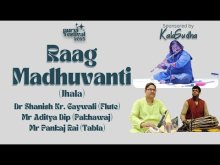
Raag Madhuvanti Jhala | Flute | Tabla | Pakhawaj | Music of India | Purvi Festival 2023
Shanish Kumar

Raag Madhuvanti | Flute | Pakhawaj | Tabla | Music of India | Purvi Festival 2023

Raag Madhuvanti Alap | Flute | Music of India | Shanish Kumar Gaywali | Purvi Festival 2023
Shanish Kumar
Tracks
Master Performers
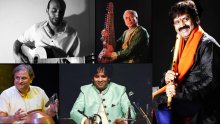
Artists renowned for their renditions of Madhuvanti

Deepak Shah
Piano

Shanish Kumar
Bansuri (Flute)

Debasis Chakroborty
Indian Slide Guitar

Giuliano Modarelli
Guitar
Classifiers
Swara geometries, relationships, and classifications
Swara Geometries
Estructura
Around the World
Global connections and equivalent scales
Con Sa en do, las notas de Madhuvanti son do re mi bemol fa sostenido sol la si, la escala que George Howlett llama lidio bemol 3. El ascenso y el descenso usan las mismas notas occidentales.
Lidio bemol 3
C D Eb F# G A B
George Howlett llama lidio bemol 3 a la escala de Madhuvanti. Con Sa en do, coincide nota por nota con Madhuvanti.
Preguntas frecuentes
Where can I hear Raag Madhuvanti played live in concert?
You can hear Raag Madhuvanti at KalaSudha's concerts in the UK, Europe and India. Pandit Debasis Chakroborty and the guitarist Giuliano Modarelli opened their set with it at the Raga Unison concert in the Assembly Rooms, Edinburgh, with the tabla player Ustad Shahbaz Hussain. The AUTRIM project calls Madhuvanti popular among musicians, especially instrumentalists. Coming concerts are on the events page.
Which recordings of Raag Madhuvanti should I listen to first?
KalaSudha's recordings of Raag Madhuvanti include Madhuvanti, Pt. 1, a live performance by the raga pianist Deepak Shah with the tabla player Durjay Bhaumik. Deepak Shah also plays the alap, the unmetered opening, and a gat in Tintal on piano in KalaSudha studio recordings. Dr Shanish Kumar's bansuri performance at Purvi Festival in Motihari and the Edinburgh alap of Pandit Debasis Chakroborty and Giuliano Modarelli are out as video releases.
What is the difference between Raag Madhuvanti and Raag Multani?
Raag Madhuvanti and Raag Multani move in similar phrases, but Multani lowers Re and Dha, where Madhuvanti keeps them shuddha, or natural. Both use komal Ga and tivra Ma, the raised fourth, with shuddha Ni. In Multani, the AUTRIM project writes, Re and Dha are weak and left out going up, and most movements start from the lower Ni.
What is the Carnatic equivalent of Raag Madhuvanti?
The Carnatic counterpart of Raag Madhuvanti's scale is Dharmavati, the 59th melakarta, or parent scale, with the same seven notes, in George Howlett's table. Howlett adds that Madhuvanti itself was taken into Carnatic music over the past half-century, keeping its shape, with Re and Dha left out going up.
Which film songs are based on Raag Madhuvanti?
George Howlett names two film settings of Raag Madhuvanti: Rasm-E-Ulfat, sung by Lata Mangeshkar, and Muskurahat, sung by Arijit Singh. Madhuvanti is a modern raga: the AUTRIM project credits its creation to Wamanrao Padhye, a disciple of V. D. Paluskar.
Which bandishes are sung in Raag Madhuvanti?
Bandishes, or set compositions, in Raag Madhuvanti include Main Aavun Tore Mandarva, a chhota khayal in Sitarkhani tala sung by Ashwini Bhide for the AUTRIM project. A chhota khayal is a shorter khayal composition, and in this one a lover promises to come to the beloved's home. AUTRIM also presents E Ho More Sai, a bada khayal in slow Ektal sung by Aslam Khan, a song of longing, day and night.
How can I learn a raga online?
You can learn a raga online with the KalaSudha Academy, in live one-to-one lessons with a teacher or in a structured course, from foundation to advanced. Learners book lessons in their own time zone, and teachers teach live in their own language. Instructors and touring artists also lead in-person workshops and summer camps where enough learners register interest.
Have more questions? Contact our support team and we'll be happy to help!