

기원과 배경
라가 조그는 힌두스타니 고전 음악 전통에서 발견되는 감정적 복잡성을 보여줍니다. 단 하나의 분위기에 맞추는 대신 이 라가는 분류하기 어렵습니다. 이것은 카피 타트의 일부이며 독특한 점은 두 간다라의 사용입니다: 슈다 가(G)와 코말 가(g). 이 혼합은 기쁨과 슬픔, 안정과 불안 사이의 미묘한 균형을 포착하는 특별한 종류의 긴장을 만듭니다. 많은 라가가 이중 음을 단지 경과음으로만 사용하는 반면 조그는 이를 사운드의 중심으로 만듭니다. 슈다 가는 일반적으로 상승 음에서 나타나 밝음과 해결의 느낌을 줍니다. 코말 가는 하강 음에서 더 일반적이며 멜로디에 영혼이 담긴 블루스와 같은 깊이를 더합니다. 조그는 일반적으로 초저녁 시간(2번째 프라하르)에 연주되며 그 반복적이고 최면적인 문구가 청취자를 트랜스와 같은 상태로 만들 수 있습니다.
조그를 완전히 이해하려면 카피 가족의 다른 라가를 살펴보는 것이 도움이 됩니다.
더 보기간략히 보기
- 조그와 틸랑은 모두 5음 음계(SGMPnS′)를 사용하고 니-니 이중성을 공유합니다. 그러나 조그는 코말 가(g)를 포함하는 반면 틸랑은 포함하지 않습니다. 이 음은 틸랑의 가볍고 장난스러운 느낌에서 조그의 더 깊고 사려 깊은 블루스 특성으로 분위기를 바꿉니다.
- 조그와 바게시리는 모두 카피 타트의 일부이며 둘 다 갈망의 감각을 표현합니다. 바게시리의 멜로디는 마디아마(M)에 초점을 맞추는 반면 조그는 두 간다라 사이의 긴장에 중심을 둡니다. 바게시리는 조용한 분리감처럼 느껴지지만 조그는 삶의 기복에 대한 성찰처럼 느껴집니다.
"블루스" 연결: 음악 학자들은 종종 조그가 서양 블루스 스케일과 가장 유사한 인도 라가라고 말합니다. 블루스의 "블루 노트"는 조그의 슈다와 코말 간다르 사이의 작은 간격과 일치합니다. 이것은 조그를 음악에서 공통점을 찾고자 하는 전 세계 음악가들을 위한 다리로 만듭니다.
기술적 세부 사항
선율 구조와 진행 방식
아로하 (상행)
S G m P n S'
아바로하 (하행)
S' n P m g S
파카드 (특징적 악구)
n(o) S G m, g S, G m P m g S
Chalan (Movement)
S, Gm, gS, .nSGm, mP, mgS, GmPnS′, nPmgS
Tanpura Tuning
m—S—S—Sa
Additional Notes
Phraseologies
조그의 움직임은 간다라 주변에서 "곡선"입니다. 두 가 사이를 이동할 때 특정 "저크" 또는 카트카를 사용합니다.
- 이중 3도 슬라이드: S−G−m−g−S
- 자정 도달: n(o)−S−G−m−P−n−S′
- 하강 해결: S′−n−P−m−g−S
- 찰란: S, Gm, gS, .nSGm, mP, mgS, GmPnS′, nPmgS
Common Phrases
- S−G−m−g−S
녹음 및 공연
거장들이 연주하는 이 라가를 들어 보세요

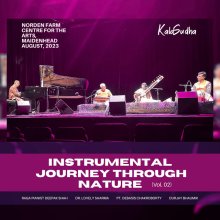

Master Performers
Artists renowned for their renditions of 조그

Dr Lovely Sharma

데바시스 차크로보르티
Indian Slide Guitar

두르자이 바움릭
Tabla

디파크 샤
Piano
Classifiers
Swara geometries, relationships, and classifications
Swara Geometries
구조
Around the World
Global connections and equivalent scales
The Blues Scale
C−Eb−E−F−G−Bb
The Eb to E transition mirrors Jog’s g to G friction.
자주 묻는 질문
Where can I hear Raag Jog played live in concert?
You can hear Raag Jog at KalaSudha's concerts in the UK, Europe and India. Pandit Debasis Chakroborty, Dr Lovely Sharma, the raga pianist Deepak Shah and the tabla player Durjay Bhaumik played it at Kala Festival, a touring festival. Their concert was at Norden Farm Centre for the Arts in Maidenhead. Coming concerts are on the events page.
Which recordings of Raag Jog should I listen to first?
KalaSudha's recordings of Raag Jog include Raag Jog, Pt. 1, the first of two parts recorded live at Kala Festival. Pandit Debasis Chakroborty plays Indian slide guitar with the sitar player Dr Lovely Sharma, the raga pianist Deepak Shah and the tabla player Durjay Bhaumik. The same performance is also out as a video release.
What is the difference between Raag Jog and Raag Jogkauns?
Raag Jogkauns adds komal Dha and shuddha Ni to the notes of Raag Jog, which leaves out Re and Dha. The AUTRIM project of the National Centre for the Performing Arts and the University of Amsterdam calls Jogkauns a modern raga that combines Jog and Malkauns. It attributes the raga to Jagannathbua Purohit, known as Gunidas, of the Agra gharana. AUTRIM finds a slight element of Jog in Jogkauns but calls it more complex.
Is Raag Jog a good raga for a beginner to learn?
Raag Jog is one of the more straightforward ragas to learn, in George Howlett's view. He writes that its character rests more on its scale than on set phrases. Its unusual feature is its pair of Ga: shuddha, or natural, going up and komal, or lowered, coming down. The AUTRIM project of the National Centre for the Performing Arts and the University of Amsterdam notes that some musicians sing both forms of Ga one after the other in the descent.
Which film songs are based on Raag Jog?
Hindi film songs that David Courtney lists in Raag Jog include Poore Se Zara Sa Kam Hai, from Mausam, which he calls "a fairly good example of Jog". He calls Naina Dwara Se, from Sawan, only "Jog-ish". George Howlett notes that Jog is popular in light-classical forms such as bhajan, thumri and ghazal.
Which bandishes are sung in Raag Jog?
The AUTRIM project of the National Centre for the Performing Arts and the University of Amsterdam presents a chhota khayal, a short khayal, in Raag Jog. Ashwini Bhide sings it in medium Ektal. It opens Ja Re Ja Ja Kagava, and in it a woman asks a bird to carry a message to her beloved.
How can I learn a raga online?
You can learn a raga online with the KalaSudha Academy, in live one-to-one lessons with a teacher or in a structured course, from foundation to advanced. Learners book lessons in their own time zone, and teachers teach live in their own language. Instructors and touring artists also lead in-person workshops and summer camps where enough learners register interest.
Have more questions? Contact our support team and we'll be happy to help!