

Hindustani VocalPrepared by KalaSudha
Intermediate Hindustani Vocal
Intermediate Hindustani vocal, prepared by KalaSudha: meend and murki, raga development, Ektal and Jhaptal, bol-alap and bol-bant, and singing with accompanists.
- Modules
- 2A–2C
- Lessons
- One-to-one or in a group
- Ends in
- A KalaSudha certificate

Overzicht
About Intermediate
Intermediate Hindustani vocal adds ornament and accompanied singing, once you can hold Sa and sing a first chhota khayal. You enter after Foundation or a placement session that shows the same skills. It is the second level of the Hindustani Vocal course prepared by KalaSudha.
Module 2A brings meend, the glide between two swaras, then kan, murki and khatka, and the chalan of a third raga. You sing a 3-minute alap that stays in the raga and work on pitch in the upper octave. Module 2B adds the suggested Ektal and Jhaptal and a bandish in medium tempo. You develop its words in bol-alap and bol-bant and notate the full bandish.
Read the full overviewMinder tonen
Module 2C is about singing with accompanists. You sing a bandish with tabla and harmonium, give the ending cue and finish together on sam. You compare the six gharanas through examples, such as Agra, and learn voice care under performance load. Electives add dhrupad, thumri and bhajan.
Each module has 14 topics, eight core and six electives, and your path is 12 topics per module. As a typical guide, Intermediate takes 9–15 months, and you agree the pace with your teacher. In a cohort, learners hear how each one sings the same bandish with the accompanists. The level ends with a 12-minute set with tabla and harmonium and leads to a KalaSudha award (see certificates). Ask about Intermediate in the Academy.
Modules
The three Intermediate modules
-
2A
Module 2A: Ornament and raga development
8 core + 4 teacher-setfrom 14 topics
Agree a practice plan and review the voice. Sing meend between two swaras, then kan, murki and khatka. Learn the chalan of a third raga, sing an alap in the middle octave and work on pitch in the upper octave.-
Review the voice and agree a practice planKern
Review your Foundation recordings with your teacher and agree a practice plan for the module.
-
Meend between two swarasKern
Glide from one swara to another without breaking the voice or losing the arrival note.
-
Kan, murki and khatkaKern
Sing kan, murki and khatka in raga phrases, each ornament clean and light.
-
Chalan of a third ragaKern
Learn the chalan, the characteristic movement, of a third raga (suggested: Bhimpalasi).
-
Alap in the middle octaveKern
Develop the raga swara by swara in a slow alap, resting on its important notes.
-
Pitch in the upper octaveKern
Extend the raga into the upper octave with the same pitch control as the middle octave.
-
Guided rehearsal: ornament and raga developmentKern
Rehearse your ornament and alap set and correct one fault using teacher feedback.
-
Review and presentation: ornament and raga developmentKern
Present your ornament and alap set and discuss your preparation and corrections with the assessor.
-
Gamak in a raga phraseKeuzeonderwerp
Sing a gamak, the oscillating ornament, on two swaras of the raga.
-
A fourth ragaKeuzeonderwerp
Learn the chalan and a drut bandish in a fourth raga (suggested: Bihag).
-
Sight-sing a sargam lineKeuzeonderwerp
Sing an unfamiliar line of sargam notation after a short preparation.
-
Andolan on a held swaraKeuzeonderwerp
Sing a slow andolan, the measured oscillation, on a swara that a taught raga treats this way.
-
Voice range and comfortKeuzeonderwerp
Map your comfortable range with your teacher and choose phrases that sit inside it.
-
Ornament listening studyKeuzeonderwerp
Compare how two attributed recordings use meend and murki in the same raga.
Your teacher fills 4 slots from the electives, their own topics or both.
-
-
2B
Module 2B: Bandish, laya and layakari
8 core + 4 teacher-setfrom 14 topics
Keep the suggested Ektal and Jhaptal and learn a bandish in medium tempo. Develop its words in bol-alap and bol-bant, sing sargam and a tihai from the text, and notate the full bandish.-
Review the bandish and the cycleKern
Sing your Foundation bandish with hand-count and correct one rhythmic fault from a recording.
-
Ektal and JhaptalKern
Recite and keep the suggested Ektal and Jhaptal, then sing a sargam passage in each.
-
A madhya laya bandishKern
Learn a bandish in medium tempo in Ektal or Jhaptal, sthayi and antara.
-
Bol-alap and bol-bantKern
Develop the bandish's words melodically in bol-alap, then rhythmically in bol-bant.
-
Sargam and a tihai from the textKern
Sing a sargam passage, then a tihai made from a phrase of the text that lands on sam.
-
Notate a full bandishKern
Write the bandish in sargam notation with beats, text and divisions.
-
Guided rehearsal: bandish, laya and layakariKern
Rehearse your bandish and layakari set and correct one fault using teacher feedback.
-
Review and presentation: bandish, laya and layakariKern
Present your bandish and layakari set and discuss your preparation and corrections with the assessor.
-
Rupak with a khali openingKeuzeonderwerp
Keep the suggested Rupak, which opens on khali, and sing a bandish phrase in it.
-
Dugun and chaugunKeuzeonderwerp
Sing a phrase at single, double and four-fold density over a steady hand-count.
-
A taranaKeuzeonderwerp
Learn a short teacher-selected tarana and keep its syllables clear at drut tempo.
-
Bol taanKeuzeonderwerp
Sing taans on the words of the bandish rather than on akar.
-
Tilwada by handKeuzeonderwerp
Recite and keep the suggested Tilwada at a slow tempo.
-
Sing with a tabla playerKeuzeonderwerp
Sing your bandish with a live or online tabla player and agree tempo and ending.
Your teacher fills 4 slots from the electives, their own topics or both.
-
-
2C
Module 2C: Accompanied singing and gharana comparison
8 core + 4 teacher-setfrom 14 topics
Sing a bandish with tabla and harmonium, and a second chhota khayal with taans. Recognise the taught ragas, compare gharanas through examples and practise voice care under performance load.-
Plan practice for accompanied singingKern
Plan a week of practice that includes tempo, ending and cue rehearsal with accompanists.
-
Sing with tabla and harmoniumKern
Sing a bandish with tabla and harmonium accompanists, keeping tempo, cues and balance.
-
A second chhota khayal with taansKern
Learn a drut bandish in a new raga and develop it with alap, sargam and akar taans.
-
Recognise the taught ragasKern
Identify each taught raga from short phrases sung or played by your teacher.
-
Compare gharanas through examplesKern
Compare attributed excerpts from the six gharanas in how they treat alap, taan and the words.
-
Voice care under performance loadKern
Plan warm-up, rest and recovery for a twelve-minute set and recognise strain early.
-
Guided rehearsal: accompanied singing and gharana comparisonKern
Rehearse your twelve-minute Intermediate set and correct one fault using teacher feedback.
-
Review and presentation: accompanied singing and gharana comparisonKern
Present your twelve-minute Intermediate set and discuss your preparation and corrections with the assessor.
-
Dhrupad alap in nom-tomKeuzeonderwerp
Sing a short dhrupad-style alap on syllables, without drum, from the middle into the low register.
-
A dhrupad in ChautalKeuzeonderwerp
Learn the sthayi and antara of a teacher-selected dhrupad in the suggested Chautal.
-
A thumri in DeepchandiKeuzeonderwerp
Learn the sthayi and antara of a teacher-selected thumri in the suggested Deepchandi.
-
Bol banaoKeuzeonderwerp
Sing one line of the thumri several times, giving each repetition a new melodic shape and meaning.
-
A bhajan in a ragaKeuzeonderwerp
Learn a raga-based bhajan and shape its tek and lines within the tala.
-
A nirgun bhajan of KabirKeuzeonderwerp
Learn a Kabir bhajan and present its words with clear diction and a steady refrain.
Your teacher fills 4 slots from the electives, their own topics or both.
-
Why Intermediate
What Intermediate builds
-
Ornament on a secure voice
Meend, kan, murki and khatka come once your Sa and swaras are secure. Each meend is checked for arriving in tune on the named swara. -
Words and rhythm in a bandish
Develop a bandish melodically in bol-alap and rhythmically in bol-bant, then build a tihai from its text that lands on sam. -
Singing with accompanists
Sing a bandish with tabla and harmonium players. Keep tempo and balance, give the ending cue and finish together on sam.
Lessons
Ways to learn
One-to-one
Learn at your own pace. You book online lessons through KalaSudha in your own time zone.
Register interest in 1:1 lessonsIn a group
Learn in a group on a timetable.
Ask about group lessonsTeachers
Teachers for Intermediate
-
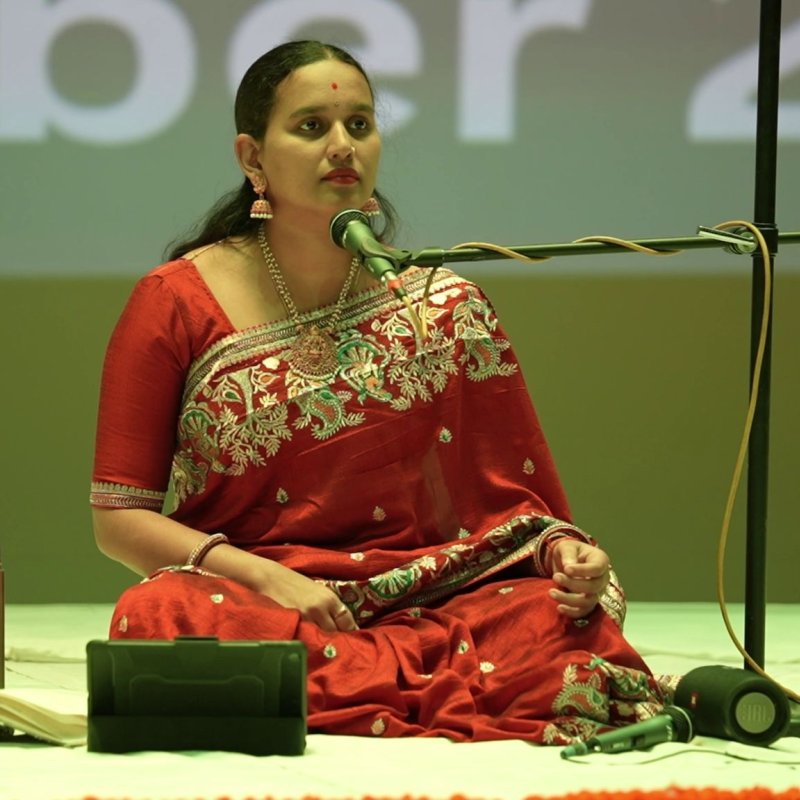
Tejaswini Vernekar is een gerespecteerde hindoestaanse klassieke zangeres, met een gouden medaille van de Banaras Hindu University en de status van gegradeerd artiest bij All India Radio, opgeleid bij vooraanstaande meesters van de traditie.
Teaches
Hindustani Vocal

Questions
Questions about Intermediate
Entry, pace, assessment and what you show to finish the level.
You move to Intermediate Hindustani vocal when you have closed the Foundation topics or shown the same skills in a placement session. Your teacher checks that you hold Sa, sing alankars to a cycle and sing a chhota khayal with a short alap.
Intermediate then adds ornament, new talas and singing with accompanists.
Singing with tabla and harmonium comes in module 2C of Intermediate Hindustani vocal. You sing a bandish with both accompanists, keep tempo and balance, give the ending cue and finish together on sam.
Before 2C a theka track stands in for the tabla, and a 2B elective lets you sing with a tabla player earlier.
Bol-alap and bol-bant are two ways of developing a bandish through its words, and Intermediate Hindustani vocal teaches them in module 2B. Bol-alap develops the words melodically; bol-bant develops them rhythmically.
The topic closes when you sing one passage of each and both return to the mukhda on sam.
The Intermediate level of the Hindustani Vocal course ends with a 12-minute set with tabla and harmonium. You sing without losing the cycle, explain one choice and recover from any slip, and you submit a written notation and theory portfolio.
Completion needs all 16 Intermediate skills, not only the presentation.
Still have questions?
Our support team can help you find the right answer.
Contact opnemen met supportVolgende stappen
Klaar om aan Intermediate te beginnen?
Tell us what you want to learn and where you are today. An academy advisor will help you find a good next step.