

Bageshri
बागेश्री
.n S g M D n S' | S' n D M P D m G R S
Oorsprong en context
In de diepe stilte van de tweede prahar van de nacht, wanneer de wereld tot stilstand is gekomen, komt Raag Bageshri tevoorschijn als een gesprek tussen de ziel en zijn geliefde. Het is een raga van "Viraha" (verlangen) en "Shringar" (romantiek), traditioneel beschreven als een vrouw die wacht op de terugkeer van haar minnaar.
Een Kafi Thaat-compositie, Bageshri, is een emotioneel meesterwerk, waarvan de kracht ligt in zijn "Vakra" (kromme) geometrie. Het beweegt niet in rechte lijnen; in plaats daarvan dwaalt het door de lagere en middelste octaven, cirkelt rond de Madhyama (M) met een tedere, bijna pijnlijke delicatesse. Zijn schoonheid ligt niet in grote snelheid, maar in zijn vermogen om "te blijven hangen." Het is een melodie van schaduwen en zacht maanlicht, waar elke noot wordt behandeld met een tedere, bijna pijnlijke delicatesse.
Meer tonenMinder tonen
Net als Raag Bangala, legt Bageshri immens gewicht op de Madhyama (Ma). Echter, waar Bangala Ma gebruikt om een "luchtig" ochtendgebed te creëren, gebruikt Bageshri het om een diepgaande emotionele diepte op te roepen. De manier waarop een zanger de Ma benadert vanuit de Komal Ni creëert een kenmerkende "hook" die het romantische klanklandschap van de Indische muziek al eeuwenlang heeft gedefinieerd.
Bij KalaSudha zien we Bageshri als het ultieme "Nachtgedicht." Het is een raga die een hoge mate van volwassenheid van de uitvoerder eist. Het gaat niet om de noten die je speelt, maar om de stilte die je ertussen laat. Het is het geluid van een hart dat vol is, maar nog steeds wacht.
Technische details
Melodische structuur en bewegingspatronen
Aroha (opgang)
.n S g M D n S.
Avroh (afgang)
S. n d , M P D , M g R S
Pakad (kenmerkende frase)
S .n .D S , M g , M D n D , M g , M g R S
Chalan (Movement)
.n .D S M
Tanpura Tuning
M — S — S — Sa
Additional Notes
Phraseologies
Bageshri is defined by a "Vakra" (Crooked) grammar that avoids linear paths. The movement is a diagonal reach from the lower register to the Madhyama (M). It omits R and P in the ascent to create tension, resolving them through heavy, soulful glides (Meends) in the descent. The melody is "suspended," never settling too quickly on the tonic.
Common Phrases
- .n .D S m
Opnamen en optredens
Luister naar meesters die deze raga spelen

Tracks
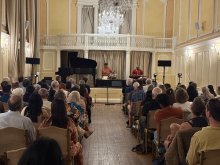
Raag Bageshri - Alap - Live from Kala Festival 2025
Debasis Chakroborty
Raag Bageshri - Drut Gat - Teental (with Akram Khan) - Live from Kala Festival 2025
Debasis Chakroborty
Raag Bageshri - Madhyalaya Gat - Teental (with Akram Khan) - Live from Kala Festival 2025
Debasis Chakroborty
Raag Bageshri - Vilambit Gat - Teental (with Akram Khan) - Live from Kala Festival 2025
Debasis Chakroborty
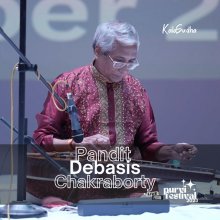
Raag Bageshwari – Jhala
Debasis Chakroborty
Raag Bageshwari – Madhya Laya
Debasis Chakroborty
Master Performers
Artists renowned for their renditions of Bageshri

Debasis Chakroborty
Indian Slide Guitar

Sandipan Mukherjee
Tabla
Classifiers
Swara geometries, relationships, and classifications
Swara Geometries
Structuur
Around the World
Global connections and equivalent scales
Bageshri aligns with the "minor-major" hybrids of the West, perfect for late-night jazz.
Dorian Mode
C−D−Eb−F−G−A−Bb−C
A "minor" mode with a "major" 6th; evokes soulful, non-melancholic depth.
Veelgestelde vragen
Where can I hear Raag Bageshri played live in concert?
You can hear Raag Bageshri live at KalaSudha's concerts in the UK, Europe and India, and Pandit Debasis Chakroborty has played it at Kala Festival, a touring festival. He has also played it on Indian slide guitar at Purvi Festival in Motihari, Bihar. The AUTRIM project of the National Centre for the Performing Arts and the University of Amsterdam places Bageshri in the late night. Coming concerts are on the events page.
Which recordings of Raag Bageshri should I listen to first?
KalaSudha's recordings of Raag Bageshri include a solo alap recorded live at Kala Festival, where Pandit Debasis Chakroborty sets out the raga on Indian slide guitar with no tabla and no fixed beat. On the album Norwich Ragas, gats in Tintal with the tabla player Ustad Akram Khan follow it, each faster than the last. Pandit Debasis Chakroborty's Purvi Festival performance, with the tabla player Sandipan Mukherjee, is also out as a video release.
What is the difference between Raag Bageshri and Raag Rageshri?
Raag Bageshri uses komal Ga, the lowered form, and keeps Pa, while Raag Rageshri takes shuddha Ga, the natural form, and leaves Pa out. The AUTRIM project gives Bageshri seven notes, with komal Ga and komal Ni, and writes that Pa is left out going up and used sparingly. It finds their upper halves alike apart from Pa. Turns such as Ma, Dha, komal Ni, Dha, Ma belong to both, but Bageshri's oscillated komal Ni makes it very distinct.
What is the Carnatic equivalent of Raag Bageshri?
Carnatic music has its own Raag Bageshri, which George Howlett describes as imported from Hindustani music and retaining many of its original features; he gives the era as unclear. He lists it under Kharaharapriya, the 22nd melakarta, or parent scale. Among other Carnatic ragas, Howlett pairs Bageshri with Sriranjani, which he sums up as Bageshri with no Pa.
Which bandishes are sung in Raag Bageshri?
Bandishes, or set compositions, in Raag Bageshri include Gunde Lavo Ri Malaniya, a chhota khayal sung by Padma Talwalkar for the AUTRIM project of the National Centre for the Performing Arts. A chhota khayal is a shorter khayal composition, and this one is set in Tintal at a fast tempo. In its words a woman asks the flower girl for garlands as she prepares to welcome her loved one. She wonders how the night will pass without him.
How can I learn a raga online?
You can learn a raga online with the KalaSudha Academy, in live one-to-one lessons with a teacher or in a structured course, from foundation to advanced. Learners book lessons in their own time zone, and teachers teach live in their own language. Instructors and touring artists also lead in-person workshops and summer camps where enough learners register interest.
Is Raag Bageshri a good raga for a beginner to learn?
Raag Bageshri is a Class XII raga in the Hindustani vocal course that India's Central Board of Secondary Education (CBSE) sets for schools, the last class the course covers. Before it, students learn ragas such as Yaman and Kafi in Class IX, Bhupali in Class X and Bhairavi in Class XI. In Class XII, students sing Bageshri as a drut, or fast, khayal beside Bhairav and Malkauns.
Which film songs are based on Raag Bageshri?
Hindi film songs that David Courtney lists in Raag Bageshri include Aja Re, Paradesi, from Madhumati, and Bedardi Dagabaz Ja Tu Nahin Balma Mora, from Bluff Master. Courtney calls the Bluff Master song a "pretty good example" of the raga, and Bolo Na, from Chittagong, "quite a good approach to Bageshri".
Have more questions? Contact our support team and we'll be happy to help!