

Jog
जोग
S G m P n S' | S' n P m g S
Oorsprong en context
Raag Jog toont de emotionele complexiteit die wordt gevonden in Hindustani klassieke muziek. In plaats van in slechts één stemming te passen, is deze raga moeilijk te categoriseren. Het maakt deel uit van het Kafi Thaat, en wat het uniek maakt is het gebruik van beide Gandharas: Shuddha Ga (G) en Komal g (g). Deze mix creëert een speciaal soort spanning, die de subtiele balans tussen vreugde en verdriet, en tussen stabiliteit en rusteloosheid vastlegt. Terwijl veel raga's dubbele noten alleen gebruiken als passerende tonen, maakt Jog ze centraal in zijn geluid. Shuddha Ga komt meestal naar voren in de stijgende noten, wat een gevoel van helderheid en resolutie geeft. Komal Ga is meer gebruikelijk in de dalende noten, wat een soulvolle, blues-achtige diepte toevoegt aan de melodie. Jog wordt meestal gespeeld in de vroege nachtelijke uren (2e Prahar), wanneer zijn herhalende, hypnotische zinnen luisteraars in een trance-achtige staat kunnen brengen.
Om Jog volledig te begrijpen, helpt het om naar andere raga's in de Kafi-familie te kijken:
Meer tonenMinder tonen
- Jog en Tilang gebruiken beide een pentatonische toonladder (SGMPnS′) en delen de Ni-Ni dualiteit. Echter, Jog bevat de Komal Ga (g), terwijl Tilang dat niet doet. Deze noot verandert de stemming van Tilangs lichte, speelse gevoel naar de diepere, meer bedachtzame blues-kwaliteit van Jog.
- Jog en Bageshri maken beide deel uit van het Kafi Thaat, en beide drukken een gevoel van verlangen uit. Bageshri's melodie richt zich op de Madhyama (M), terwijl Jog zich concentreert op de spanning tussen de twee Gandharas. Bageshri voelt als een stil gevoel van scheiding, maar Jog voelt meer als een reflectie op de ups en downs van het leven.
De "Blues" Connectie: Muziekgeleerden zeggen vaak dat Jog de Indische raga is die het meest lijkt op de Westerse Blues Toonladder. De "Blue Note" in blues komt overeen met het kleine interval tussen de Shuddha en Komal Gandhar in Jog. Dit maakt Jog een brug voor muzikanten over de hele wereld die gemeenschappelijke grond in muziek willen vinden.
Technische details
Melodische structuur en bewegingspatronen
Aroha (opgang)
S G m P n S'
Avroh (afgang)
S' n P m g S
Pakad (kenmerkende frase)
n(o) S G m, g S, G m P m g S
Chalan (Movement)
S, Gm, gS, .nSGm, mP, mgS, GmPnS′, nPmgS
Tanpura Tuning
m—S—S—Sa
Additional Notes
Phraseologies
De beweging van Jog is "curvilineair" rond de Gandhara. Het gebruikt een specifieke "ruk" of Khatka bij het bewegen tussen de twee Gas.
- De Dubbele-Derde Glij: S−G−m−g−S
- Het Middernacht Bereik: n(o)−S−G−m−P−n−S′
- De Dalings Resolutie: S′−n−P−m−g−S
- Chalan: S, Gm, gS, .nSGm, mP, mgS, GmPnS′, nPmgS
Common Phrases
- S−G−m−g−S
Opnamen en optredens
Luister naar meesters die deze raga spelen

Tracks
Albums

Master Performers
Artists renowned for their renditions of Jog

Debasis Chakroborty
Indian Slide Guitar

Deepak Shah
Piano

Dr Lovely Sharma

Durjay Bhaumik
Tabla
Classifiers
Swara geometries, relationships, and classifications
Swara Geometries
Structuur
Around the World
Global connections and equivalent scales
The Blues Scale
C−Eb−E−F−G−Bb
The Eb to E transition mirrors Jog’s g to G friction.
Veelgestelde vragen
Where can I hear Raag Jog played live in concert?
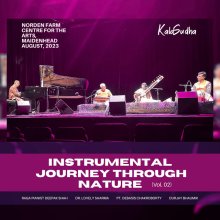
You can hear Raag Jog at KalaSudha's concerts in the UK, Europe and India. Pandit Debasis Chakroborty, Dr Lovely Sharma, the raga pianist Deepak Shah and the tabla player Durjay Bhaumik played it at Kala Festival, a touring festival. Their concert was at Norden Farm Centre for the Arts in Maidenhead. Coming concerts are on the events page.
Which recordings of Raag Jog should I listen to first?
KalaSudha's recordings of Raag Jog include Raag Jog, Pt. 1, the first of two parts recorded live at Kala Festival. Pandit Debasis Chakroborty plays Indian slide guitar with the sitar player Dr Lovely Sharma, the raga pianist Deepak Shah and the tabla player Durjay Bhaumik. The same performance is also out as a video release.
What is the difference between Raag Jog and Raag Jogkauns?
Raag Jogkauns adds komal Dha and shuddha Ni to the notes of Raag Jog, which leaves out Re and Dha. The AUTRIM project of the National Centre for the Performing Arts and the University of Amsterdam calls Jogkauns a modern raga that combines Jog and Malkauns. It attributes the raga to Jagannathbua Purohit, known as Gunidas, of the Agra gharana. AUTRIM finds a slight element of Jog in Jogkauns but calls it more complex.
Is Raag Jog a good raga for a beginner to learn?
Raag Jog is one of the more straightforward ragas to learn, in George Howlett's view. He writes that its character rests more on its scale than on set phrases. Its unusual feature is its pair of Ga: shuddha, or natural, going up and komal, or lowered, coming down. The AUTRIM project of the National Centre for the Performing Arts and the University of Amsterdam notes that some musicians sing both forms of Ga one after the other in the descent.
Which film songs are based on Raag Jog?
Hindi film songs that David Courtney lists in Raag Jog include Poore Se Zara Sa Kam Hai, from Mausam, which he calls "a fairly good example of Jog". He calls Naina Dwara Se, from Sawan, only "Jog-ish". George Howlett notes that Jog is popular in light-classical forms such as bhajan, thumri and ghazal.
Which bandishes are sung in Raag Jog?
The AUTRIM project of the National Centre for the Performing Arts and the University of Amsterdam presents a chhota khayal, a short khayal, in Raag Jog. Ashwini Bhide sings it in medium Ektal. It opens Ja Re Ja Ja Kagava, and in it a woman asks a bird to carry a message to her beloved.
How can I learn a raga online?
You can learn a raga online with the KalaSudha Academy, in live one-to-one lessons with a teacher or in a structured course, from foundation to advanced. Learners book lessons in their own time zone, and teachers teach live in their own language. Instructors and touring artists also lead in-person workshops and summer camps where enough learners register interest.
Have more questions? Contact our support team and we'll be happy to help!