

Kirwani
किरवानी
S R g m P d N S' | S' N d P m g R S
Oorsprong en context
Raag Kirwani toont hoe Indische muziek kan stromen tussen tradities. Het begon als een belangrijke ouder-schaal in Zuid-Indische Carnatic muziek. Later begonnen muzikanten in Noord-India het ook te gebruiken, wat nieuwe nuances en diepte aan de raga toevoegde. Kirwani wordt meestal laat in de nacht gespeeld, rond middernacht, omdat zijn geluid mensen stil laat nadenken en een zachte droefheid voelen. Deze raga is voor ons een herinnering dat muziek grenzen kan overschrijden en overal harten kan raken. Zoals een bekende uitspraak zegt, "Waar woorden falen, spreekt muziek."
Kirwani is opmerkelijk om zijn symmetrie, omdat beide helften van de schaal elkaar spiegelen met mathematische precisie. Deze balans geeft het een Westers karakter en maakt het populair in interculturele samenwerkingen. Bij KalaSudha beschouwen we Kirwani als een raga van pure emotie, die vertrouwt op de expressieve kwaliteit van zijn mineur intervallen in plaats van complexe bewegingen.
Technische details
Melodische structuur en bewegingspatronen
Aroha (opgang)
S R g m P d N S'
Avroh (afgang)
S' N d P m g R S
Pakad (kenmerkende frase)
g m P, d P, m g R S, .N R S
Tanpura Tuning
P—S—S—Sa
Additional Notes
Phraseologies
De beweging is vloeiend en lyrisch, beweegt soepel over octaven zonder kromme bochten.
- De Melancholische Haak: g m P, d P, m g R S
- Het Stijgende Bereik: m P d N S'
- De Kenmerkende Resolutie: .N R S (De leidende noot N die oplost naar S).
- Chalan: S R g m P, d P, m P d N S', S' N d P m g R S, .N R S
Opnamen en optredens
Luister naar meesters die deze raga spelen
Video's


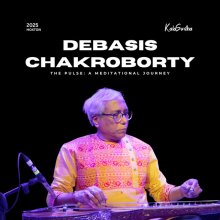
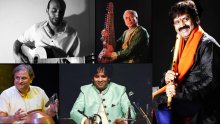
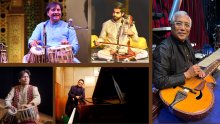
Master Performers
Artists renowned for their renditions of Kirwani

Debasis Chakroborty
Indian Slide Guitar

Deepak Shah
Piano

Giuliano Modarelli
Guitar

Hanif Khan
Tabla

Shahbaz Hussain
Tabla
Classifiers
Swara geometries, relationships, and classifications
Swara Geometries
Structuur
Around the World
Global connections and equivalent scales
Kirwani is arguably the most recognisable Indian raga to Western ears.
Harmonic Minor
C−D−Eb−F−G−Ab−B
The quintessential scale for drama and tension in Western classical music.
Veelgestelde vragen
Where can I hear Raag Kirwani played live in concert?
You can hear Raag Kirwani at KalaSudha's concerts in the UK, Europe and India. The raga pianist Deepak Shah played it at Kala Festival, a touring festival, at The Great Hall of the University of Reading, with the tabla player Hanif Khan. Pandit Debasis Chakroborty and the guitarist Giuliano Modarelli played it at the Assembly Rooms in Edinburgh, with Ustad Shahbaz Hussain on tabla. Coming concerts are on the events page.
Which recordings of Raag Kirwani should I listen to first?
KalaSudha's recordings of Raag Kirwani include Meditative Vibe, on which Pandit Debasis Chakroborty plays the raga on solo Indian slide guitar. Video releases show the raga pianist Deepak Shah's Kirwani at Kala Festival in Reading and Pandit Debasis Chakroborty's duet with the guitarist Giuliano Modarelli in Edinburgh.
What is the difference between Raag Kirwani and Raag Charukesi?
Raag Kirwani and Raag Charukesi both use all seven notes with komal, or lowered, Dha, but they swap two notes. Kirwani takes komal Ga with shuddha, or natural, Ni, while Charukesi takes shuddha Ga with komal Ni. Both came from Carnatic music: George Howlett traces Kirwani to Keeravani, the 21st melakarta, or parent scale, and Charukesi to the 26th.
What is the Carnatic equivalent of Raag Kirwani?
Raag Kirwani comes from the Carnatic raga Kiravani, also written Keeravani, the 21st melakarta, or parent scale, with the same seven notes. George Howlett writes that Kirwani was popularised in Hindustani music chiefly through Pandit Ravi Shankar's borrowings from the South. With Sa on C, the scale is the Western harmonic minor, which Howlett notes as congruent with Kirwani.
Which film songs are based on Raag Kirwani?
Hindi film songs that David Courtney lists in Raag Kirwani include Ankhon Se Jo Utari, from Phir Wohi Dil Laaya Hoon, which he calls "a surprisingly good example". His list also includes Anewala Pal, Janewala Hai, from Golmaal, and Ek Radha Ek Meera, from Ram Teri Ganga Maili.
How can I learn a raga online?
You can learn a raga online with the KalaSudha Academy, in live one-to-one lessons with a teacher or in a structured course, from foundation to advanced. Learners book lessons in their own time zone, and teachers teach live in their own language. Instructors and touring artists also lead in-person workshops and summer camps where enough learners register interest.
Have more questions? Contact our support team and we'll be happy to help!