

Madhuvanti
मधुवंती
S g M# P N S' | S' N D P M# g R S
Oorsprong en context
Terwijl de intensiteit van de middagzon begint te verzachten tot een warme, gouden gloed, neemt Raag Madhuvanti zijn vlucht. Een relatief moderne toevoeging aan het klassieke pantheon, wordt Madhuvanti vaak beschreven als een "zoete" (Madhu) versie van de Todi-familie. Het is een raga van de late namiddag, die de overgang vastlegt van de arbeid van de dag naar de verwachting van de avond.
Structureel is Madhuvanti een emotioneel krachtpatser. Door gebruik te maken van de Teevra Madhyama (M#) en de Komal Gandhar (g), creëert het een unieke harmonische spanning die zowel verfijnd als diep romantisch aanvoelt. Bij KalaSudha zien we Madhuvanti als de brug tussen intellectuele complexiteit en pure, melodische schoonheid. Het is een raga die precisie vereist in zijn glides (Meends) en een soulvolle benadering van zijn dominante Pancham (P).
Technische details
Melodische structuur en bewegingspatronen
Aroha (opgang)
S g M# P N S'
Avroh (afgang)
S g M# P N S'
Pakad (kenmerkende frase)
n(o) S g M# P | M# g R S | g M# P N D P
Chalan (Movement)
N(o)SgM#P ∣ gM#PNS′ ∣ S′NDPM#gRS
Tanpura Tuning
P — S — S — Sa
Additional Notes
Phraseologies
The movement is defined by "leaping" past the R and D in the ascent and landing heavily on the P.
- The Golden Reach: g M# P, N S'
- The Signature Glide: S' N D P, M# g R S
- The Todi Touch: n(o) S g M# P
- Pakad: g M# P, M# g, R S
Common Phrases
- g M# P, N S'
Opnamen en optredens
Luister naar meesters die deze raga spelen
Video's

Raag Madhuvanti Alaap | Debasis Chakroborty & Giuliano Modarelli
Debasis Chakroborty
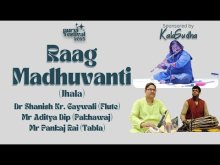
Raag Madhuvanti Jhala | Flute | Tabla | Pakhawaj | Music of India | Purvi Festival 2023
Shanish Kumar

Raag Madhuvanti | Flute | Pakhawaj | Tabla | Music of India | Purvi Festival 2023

Raag Madhuvanti Alap | Flute | Music of India | Shanish Kumar Gaywali | Purvi Festival 2023
Shanish Kumar
Tracks
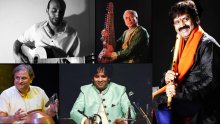
Master Performers
Artists renowned for their renditions of Madhuvanti

Deepak Shah
Piano

Shanish Kumar
Bansuri (Flute)

Debasis Chakroborty
Indian Slide Guitar

Giuliano Modarelli
Guitar
Classifiers
Swara geometries, relationships, and classifications
Swara Geometries
Structuur
Around the World
Global connections and equivalent scales
Lydian #2 Mode
C - D# - E - F# - G - A - B
A bright, "sparkling" minor scale; uses #2 and #4.
Veelgestelde vragen
Where can I hear Raag Madhuvanti played live in concert?
You can hear Raag Madhuvanti at KalaSudha's concerts in the UK, Europe and India. Pandit Debasis Chakroborty and the guitarist Giuliano Modarelli opened their set with it at the Raga Unison concert in the Assembly Rooms, Edinburgh, with the tabla player Ustad Shahbaz Hussain. The AUTRIM project calls Madhuvanti popular among musicians, especially instrumentalists. Coming concerts are on the events page.
Which recordings of Raag Madhuvanti should I listen to first?
KalaSudha's recordings of Raag Madhuvanti include Madhuvanti, Pt. 1, a live performance by the raga pianist Deepak Shah with the tabla player Durjay Bhaumik. Deepak Shah also plays the alap, the unmetered opening, and a gat in Tintal on piano in KalaSudha studio recordings. Dr Shanish Kumar's bansuri performance at Purvi Festival in Motihari and the Edinburgh alap of Pandit Debasis Chakroborty and Giuliano Modarelli are out as video releases.
What is the difference between Raag Madhuvanti and Raag Multani?
Raag Madhuvanti and Raag Multani move in similar phrases, but Multani lowers Re and Dha, where Madhuvanti keeps them shuddha, or natural. Both use komal Ga and tivra Ma, the raised fourth, with shuddha Ni. In Multani, the AUTRIM project writes, Re and Dha are weak and left out going up, and most movements start from the lower Ni.
What is the Carnatic equivalent of Raag Madhuvanti?
The Carnatic counterpart of Raag Madhuvanti's scale is Dharmavati, the 59th melakarta, or parent scale, with the same seven notes, in George Howlett's table. Howlett adds that Madhuvanti itself was taken into Carnatic music over the past half-century, keeping its shape, with Re and Dha left out going up.
Which film songs are based on Raag Madhuvanti?
George Howlett names two film settings of Raag Madhuvanti: Rasm-E-Ulfat, sung by Lata Mangeshkar, and Muskurahat, sung by Arijit Singh. Madhuvanti is a modern raga: the AUTRIM project credits its creation to Wamanrao Padhye, a disciple of V. D. Paluskar.
Which bandishes are sung in Raag Madhuvanti?
Bandishes, or set compositions, in Raag Madhuvanti include Main Aavun Tore Mandarva, a chhota khayal in Sitarkhani tala sung by Ashwini Bhide for the AUTRIM project. A chhota khayal is a shorter khayal composition, and in this one a lover promises to come to the beloved's home. AUTRIM also presents E Ho More Sai, a bada khayal in slow Ektal sung by Aslam Khan, a song of longing, day and night.
How can I learn a raga online?
You can learn a raga online with the KalaSudha Academy, in live one-to-one lessons with a teacher or in a structured course, from foundation to advanced. Learners book lessons in their own time zone, and teachers teach live in their own language. Instructors and touring artists also lead in-person workshops and summer camps where enough learners register interest.
Have more questions? Contact our support team and we'll be happy to help!