

Megh
मेघ
S R m P n S' | S' n P m R S
Oorsprong en context
Raag Megh is een sonische aanroeping van de moesson. Als een van de kern-raga's van het Kafi Thaat, behoort het tot de prestigieuze "Malhar"-familie. Echter, terwijl andere Malhars, zoals Mian Ki Malhar, ingewikkeld en hoffelijk zijn, is Megh rauw, krachtig en majestueus.
Het wordt traditioneel uitgevoerd tijdens het regenseizoen op elk moment van de dag, hoewel het een speciale zwaarte draagt wanneer het laat in de nacht wordt gezongen terwijl de wolken zich verzamelen. De raga is een pentatonisch meesterwerk, dat slechts vijf noten gebruikt om een sfeer van immense uitgestrektheid te creëren. Door de Gandhar (G) en Dhaivat (D) weg te laten, creëert Megh een "holle" en resonerende geometrie die het diepe gerommel van donder nabootst.
Meer tonenMinder tonen
De ziel van Megh ligt in zijn zware, oscillerende Rishabh (R) en zijn krachtige Pancham (P). Wanneer een vocalist van de Madhyama naar de Rishabh glijdt met een zware Andolan (oscillatie), wordt gezegd dat het lijkt op de bliksem die de regen voorafgaat. Bij KalaSudha zien we Megh als de ultieme studie in "Kracht door Eenvoud." Het is een raga die ademcontrole en een diepe, resonerende stem vereist om recht te doen aan zijn zware, regendoordrenkte karakter.
Technische details
Melodische structuur en bewegingspatronen
Aroha (opgang)
S R m P n S'
Avroh (afgang)
S' n P m R S
Pakad (kenmerkende frase)
S R n(o) P, m R, n(o) S
Chalan (Movement)
S, R n(o) P, n(o) S, S R m, m R, R m P, n P, m R, S R n(o) P, S
Tanpura Tuning
P — S — S — Sa
Additional Notes
Phraseologies
The movement is grave and slow, using wide leaps and deep, resonant glides.
- The Thunderous Leap: S R m P
- The Signature Andolan: m R (heavy oscillation on R)
- The Rainy Descent: n P, m R, S
- Phrase Example: R n(o) P, m R, S
Opnamen en optredens
Luister naar meesters die deze raga spelen
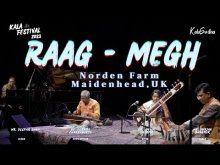
Tracks
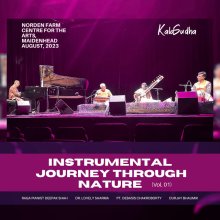
Albums

Master Performers
Artists renowned for their renditions of Megh

Debasis Chakroborty
Indian Slide Guitar

Deepak Shah
Piano

Dr Lovely Sharma

Durjay Bhaumik
Tabla
Classifiers
Swara geometries, relationships, and classifications
Swara Geometries
Structuur
Around the World
Global connections and equivalent scales
Raag Megh is the Indian classical equivalent to the Minor Pentatonic "Power Scale" found in ancient warrior cultures and early Blues. Its avoidance of the 3rd and 6th creates a "Perfect Fourth/Fifth" dominated soundscape that is universally recognised as majestic and unyielding. In Western musicology, this is the "Scale of Open Intervals," used to denote vast landscapes and the raw power of the elements.
Suspended Pentatonic
C - D - F - G - Bb
An "open" scale that avoids the emotional bias of major or minor thirds.
Minor Pentatonic (Skeleton)
1 - b3 - 4 - 5 - b7
Megh uses the Natural 2nd instead of b3, giving it a more heroic, less "blue" feel.
Veelgestelde vragen
Where can I hear Raag Megh played live in concert?
You can hear Raag Megh live at KalaSudha's concerts in the UK, Europe and India, and the ensemble of Pandit Debasis Chakroborty has played it at Kala Festival, a touring festival. Megh is a raga of the rainy season. The AUTRIM project of the National Centre for the Performing Arts and the University of Amsterdam gives its time as any time during the rains. Coming concerts are on the events page.
Which recordings of Raag Megh should I listen to first?
KalaSudha's recordings of Raag Megh include Raag Megh, Pt. 1, which opens a performance recorded live at Kala Festival. Pandit Debasis Chakroborty plays Indian slide guitar with the sitar player Dr Lovely Sharma, the raga pianist Deepak Shah and the tabla player Durjay Bhaumik. Parts 2 and 3 complete the raga, and all three parts are on the album Instrumental Journey Through Nature, Vol. 1; the concert is also out as a video release.
What is the difference between Raag Megh and Raag Miyan Ki Malhar?
In its common form, Raag Megh uses five notes, Sa, Re, Ma, Pa and komal, or lowered, Ni, and leaves out Ga and Dha. Raag Miyan Ki Malhar adds komal Ga, Dha and shuddha, or natural, Ni. The AUTRIM project writes that its komal Ga comes only in descent and its two forms of Ni follow one another. Both belong to the Malhar family and share its rising glide, Re up to Pa.
What is the Carnatic equivalent of Raag Megh?
The Carnatic raga with the same notes as Raag Megh is Madhyamavati, and George Howlett pairs the two as approximate counterparts. Madhyamavati uses Sa, Re, Ma, Pa and komal, or lowered, Ni, in both ascent and descent. Howlett lists it under Kharaharapriya, the 22nd melakarta, or parent scale, of Carnatic music, and also pairs it with Raag Madhumad Sarang, which shares Megh's notes.
Which bandishes are sung in Raag Megh?
Bandishes, or set compositions, in Raag Megh include Ghanana Ghanana, in the 16-beat Tintal, sung by Vijay Rajput in David Clarke's book Rāgs Around the Clock. Its second part, the antara, carries the pen name Sadarang, which Clarke says may or may not be authentic. The AUTRIM project of the National Centre for the Performing Arts presents a chhota khayal, a shorter khayal composition, in Ektal. It opens Garaj Ghata Ghan Kare and is sung by Veena Sahasrabuddhe.
How can I learn a raga online?
You can learn a raga online with the KalaSudha Academy, in live one-to-one lessons with a teacher or in a structured course, from foundation to advanced. Learners book lessons in their own time zone, and teachers teach live in their own language. Instructors and touring artists also lead in-person workshops and summer camps where enough learners register interest.
Does Raag Megh bring rain?
The idea that Raag Megh brings rain comes from legend. Nikhil Inamdar, in Live History India, retells how Tansen taught his daughter to sing Megh Malhar to bring down rain and douse the fire of Raga Deepak. He calls it an allegory that has come to be read literally. George Howlett's version has two sisters, Tana and Riri, sing Megh. Howlett also writes that Tansen is said to have sung Miyan Ki Malhar to summon the monsoon.
Which film songs are based on Raag Megh?
Hindi film songs that David Courtney lists in Raag Megh include Kahan Se Aye Badra, from Chashme Buddoor. Courtney keeps a separate list for Megh Malhar, which includes Baraso Re, from Tansen, and Dukha Bhare Din Bite Re Bhaiya, from Mother India. David Clarke writes that Megh is often known as Megh Malhar, while the khayal singer Vijay Rajput keeps that name for a form with a subtle komal, or lowered, Ga.
Have more questions? Contact our support team and we'll be happy to help!