

Jog
जोग
S G M P n S' | S' n P M g S, .n S
Origins & Context
Raag Jog is a Kafi thaat raga of Hindustani music, performed late in the evening, that uses shuddha and komal Ga with Ma, Pa and komal Ni. It leaves out Re and Dha. Shuddha means natural and komal means lowered. A thaat is a parent scale, and Jog is also filed under Khamaj. It is also written Raag Jog, Raga Jog or Yog.
In the notation here, lowercase marks a komal note, a dot the lower octave and an apostrophe the upper. The aroha, or ascent, is S G M P n S'. The avaroha, or descent, is S' n P M g S, .n S, closing through lower Ni. Shuddha Ga leads the way up, and komal Ga colours the way down, often in the close G M g S. The vadi, the most prominent note, is Ma, and the samvadi, its partner, is Sa. Other accounts name Ga and Sa instead. The AUTRIM project of the National Centre for the Performing Arts and the University of Amsterdam hears Sa and Pa as the important notes.
Show MoreShow Less
Jog is a young raga. It has about a hundred years of history, and George Howlett traces it to Tilang, which uses shuddha Ga only and adds shuddha Ni in the ascent. Howlett hears a bluesy blend of major and minor in its two forms of Ga.
KalaSudha releases Jog recordings made live at Kala Festival, such as Raag Jog, Pt. 1. Its academy teaches ragas online and in local workshops.
George Howlett gives the name the sense of "state of union", from the Sanskrit idea of yoga, and lists Joga and Yoga among its spellings. The AUTRIM project notes that in dhrupad and in South India the raga is known as Chalnat.
Howlett calls Jog a recent innovation, an offshoot of the Tilang line, and describes Jogkauns as Gunidas's blend of Jog and Malkauns. AUTRIM keeps Jogkauns apart: it uses komal Dha and shuddha Ni.
The AUTRIM project presents a chhota khayal in medium Ektal, sung by Ashwini Bhide, in which a woman asks a bird to carry a message to her beloved.
Technical Details
Melodic structure and movement patterns
Aroha (Ascent)
S G M P n S'
Avroh (Descent)
S' n P M g S, .n S
Pakad (Catch Phrase)
G M P n P, P n P M G M, G M g S
Tanpura Tuning
P - S - S - .S
Additional Notes
Phraseologies
Key for these phrases: lowercase letters are komal notes, and a dot puts a note in the lower octave.
The catch phrases G M P n P and P n P M G M keep shuddha Ga and Ma close together. G M g S drops through komal Ga to Sa. The AUTRIM project hears both forms of Ga in such endings, as in G S g S. It notes that some musicians sound the two in succession on the way down.
The two Ga are now often used chromatically. AUTRIM finds shades of Tilang when both forms of Ni appear, while Ga keeps the Jog colour.
Common Phrases
- G M g S
Recordings & Performances
Listen to master musicians perform this raga

Tracks
Albums

Master Performers
Artists renowned for their renditions of Jog

Debasis Chakroborty
Indian Slide Guitar

Deepak Shah
Piano

Dr Lovely Sharma

Durjay Bhaumik
Tabla
Classifiers
Swara geometries, relationships, and classifications
Swara Geometries
Structure
Around the World
Global connections and equivalent scales
With Sa on C, Jog's notes are C E flat E F G B flat. George Howlett lists this scale as a minor pentatonic with a doubled third, 1 b3 3 4 5 b7. He hears the two thirds as a bluesy blend of major and minor.
Minor pentatonic with a doubled third
C Eb E F G Bb
George Howlett gives this scale as 1 b3 3 4 5 b7. With Sa on C, it matches Jog note for note.
Frequently Asked Questions
Where can I hear Raag Jog played live in concert?
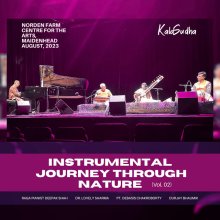
You can hear Raag Jog at KalaSudha's concerts in the UK, Europe and India. Pandit Debasis Chakroborty, Dr Lovely Sharma, the raga pianist Deepak Shah and the tabla player Durjay Bhaumik played it at Kala Festival, a touring festival. Their concert was at Norden Farm Centre for the Arts in Maidenhead. Coming concerts are on the events page.
Which recordings of Raag Jog should I listen to first?
KalaSudha's recordings of Raag Jog include Raag Jog, Pt. 1, the first of two parts recorded live at Kala Festival. Pandit Debasis Chakroborty plays Indian slide guitar with the sitar player Dr Lovely Sharma, the raga pianist Deepak Shah and the tabla player Durjay Bhaumik. The same performance is also out as a video release.
What is the difference between Raag Jog and Raag Jogkauns?
Raag Jogkauns adds komal Dha and shuddha Ni to the notes of Raag Jog, which leaves out Re and Dha. The AUTRIM project of the National Centre for the Performing Arts and the University of Amsterdam calls Jogkauns a modern raga that combines Jog and Malkauns. It attributes the raga to Jagannathbua Purohit, known as Gunidas, of the Agra gharana. AUTRIM finds a slight element of Jog in Jogkauns but calls it more complex.
Is Raag Jog a good raga for a beginner to learn?
Raag Jog is one of the more straightforward ragas to learn, in George Howlett's view. He writes that its character rests more on its scale than on set phrases. Its unusual feature is its pair of Ga: shuddha, or natural, going up and komal, or lowered, coming down. The AUTRIM project of the National Centre for the Performing Arts and the University of Amsterdam notes that some musicians sing both forms of Ga one after the other in the descent.
Which film songs are based on Raag Jog?
Hindi film songs that David Courtney lists in Raag Jog include Poore Se Zara Sa Kam Hai, from Mausam, which he calls "a fairly good example of Jog". He calls Naina Dwara Se, from Sawan, only "Jog-ish". George Howlett notes that Jog is popular in light-classical forms such as bhajan, thumri and ghazal.
Which bandishes are sung in Raag Jog?
The AUTRIM project of the National Centre for the Performing Arts and the University of Amsterdam presents a chhota khayal, a short khayal, in Raag Jog. Ashwini Bhide sings it in medium Ektal. It opens Ja Re Ja Ja Kagava, and in it a woman asks a bird to carry a message to her beloved.
How can I learn a raga online?
You can learn a raga online with the KalaSudha Academy, in live one-to-one lessons with a teacher or in a structured course, from foundation to advanced. Learners book lessons in their own time zone, and teachers teach live in their own language. Instructors and touring artists also lead in-person workshops and summer camps where enough learners register interest.
Have more questions? Contact our support team and we'll be happy to help!