

Yaman
यमन
.N R G M# P D N S' | S' N D P M# G R S
Origins & Context
Raag Yaman is a Kalyan thaat raga of Hindustani music, performed in the evening, the first prahar of the night, that uses all seven notes with tivra Ma. Tivra means raised: Ma sits a semitone above its shuddha, or natural, position, and the other six notes stay shuddha. A prahar is a three-hour watch of the day or night. It is also written Raag Yaman or Raga Yaman, and David Courtney lists Kalyan, Iman and Eman as other names for it.
In the notation here, M# is tivra Ma, a dot marks the lower octave and an apostrophe the upper. The aroha, or ascent, is .N R G M# P D N S', and the avaroha, or descent, is S' N D P M# G R S. The vadi, the most prominent note, is Ga, and the samvadi, its partner, is Ni. Courtney gives .N R G M# as a short identifying phrase, or pakad. A musician can play down Sa and Pa in ascending phrases, while the raga keeps all seven notes.
Show MoreShow Less
Courtney writes that Yaman carries romantic moods and moods of joy, and that Sikh musicians use it for devotion. He treats Yaman Kalyan as a different raga, which adds a restrained shuddha Ma in descent. Its Carnatic counterpart is Kalyani, the 65th melakarta, which Rajan Parrikar notes has the same scale as Kalyan, a name used for Yaman. Archana Nathan hears it in film songs too, such as Ek Dil Ek Jaan from Sanjay Leela Bhansali's Padmaavat.
KalaSudha's Yaman recordings include a dhun, a light piece on the raga, recorded at Kala Festival. Its academy teaches ragas online and in local workshops, and each course is built by its instructor with KalaSudha.
Dileep Karanth, writing in Sangeet Natak in 2008, calls the ascription of Yaman to Amir Khusrau suspect. He notes that early Sanskrit texts name no raga Yamana. He also records that after Alauddin Khilji conquered Devgiri, its capital Kalyana was renamed Aimanabad. Karanth compares the accounts of Aiman, Aimani and Yaman in Rag Darpan and Tuhfat-ul-Hind, which describe them differently.
Prabha Atre told Bhushan Toshniwal in 2022 that she learned only Yaman for nearly two years with Sureshbabu Mane.
Archana Nathan, writing in Scroll in 2018, finds Yaman across Sanjay Leela Bhansali's films. Her examples include Ek Dil Ek Jaan in Padmaavat, Hamesha Tum Ko Chaha in Devdas and Jhonka Hawa Ka Aaj Bhi in Hum Dil De Chuke Sanam. She also hears Yaman in Goliyon Ki Raasleela: Ramleela, whose song Laal Ishq plays over its ending.
Vipin Nair describes Roshan's Man Re Tu Kaahe Naa Dheer Dhare, from Chitralekha (1964), as a melody based on Yaman Kalyan. That song came first in Outlook's 2006 poll of the best Hindi film songs. Nair calls Jab Deep Jale Aana, from Chitchor, a Yaman-based composition. It is also described as set in Yaman Kalyan.
Technical Details
Melodic structure and movement patterns
Aroha (Ascent)
.N R G M# P D N S'
Avroh (Descent)
S' N D P M# G R S
Pakad (Catch Phrase)
.N R G M#
Chalan (Movement)
.N R G, .N R M# G, M# P, M# D P N D P M# R G R, .N R .D .N S
Tanpura Tuning
P - S - S - .S
Additional Notes
Phraseologies
Key for these phrases: M# stands for tivra Ma, and a dot before a note puts it in the lower octave. Compare different approaches to a note. In .N R G, you approach Ga through lower Ni and Re; in M# R G, you reach it through tivra Ma and Re.
Try following M# D N: you move from tivra Ma to Dha without Pa. These examples show the difference between a scale outline and Yaman's phrase vocabulary. Work with a teacher on note duration and ornament.
Common Phrases
- Lower Ni approach: .N R G
- Return through tivra Ma: M# R G
- Ascending movement: M# D N
- Descending phrase: N D P M# G R S
Recordings & Performances
Listen to master musicians perform this raga

Tracks
Yaman, Pt. 1
Dr Lovely Sharma
Yaman, Pt. 2
Dr Lovely Sharma
Yaman, Pt. 3
Dr Lovely Sharma
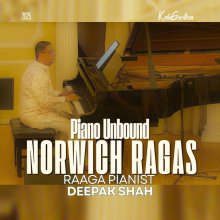
Raag Yaman - Alap - Live from Kala Festival 2025
Deepak Shah
Raag Yaman - Jhala - Live from Kala Festival 2025
Deepak Shah
Raag Yaman - Jod - Live from Kala Festival 2025
Deepak Shah
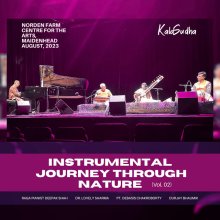
Dhun Based on Raag Yaman, Pt. 1 - Kala Festival 2023
Debasis Chakroborty
Dhun Based on Raag Yaman, Pt. 2 - Kala Festival 2023
Debasis Chakroborty
Dhun Based on Raag Yaman, Pt. 3 - Kala Festival 2023
Debasis Chakroborty
Dhun Based on Raag Yaman, Pt. 4 - Kala Festival 2023
Debasis Chakroborty
Dhun Based on Raag Yaman, Pt. 5 - Kala Festival 2023
Debasis Chakroborty
Albums
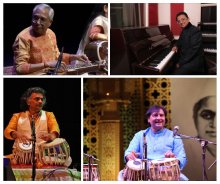
Master Performers
Artists renowned for their renditions of Yaman

Deepak Shah
Piano

Dr Lovely Sharma

Debasis Chakroborty
Indian Slide Guitar

Durjay Bhaumik
Tabla
Classifiers
Swara geometries, relationships, and classifications
Swara Geometries
Structure
Around the World
Global connections and equivalent scales
Yaman's seven notes match the Lydian mode: with Sa on C, they are C D E F# G A B. Chelsey Hamm sets out the Lydian pattern in Open Music Theory.
To learn Yaman, study how musicians approach and connect its notes, including their ornaments and intonation. The Lydian comparison covers the available pitches only. David Courtney cautions against reading Indian notation in a fixed key or equal temperament.
Kalyani
C D E F# G A B C
Kalyani, the 65th melakarta of Carnatic music, uses the same seven notes as Yaman: shuddha Re, Ga, Dha and Ni with tivra Ma. Rajan Parrikar writes that Kalyan, a name used with Yaman, shares its scale with Kalyani.
Frequently Asked Questions
Where can I hear Raag Yaman played live in concert?
KalaSudha's musicians play Raag Yaman in concert, and have performed it live at Kala Festival, KalaSudha's touring festival. KalaSudha presents Hindustani musicians in the UK, Europe and India, in series such as London Ragas in London and Kala Concert in India. Yaman belongs to the first prahar, or three-hour watch, of the night. Coming concerts are on the events page.
Which recordings of Raag Yaman should I listen to first?
KalaSudha's recordings of Raag Yaman include the raga pianist Deepak Shah's alap, jod and jhala, recorded live at Kala Festival. They also include Dr Lovely Sharma's sitar performance with the tabla player Durjay Bhaumik. The alap is the unmetered opening, where the raga takes shape phrase by phrase. For a lighter piece, hear the ensemble of Pandit Debasis Chakroborty in a dhun based on Raag Yaman.
What is the difference between Raag Yaman and Raag Yaman Kalyan?
Raag Yaman Kalyan follows Raag Yaman closely but adds shuddha, or natural, Ma beside Yaman's tivra Ma. David Courtney calls that shuddha Ma weak, places it in the descent and says most accounts treat the two as different ragas. Rajan Parrikar writes that the shuddha Ma has no independent life in Yaman Kalyan and that its other contours match Yaman. He also notes that some musicians touch shuddha Ma while still calling the raga Yaman.
What is the Carnatic equivalent of Raag Yaman?
The Carnatic equivalent of Raag Yaman is Kalyani, the 65th melakarta, or parent scale, of Carnatic music. Kalyani uses the same seven notes as Yaman: Sa and Pa, shuddha Re, Ga, Dha and Ni, and tivra Ma, the raised fourth. Rajan Parrikar writes that Kalyan, a name often used for Yaman, shares its scale with Kalyani.
Is Raag Yaman a good raga for a beginner to learn?
Raag Yaman is often taught to beginners. The AUTRIM project of the National Centre for the Performing Arts and the University of Amsterdam links this to its simple melodic structure, which leaves wide room for improvisation. Rajan Parrikar writes that mastery of Yaman is held essential for any serious student. Prabha Atre recalled learning only Yaman for nearly two years with Sureshbabu Mane, in an interview with Bhushan Toshniwal.
Which film songs are based on Raag Yaman?
Film songs based on Raag Yaman include Ek Dil Ek Jaan from Padmaavat, which Archana Nathan, writing in Scroll, hears in Yaman. Nathan also hears it in Hamesha Tum Ko Chaha from Devdas and Jhonka Hawa Ka Aaj Bhi from Hum Dil De Chuke Sanam. Vipin Nair calls Jab Deep Jale Aana, from Chitchor, a Yaman-based composition. It is also described as set in Yaman Kalyan.
Which bandishes are well known in Raag Yaman?
Well-known bandishes, or set compositions, in Raag Yaman include Eri Aali Piya Bina, which Rajan Parrikar calls a very popular classical bandish, and Piharva Tihari, a well-known cheez in his account. Cheez is another word for a composition. Parrikar writes of Yaman under its other name, Kalyan. He also names Main Vari Vari Ja'oongi, a popular cheez of Vilayat Hussain Khan, and the traditional Mandara Mana Laye.
How can I learn a raga online?
You can learn a raga online with the KalaSudha Academy, in live one-to-one lessons with a teacher or in a structured course, from foundation to advanced. Learners book lessons in their own time zone, and teachers teach live in their own language. Instructors and touring artists also lead in-person workshops and summer camps where enough learners register interest.
Have more questions? Contact our support team and we'll be happy to help!