

Kirwani
किरवानी
S R g M P d N S' | S' N d P M g R S
Origins & Context
Raag Kirwani is a Hindustani raga outside the ten thaats, performed late at night, that uses komal Ga and komal Dha with shuddha Re, Ma, Pa and Ni. Komal means lowered and shuddha means natural, so Re stays natural in Kirwani. A thaat is a parent scale. It is also written Raag Kirvani or Keerwani.
In the notation here, lowercase marks a komal note, a dot the lower octave and an apostrophe the upper. The aroha, or ascent, is S R g M P d N S', and the avaroha, or descent, is S' N d P M g R S. The vadi, the most prominent note, is Pa, and the samvadi, its partner, is Sa. With Sa on C, its notes are C D E flat F G A flat B: the Western harmonic minor, as George Howlett notes.
Show MoreShow Less
Kirwani came into Hindustani music from Carnatic music. There Kiravani, the 21st melakarta, uses the same seven notes. Peerzada Salman reported in Dawn in 2014 that Slawek, a student of Ravi Shankar, credited his teacher with making the raga popular.
KalaSudha regards Kirwani as a raga of pure emotion, carried by its minor intervals more than by complex movement. KalaSudha releases Kirwani recordings, such as a solo studio piece in Kirwani. Its academy teaches ragas online and in local workshops.
George Howlett writes that Kirwani has its origins in the Carnatic Keeravani and lists Kirwani, Kirvani and Keerwani among its names. He gives Keeravani as the 21st melakarta, S R2 G2 M1 P D1 N3.
Technical Details
Melodic structure and movement patterns
Aroha (Ascent)
S R g M P d N S'
Avroh (Descent)
S' N d P M g R S
Pakad (Catch Phrase)
P d S', S' N S' R' g' R' S' N d P, d P M P, P M g R, g M, g R S .N .d .N R S
Tanpura Tuning
P - S - S - .S
Additional Notes
Phraseologies
Key for these phrases: lowercase letters are komal notes, a dot puts a note in the lower octave and an apostrophe in the upper.
The catch phrase opens in the upper octave, P d S', then circles upper Sa through S' N S' R' g' R' S' before it falls to Pa. In the middle octave, d P M P and P M g R step down by turns. The close g R S .N .d .N R S dips to lower Dha and Ni before it settles.
Common Phrases
- g R S .N .d .N R S
Recordings & Performances
Listen to master musicians perform this raga
Videos


Master Performers
Artists renowned for their renditions of Kirwani

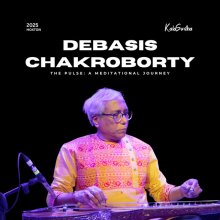
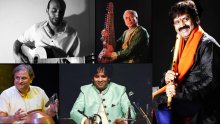
Debasis Chakroborty
Indian Slide Guitar

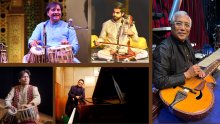
Deepak Shah
Piano

Giuliano Modarelli
Guitar

Hanif Khan
Tabla

Shahbaz Hussain
Tabla
Classifiers
Swara geometries, relationships, and classifications
Swara Geometries
Structure
Around the World
Global connections and equivalent scales
Berklee PULSE gives the C harmonic minor scale as C D Eb F G Ab B, note for note Kirwani with Sa on C. Between komal Dha and shuddha Ni the scale leaves a gap of three semitones.
Harmonic minor
C D Eb F G Ab B
Berklee PULSE gives C harmonic minor as C D Eb F G Ab B. With Sa on C, it matches Kirwani note for note.
Frequently Asked Questions
Where can I hear Raag Kirwani played live in concert?
You can hear Raag Kirwani at KalaSudha's concerts in the UK, Europe and India. The raga pianist Deepak Shah played it at Kala Festival, a touring festival, at The Great Hall of the University of Reading, with the tabla player Hanif Khan. Pandit Debasis Chakroborty and the guitarist Giuliano Modarelli played it at the Assembly Rooms in Edinburgh, with Ustad Shahbaz Hussain on tabla. Coming concerts are on the events page.
Which recordings of Raag Kirwani should I listen to first?
KalaSudha's recordings of Raag Kirwani include Meditative Vibe, on which Pandit Debasis Chakroborty plays the raga on solo Indian slide guitar. Video releases show the raga pianist Deepak Shah's Kirwani at Kala Festival in Reading and Pandit Debasis Chakroborty's duet with the guitarist Giuliano Modarelli in Edinburgh.
What is the difference between Raag Kirwani and Raag Charukesi?
Raag Kirwani and Raag Charukesi both use all seven notes with komal, or lowered, Dha, but they swap two notes. Kirwani takes komal Ga with shuddha, or natural, Ni, while Charukesi takes shuddha Ga with komal Ni. Both came from Carnatic music: George Howlett traces Kirwani to Keeravani, the 21st melakarta, or parent scale, and Charukesi to the 26th.
What is the Carnatic equivalent of Raag Kirwani?
Raag Kirwani comes from the Carnatic raga Kiravani, also written Keeravani, the 21st melakarta, or parent scale, with the same seven notes. George Howlett writes that Kirwani was popularised in Hindustani music chiefly through Pandit Ravi Shankar's borrowings from the South. With Sa on C, the scale is the Western harmonic minor, which Howlett notes as congruent with Kirwani.
Which film songs are based on Raag Kirwani?
Hindi film songs that David Courtney lists in Raag Kirwani include Ankhon Se Jo Utari, from Phir Wohi Dil Laaya Hoon, which he calls "a surprisingly good example". His list also includes Anewala Pal, Janewala Hai, from Golmaal, and Ek Radha Ek Meera, from Ram Teri Ganga Maili.
How can I learn a raga online?
You can learn a raga online with the KalaSudha Academy, in live one-to-one lessons with a teacher or in a structured course, from foundation to advanced. Learners book lessons in their own time zone, and teachers teach live in their own language. Instructors and touring artists also lead in-person workshops and summer camps where enough learners register interest.
Have more questions? Contact our support team and we'll be happy to help!