

Madhuvanti
मधुवंती
.N S g M# P N S' | S' N D P M# g M# g R S .N S
Origins & Context
Raag Madhuvanti is a Hindustani raga outside the ten thaats, performed in the late afternoon, that uses komal Ga and tivra Ma with shuddha Re, Pa, Dha and Ni. Komal means lowered and tivra means raised, while shuddha means natural. A thaat is a parent scale. It is also written Raag Madhuwanti or Raga Madhuvanti, and older names for it include Ambika.
In the notation here, lowercase marks a komal note, M# is tivra Ma, a dot marks the lower octave and an apostrophe the upper. The aroha, or ascent, is .N S g M# P N S'. It leaves out Re and Dha, which return in the descent. The avaroha, or descent, is S' N D P M# g M# g R S .N S. The vadi, the most prominent note, is Pa, and the samvadi, its partner, is Sa. Other accounts pair Pa with Re instead, and add that some take tivra Ma as vadi, with Sa as its samvadi. The AUTRIM project of the National Centre for the Performing Arts and the University of Amsterdam places it outside the thaat system. It is also filed under Todi.
Show MoreShow Less
Madhuvanti is close to Multani. AUTRIM finds similar movements in the two, but Multani lowers Re and Dha where Madhuvanti keeps them natural. George Howlett gives the Carnatic melakarta Dharmavati, the 59th, as an approximate counterpart; it has the same seven notes.
KalaSudha treats Madhuvanti as a bridge between intellectual complexity and melodic beauty, a raga that asks for precise meend, or glides, and a full, held Pa. KalaSudha releases Madhuvanti recordings, such as Madhuvanti, Pt. 1. Its academy teaches ragas online and in local workshops.
Accounts differ on when Madhuvanti appeared and who made it. The AUTRIM project credits Wamanrao Padhye, a disciple of V. D. Paluskar. George Howlett cites Rajan Parrikar on shared credit: Vilayat Khan is said to have conceived it in the 1940s, while Padhye developed a similar raga he called Ambika. Two views exist: an old raga under a new name, or a raga first heard around the 1930s.
Howlett links the name to honey or nectar, and AUTRIM gives Ambika and Madhumalati as other names.
The AUTRIM project presents a chhota khayal in Sitarkhani tala, sung by Ashwini Bhide, and a bada khayal in slow Ektal, sung by Aslam Khan, both on a lover's longing.
Technical Details
Melodic structure and movement patterns
Aroha (Ascent)
.N S g M# P N S'
Avroh (Descent)
S' N D P M# g M# g R S .N S
Pakad (Catch Phrase)
.N S M# g M# P, M# g S R S
Tanpura Tuning
P - S - S - .S
Additional Notes
Phraseologies
Key for these phrases: g is komal Ga, M# is tivra Ma, and a dot puts a note in the lower octave.
The catch phrase .N S M# g M# P climbs from lower Ni and swings between tivra Ma and komal Ga before reaching Pa. M# g S R S returns to Sa through Re. Pa is a resting point, and Ga and Ni carry weight, with a slight andol, or oscillation, on Ga.
The AUTRIM project notes that some musicians add komal Ni beside shuddha Ni. It also hears shades of Patdeep and Bhimpalasi, which a strong tivra Ma keeps apart.
Common Phrases
- g M# P N S'
Recordings & Performances
Listen to master musicians perform this raga
Videos

Raag Madhuvanti Alaap | Debasis Chakroborty & Giuliano Modarelli
Debasis Chakroborty
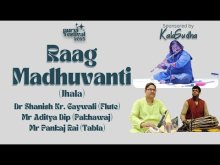
Raag Madhuvanti Jhala | Flute | Tabla | Pakhawaj | Music of India | Purvi Festival 2023
Shanish Kumar

Raag Madhuvanti | Flute | Pakhawaj | Tabla | Music of India | Purvi Festival 2023

Raag Madhuvanti Alap | Flute | Music of India | Shanish Kumar Gaywali | Purvi Festival 2023
Shanish Kumar
Tracks
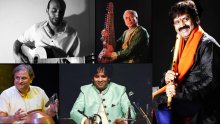
Master Performers
Artists renowned for their renditions of Madhuvanti

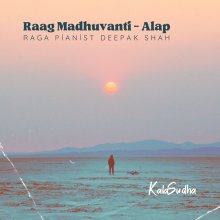
Deepak Shah
Piano

Shanish Kumar
Bansuri (Flute)

Debasis Chakroborty
Indian Slide Guitar

Giuliano Modarelli
Guitar
Classifiers
Swara geometries, relationships, and classifications
Swara Geometries
Structure
Around the World
Global connections and equivalent scales
With Sa on C, Madhuvanti's notes are C D E flat F sharp G A B, the scale George Howlett calls Lydian flat 3. Its ascent and descent use the same Western notes.
Lydian flat 3
C D Eb F# G A B
George Howlett names Madhuvanti's scale Lydian flat 3. With Sa on C, it matches Madhuvanti note for note.
Frequently Asked Questions
Where can I hear Raag Madhuvanti played live in concert?
You can hear Raag Madhuvanti at KalaSudha's concerts in the UK, Europe and India. Pandit Debasis Chakroborty and the guitarist Giuliano Modarelli opened their set with it at the Raga Unison concert in the Assembly Rooms, Edinburgh, with the tabla player Ustad Shahbaz Hussain. The AUTRIM project calls Madhuvanti popular among musicians, especially instrumentalists. Coming concerts are on the events page.
Which recordings of Raag Madhuvanti should I listen to first?
KalaSudha's recordings of Raag Madhuvanti include Madhuvanti, Pt. 1, a live performance by the raga pianist Deepak Shah with the tabla player Durjay Bhaumik. Deepak Shah also plays the alap, the unmetered opening, and a gat in Tintal on piano in KalaSudha studio recordings. Dr Shanish Kumar's bansuri performance at Purvi Festival in Motihari and the Edinburgh alap of Pandit Debasis Chakroborty and Giuliano Modarelli are out as video releases.
What is the difference between Raag Madhuvanti and Raag Multani?
Raag Madhuvanti and Raag Multani move in similar phrases, but Multani lowers Re and Dha, where Madhuvanti keeps them shuddha, or natural. Both use komal Ga and tivra Ma, the raised fourth, with shuddha Ni. In Multani, the AUTRIM project writes, Re and Dha are weak and left out going up, and most movements start from the lower Ni.
What is the Carnatic equivalent of Raag Madhuvanti?
The Carnatic counterpart of Raag Madhuvanti's scale is Dharmavati, the 59th melakarta, or parent scale, with the same seven notes, in George Howlett's table. Howlett adds that Madhuvanti itself was taken into Carnatic music over the past half-century, keeping its shape, with Re and Dha left out going up.
Which film songs are based on Raag Madhuvanti?
George Howlett names two film settings of Raag Madhuvanti: Rasm-E-Ulfat, sung by Lata Mangeshkar, and Muskurahat, sung by Arijit Singh. Madhuvanti is a modern raga: the AUTRIM project credits its creation to Wamanrao Padhye, a disciple of V. D. Paluskar.
Which bandishes are sung in Raag Madhuvanti?
Bandishes, or set compositions, in Raag Madhuvanti include Main Aavun Tore Mandarva, a chhota khayal in Sitarkhani tala sung by Ashwini Bhide for the AUTRIM project. A chhota khayal is a shorter khayal composition, and in this one a lover promises to come to the beloved's home. AUTRIM also presents E Ho More Sai, a bada khayal in slow Ektal sung by Aslam Khan, a song of longing, day and night.
How can I learn a raga online?
You can learn a raga online with the KalaSudha Academy, in live one-to-one lessons with a teacher or in a structured course, from foundation to advanced. Learners book lessons in their own time zone, and teachers teach live in their own language. Instructors and touring artists also lead in-person workshops and summer camps where enough learners register interest.
Have more questions? Contact our support team and we'll be happy to help!