

Marwa
मारवा
S .D .N r G M# D N S' | S' N D M# G r S, .N .D S .N r S
Origins & Context
Raag Marwa is a Marwa thaat raga of Hindustani music, performed at dusk, that uses komal Re, shuddha Ga, tivra Ma, shuddha Dha and Ni, and leaves out Pa. Komal means lowered, shuddha natural, tivra raised, and a thaat is a parent scale. Sa is skipped going up and coming down, and komal Re and Dha carry the weight.
In this notation, r is komal Re and M# tivra Ma. A leading dot marks the lower octave and an apostrophe the upper. One teaching outline gives the aroha, or ascent, as S .D .N r G M# D N S' and the avaroha, or descent, as S' N D M# G r S, .N .D S .N r S. It names komal Re as the vadi, the most prominent note, and Dha as the samvadi, its partner. George Howlett gives shuddha Dha as the vadi instead.
Show MoreShow Less
Rajan Parrikar calls the overwhelming dominance of komal Re and Dha the main idea in Marwa. Puriya uses the same notes with a different pair of main notes, and the outline hears more Ga and Ni there. The outline links Marwa to detachment, a renunciation of worldly pain and pleasure.
At KalaSudha, we view Marwa as the ultimate test of a musician's breath control and emotional maturity. We have released an alap in Raag Marwa by Pandit Ajay Prasanna on bansuri, recorded at the Assembly Rooms in Edinburgh. Our academy teaches ragas online and in local workshops, and each course is built by its instructor with KalaSudha.
Rajan Parrikar notes that Marwa is among the ten thaats Bhatkhande enumerated. George Howlett writes that Bhatkhande chose it as the title raga of its thaat, with Pa added to the scale. Howlett quotes Nikhil Banerjee, for whom Marwa "is considered devotional and heroic". In Banerjee's account, Pa is not used because it expresses joy, and Dha may express disgust.
Howlett notes that Amir Khan is often spoken of as the raga's foremost exponent. Parrikar ranks Amir Khan's Marwa beside Einstein's General Theory: "What Einstein's General Theory is to scientific thought Amir Khan's Marwa is to musical thought". Parrikar sets Sohini apart by its strength in Dha and Ga, and Howlett counts Puriya and Sohini as close to Marwa in character.
Technical Details
Melodic structure and movement patterns
Aroha (Ascent)
S .D .N r G M# D N S'
Avroh (Descent)
S' N D M# G r S, .N .D S .N r S
Pakad (Catch Phrase)
S, .N .D S .N r, r G M# D, D M# G r, .N .D r S
Tanpura Tuning
N - S - S - .S
Additional Notes
Phraseologies
Key for these phrases: r is komal Re, M# is tivra Ma, a leading dot marks the lower octave and an apostrophe the upper.
One teaching outline uses komal Re and Dha as resting notes and keeps Ga and Ni light. Phrases skip Sa, as in .N .D r S. Its catch phrase turns on D M# G r. The outline sings Marwa mostly in the middle octave and finds it hard to expand. Rajan Parrikar points to the same skip of Sa in both directions.
Common Phrases
- D M# G r
Recordings & Performances
Listen to master musicians perform this raga

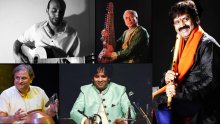
Master Performers
Artists renowned for their renditions of Marwa

Ajay Prasanna
Bansuri (Flute)
Classifiers
Swara geometries, relationships, and classifications
Swara Geometries
Structure
Around the World
Global connections and equivalent scales
With Sa on C, Marwa uses C, D flat, E, F sharp, A and B, with no G. George Howlett gives the Lydian mode with a flat second and no fifth as its jazz translation, and Carnatic Gamanashrama as an approximate counterpart.
Lydian flat 2, no fifth
C Db E F# A B
George Howlett names Marwa's scale the Lydian mode with a flat second and no fifth. With Sa on C, it matches Marwa note for note.