

Puriya Dhanashri
पूरिया धनाश्री
.N r S, .N r G M# P, M# d N S' | S' N d P M# G M# r G r S
Origins & Context
Raag Puriya Dhanashri is a Purvi thaat raga of Hindustani music, performed at sunset, that uses komal Re and Dha, tivra Ma and the other notes shuddha, with no shuddha Ma. Komal means lowered, tivra raised, shuddha natural, and a thaat is a parent scale. George Howlett traces its origins to an archaic blending of the Puriya and Dhanashri lineages.
In this notation, lowercase r and d are komal, M# is tivra Ma, a leading dot marks the lower octave and an apostrophe the upper. One teaching outline gives the aroha, or ascent, as .N r S, .N r G M# P, M# d N S'. Its avaroha, or descent, is S' N d P M# G M# r G r S. The vadi, the most prominent note, is Pa. Its partner, the samvadi, is Sa.
Show MoreShow Less
The outline makes Pa the centre of every expansion, and Howlett calls Pa the most vital note. The AUTRIM project of the National Centre for the Performing Arts and the University of Amsterdam names Pa and Sa as important notes and Ga as a strong resting note. It hears some movements in the lower half recall Puriya.
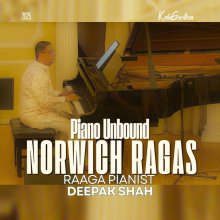
KalaSudha presents Hindustani musicians in concert and releases their recordings. We have released Deepak Shah's Raag Puriya Dhanashri, recorded live at Kala Festival 2025 in Norwich. Our academy teaches ragas online and in local workshops, and each course is built by its instructor with KalaSudha.
One teaching outline gives Puriya Dhanashri an important place among evening ragas, hears compassion in it and calls it emotional in character. George Howlett finds it typically rendered in a pensive, patient fashion, and notes a mention in Faqirullah's Rag Darpan. The AUTRIM project points out that it has the same notes as Shri, and the outline sets it close to Purvi, which uses both forms of Ma.
Technical Details
Melodic structure and movement patterns
Aroha (Ascent)
.N r S, .N r G M# P, M# d N S'
Avroh (Descent)
S' N d P M# G M# r G r S
Pakad (Catch Phrase)
.N r G M# P, P M# G M# r G, M# d P, M# d N S', N r', N d P, P d P P M# G M# r G, r S
Tanpura Tuning
P - S - S - .S
Additional Notes
Phraseologies
Key for these phrases: lowercase r and d are komal, M# is tivra Ma, a leading dot marks the lower octave and an apostrophe the upper.
One teaching outline names P M# G M# r G as the signature turn and starts alaps and taans from Ni. It often skips Pa going up, and skips Sa both ways, as in .N r G M# P and M# d N S'. The AUTRIM project starts the ascent on the lower Ni and allows Pa going up only as a closing note. Counting that closing Pa, one teaching outline labels the raga sampurna both ways. George Howlett hears shuddha Ni as a launch point for these Sa-skipping moves.
Common Phrases
- P M# G M# r G
Recordings & Performances
Listen to master musicians perform this raga
Master Performers
Artists renowned for their renditions of Puriya Dhanashri

Deepak Shah
Piano
Classifiers
Swara geometries, relationships, and classifications
Structure
Around the World
Global connections and equivalent scales
With Sa on C, Puriya Dhanashri uses C, D flat, E, F sharp, G, A flat and B. George Howlett gives the Lydian mode with a flat second and sixth as its jazz translation, and Carnatic Kamavardhini as an approximate counterpart.