

Jog
जोग
S G M P n S' | S' n P M g S, .n S
Origins & Context
Raag Jog is a Kafi thaat raga of Hindustani music, performed late in the evening, that uses shuddha and komal Ga with Ma, Pa and komal Ni. It leaves out Re and Dha. Shuddha means natural and komal means lowered. A thaat is a parent scale, and Darbar files Jog under Khamaj instead. It is also written Raag Jog, Raga Jog or Yog.
In the notation here, lowercase marks a komal note, a dot the lower octave and an apostrophe the upper. The aroha, or ascent, is S G M P n S'. The avaroha, or descent, is S' n P M g S, .n S, closing through lower Ni. Shuddha Ga leads the way up, and komal Ga colours the way down, often in the close G M g S. The vadi, the most prominent note, is Ma, and the samvadi, its partner, is Sa. Darbar names Ga and Sa instead. The AUTRIM project of the National Centre for the Performing Arts and the University of Amsterdam hears Sa and Pa as the important notes.
Jog is a young raga. Darbar gives it about a hundred years of history, and George Howlett traces it to Tilang, which uses shuddha Ga only and adds shuddha Ni in the ascent. Howlett hears a bluesy blend of major and minor in its two forms of Ga.
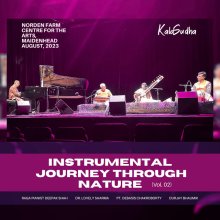
KalaSudha releases Jog recordings made live at Kala Festival, such as Raag Jog, Pt. 1. Its academy teaches ragas online and in local workshops.
Technical Details
Melodic structure and movement patterns
Aroha (Ascent)
S G M P n S'
Avroh (Descent)
S' n P M g S, .n S
Pakad (Catch Phrase)
G M P n P, P n P M G M, G M g S
Tanpura Tuning
P - S - S - .S
Additional Notes
Phraseologies
Key for these phrases: lowercase letters are komal notes, and a dot puts a note in the lower octave.
The catch phrases G M P n P and P n P M G M keep shuddha Ga and Ma close together. G M g S drops through komal Ga to Sa. The AUTRIM project hears both forms of Ga in such endings, as in G S g S. It notes that some musicians sound the two in succession on the way down.
Darbar writes that the two Ga are now often used chromatically. AUTRIM finds shades of Tilang when both forms of Ni appear, while Ga keeps the Jog colour.
Common Phrases
Recordings & Performances
Listen to master musicians perform this raga

Tracks
Albums

Classifiers
Swara geometries, relationships, and classifications
Swara Geometries
Around the World
Global connections and equivalent scales
With Sa on C, Jog's notes are C E flat E F G B flat. George Howlett lists this scale as a minor pentatonic with a doubled third, 1 b3 3 4 5 b7. He hears the two thirds as a bluesy blend of major and minor.
Minor pentatonic with a doubled third
C Eb E F G Bb
George Howlett gives this scale as 1 b3 3 4 5 b7. With Sa on C, it matches Jog note for note.