

Madhuvanti
मधुवंती
.N S g M# P N S' | S' N D P M# g M# g R S .N S
Origines et contexte
Le raga Madhuvanti est un raga hindoustani extérieur aux dix thaats, joué en fin d’après-midi, qui emploie Ga komal et Ma tivra avec Re, Pa, Dha et Ni shuddha. Komal signifie abaissé et tivra haussé, tandis que shuddha signifie naturel. Un thaat est une gamme mère. Il s’écrit aussi Raag Madhuwanti ou Raga Madhuvanti, et il a porté autrefois, entre autres, le nom d’Ambika.
Dans la notation employée ici, une minuscule indique une note komal, M# désigne Ma tivra, un point l’octave grave et une apostrophe l’octave aiguë. L’aroha, ou montée, est .N S g M# P N S'. Il omet Re et Dha, qui reviennent à la descente. L’avaroha, ou descente, est S' N D P M# g M# g R S .N S. Le vadi, la note la plus importante, est Pa, et le samvadi, son partenaire, est Sa. D’autres sources associent plutôt Pa à Re et ajoutent que certains prennent Ma tivra comme vadi, avec Sa pour samvadi. Le projet AUTRIM du National Centre for the Performing Arts et de l’université d’Amsterdam le place hors du système des thaats. Il est aussi classé sous Todi.
Afficher plusAfficher moins
Madhuvanti est proche de Multani. AUTRIM relève des mouvements semblables dans les deux, mais Multani abaisse Re et Dha là où Madhuvanti les garde naturels. George Howlett donne le melakarta carnatique Dharmavati, le 59e, comme équivalent approximatif ; il a les mêmes sept notes.
KalaSudha voit dans Madhuvanti un pont entre complexité intellectuelle et beauté mélodique, un raga qui exige des meends précis, ou glissés, et un Pa plein et tenu. KalaSudha publie des enregistrements de Madhuvanti, comme Madhuvanti, Pt. 1. Son académie enseigne les ragas en ligne et dans des ateliers locaux.
Les sources divergent sur la date d’apparition de Madhuvanti et sur son auteur. Le projet AUTRIM l’attribue à Wamanrao Padhye, disciple de V. D. Paluskar. George Howlett cite Rajan Parrikar sur une paternité partagée : Vilayat Khan l’aurait conçu dans les années 1940, tandis que Padhye développait un raga semblable qu’il appelait Ambika. Deux thèses coexistent : un raga ancien sous un nom nouveau, ou un raga apparu vers les années 1930.
Howlett rattache le nom au miel ou au nectar, et AUTRIM donne Ambika et Madhumalati comme autres noms.
Le projet AUTRIM présente un chhota khayal en tala Sitarkhani, chanté par Ashwini Bhide, et un bada khayal en ektal lent, chanté par Aslam Khan, tous deux sur le désir de l’être aimé.
Détails techniques
Structure mélodique et mouvements
Aroha (montée)
.N S g M# P N S'
Avroh (descente)
S' N D P M# g M# g R S .N S
Pakad (phrase caractéristique)
.N S M# g M# P, M# g S R S
Chalan (Movement)
N(o)SgM#P ∣ gM#PNS′ ∣ S′NDPM#gRS
Tanpura Tuning
P - S - S - .S
Additional Notes
Phraseologies
Clé de ces phrases : g désigne Ga komal, M# Ma tivra, et un point place une note dans l’octave grave.
La phrase caractéristique .N S M# g M# P part du Ni grave et oscille entre Ma tivra et Ga komal avant d’atteindre Pa. M# g S R S revient à Sa par Re. Pa est une note de repos, et Ga et Ni ont du poids, avec un léger andol, ou oscillation, sur Ga.
Le projet AUTRIM note que certains musiciens ajoutent Ni komal à côté de Ni shuddha. Il y entend aussi des nuances de Patdeep et de Bhimpalasi, dont un Ma tivra affirmé le distingue.
Common Phrases
- g M# P N S'
Enregistrements et concerts
Écoutez de grands musiciens interpréter ce raga
Vidéos

Raag Madhuvanti Alaap | Debasis Chakroborty & Giuliano Modarelli
Debasis Chakroborty
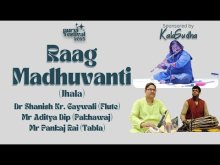
Raag Madhuvanti Jhala | Flute | Tabla | Pakhawaj | Music of India | Purvi Festival 2023
Shanish Kumar

Raag Madhuvanti | Flute | Pakhawaj | Tabla | Music of India | Purvi Festival 2023

Raag Madhuvanti Alap | Flute | Music of India | Shanish Kumar Gaywali | Purvi Festival 2023
Shanish Kumar
Tracks
Master Performers
Artists renowned for their renditions of Madhuvanti

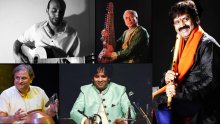
Deepak Shah
Piano

Shanish Kumar
Bansuri (Flute)

Debasis Chakroborty
Indian Slide Guitar

Giuliano Modarelli
Guitar
Classifiers
Swara geometries, relationships, and classifications
Swara Geometries
Structure
Around the World
Global connections and equivalent scales
Avec Sa sur do, les notes de Madhuvanti sont do ré mi bémol fa dièse sol la si, la gamme que George Howlett appelle lydien bémol 3. Sa montée et sa descente emploient les mêmes notes occidentales.
Lydien bémol 3
C D Eb F# G A B
George Howlett nomme la gamme de Madhuvanti lydien bémol 3. Avec Sa sur do, elle correspond note pour note à Madhuvanti.
Questions fréquentes
Where can I hear Raag Madhuvanti played live in concert?
You can hear Raag Madhuvanti at KalaSudha's concerts in the UK, Europe and India. Pandit Debasis Chakroborty and the guitarist Giuliano Modarelli opened their set with it at the Raga Unison concert in the Assembly Rooms, Edinburgh, with the tabla player Ustad Shahbaz Hussain. The AUTRIM project calls Madhuvanti popular among musicians, especially instrumentalists. Coming concerts are on the events page.
Which recordings of Raag Madhuvanti should I listen to first?
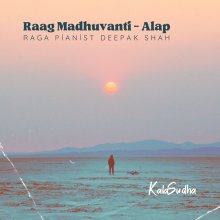
KalaSudha's recordings of Raag Madhuvanti include Madhuvanti, Pt. 1, a live performance by the raga pianist Deepak Shah with the tabla player Durjay Bhaumik. Deepak Shah also plays the alap, the unmetered opening, and a gat in Tintal on piano in KalaSudha studio recordings. Dr Shanish Kumar's bansuri performance at Purvi Festival in Motihari and the Edinburgh alap of Pandit Debasis Chakroborty and Giuliano Modarelli are out as video releases.
What is the difference between Raag Madhuvanti and Raag Multani?
Raag Madhuvanti and Raag Multani move in similar phrases, but Multani lowers Re and Dha, where Madhuvanti keeps them shuddha, or natural. Both use komal Ga and tivra Ma, the raised fourth, with shuddha Ni. In Multani, the AUTRIM project writes, Re and Dha are weak and left out going up, and most movements start from the lower Ni.
What is the Carnatic equivalent of Raag Madhuvanti?
The Carnatic counterpart of Raag Madhuvanti's scale is Dharmavati, the 59th melakarta, or parent scale, with the same seven notes, in George Howlett's table. Howlett adds that Madhuvanti itself was taken into Carnatic music over the past half-century, keeping its shape, with Re and Dha left out going up.
Which film songs are based on Raag Madhuvanti?
George Howlett names two film settings of Raag Madhuvanti: Rasm-E-Ulfat, sung by Lata Mangeshkar, and Muskurahat, sung by Arijit Singh. Madhuvanti is a modern raga: the AUTRIM project credits its creation to Wamanrao Padhye, a disciple of V. D. Paluskar.
Which bandishes are sung in Raag Madhuvanti?
Bandishes, or set compositions, in Raag Madhuvanti include Main Aavun Tore Mandarva, a chhota khayal in Sitarkhani tala sung by Ashwini Bhide for the AUTRIM project. A chhota khayal is a shorter khayal composition, and in this one a lover promises to come to the beloved's home. AUTRIM also presents E Ho More Sai, a bada khayal in slow Ektal sung by Aslam Khan, a song of longing, day and night.
How can I learn a raga online?
You can learn a raga online with the KalaSudha Academy, in live one-to-one lessons with a teacher or in a structured course, from foundation to advanced. Learners book lessons in their own time zone, and teachers teach live in their own language. Instructors and touring artists also lead in-person workshops and summer camps where enough learners register interest.
Have more questions? Contact our support team and we'll be happy to help!