

Megh
मेघ
S R M P n S' | S' n P M R S
Origines et contexte
Le raga Megh est un raga hindoustani du thaat Kafi, joué à toute heure pendant les pluies, qui emploie Sa, Re shuddha, Ma shuddha, Pa et Ni komal. Shuddha signifie naturel et komal signifie abaissé. Il s’écrit aussi Raag Megh ou Raga Megh, et AUTRIM le nomme également Megh Malhar.
Dans la notation employée ici, une minuscule indique une note komal et une apostrophe l’octave aiguë. L’aroha, ou montée, est S R M P n S', et l’avaroha, ou descente, est S' n P M R S ; Ga et Dha sont omis. Le vadi, la note la plus importante, est Sa, et le samvadi, son partenaire, est Pa. Certains musiciens prennent Ma comme samvadi, et un plan de cours donne Ma et Sa comme paire.
Afficher plusAfficher moins
Megh appartient à la famille Malhar des ragas de la pluie, et son nom signifie nuages. Le projet AUTRIM du National Centre for the Performing Arts et de l’université d’Amsterdam note que le Madhumad Sarang a les mêmes notes mais un fort accent sur Ma. Il ajoute que certains musiciens introduisent Dha pour distinguer les deux. George Howlett donne le raga carnatique Madhyamavati comme équivalent approximatif ; il emploie les mêmes cinq notes. Selon une légende, racontée par Nikhil Inamdar en 2017, la fille de Tansen chanta Megh Malhar pour faire venir la pluie et éteindre le feu qu’avait allumé le raga Deepak de son père.
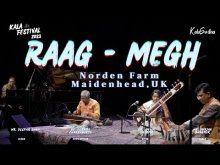
KalaSudha aborde Megh comme une étude de la puissance par la simplicité, un raga qui demande la maîtrise du souffle et une voix pleine et résonnante. KalaSudha publie des enregistrements de Megh réalisés en public au Kala Festival, comme Raag Megh, Pt. 1. Son académie enseigne les ragas en ligne et dans des ateliers locaux.
Megh est l’un des plus anciens ragas, et le projet AUTRIM, citant Tagore, le compte parmi les six ragas principaux de l’Antiquité. Des versions plus tardives ont pris le nom de Megh Malhar.
George Howlett rapporte une autre version de la légende de Tansen, dans laquelle deux sœurs, Tana et Riri, chantent Megh et éteignent le feu.
Le projet AUTRIM présente un chhota khayal en Megh, en Ektal, chanté par Veena Sahasrabuddhe. Un plan de cours cite « At Ghor Ghor Garjat Aaye » comme bada khayal en Megh, en Ektal lent.
Détails techniques
Structure mélodique et mouvements
Aroha (montée)
S R M P n S'
Avroh (descente)
S' n P M R S
Pakad (phrase caractéristique)
.n S R P M R, M P M R, M P, P M n P M R, R R P M R R S .n S
Chalan (Movement)
S, R n(o) P, n(o) S, S R m, m R, R m P, n P, m R, S R n(o) P, S
Tanpura Tuning
P - S - S - .S
Additional Notes
Phraseologies
Clé de ces phrases : n désigne Ni komal, et un point placé avant une note la met à l’octave grave.
Le projet AUTRIM désigne Re et le Pa grave comme les principales notes de repos. Re et Ni komal portent l’andol, un lent balancement de la hauteur, et une touche de Ma mène à Re. Un plan de cours donne les phrases caractéristiques .n S R P M R et M P M R, dans lesquelles la ligne revient sans cesse à Re depuis Pa et Ma.
Le même plan rend n P dans Megh Malhar par le tour propre au Malhar (P)n P, avec Pa comme note d’ornement avant Ni. Comme Megh Malhar est un raga très ancien, ajoute-t-il, il se chante sous l’influence de la manière dhrupad, avec beaucoup de gamak, des secousses appuyées, et de meend, des glissés.
Enregistrements et concerts
Écoutez de grands musiciens interpréter ce raga
Tracks
Albums

Master Performers
Artists renowned for their renditions of Megh

Debasis Chakroborty
Indian Slide Guitar

Deepak Shah
Piano

Dr Lovely Sharma

Durjay Bhaumik
Tabla
Classifiers
Swara geometries, relationships, and classifications
Swara Geometries
Structure
Around the World
Global connections and equivalent scales
Avec Sa sur do, les notes de Megh sont do, ré, fa, sol et si bémol, la gamme que George Howlett appelle pentatonique suspendue. La pentatonique mineure de do, do, mi bémol, fa, sol, si bémol, a mi bémol là où Megh a ré.
Pentatonique suspendue
C D F G Bb
George Howlett donne la pentatonique suspendue comme 1 2 4 5 b7. Avec Sa sur do, elle correspond à Megh note pour note.
Pentatonique mineure
C Eb F G Bb
Berklee PULSE donne do, mi bémol, fa, sol, si bémol pour la pentatonique mineure de do. Megh a ré à la place de mi bémol, et ses quatre autres notes concordent.
Questions fréquentes
Where can I hear Raag Megh played live in concert?
You can hear Raag Megh live at KalaSudha's concerts in the UK, Europe and India, and the ensemble of Pandit Debasis Chakroborty has played it at Kala Festival, a touring festival. Megh is a raga of the rainy season. The AUTRIM project of the National Centre for the Performing Arts and the University of Amsterdam gives its time as any time during the rains. Coming concerts are on the events page.
Which recordings of Raag Megh should I listen to first?
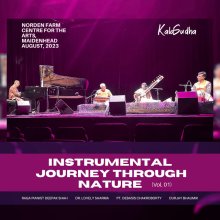
KalaSudha's recordings of Raag Megh include Raag Megh, Pt. 1, which opens a performance recorded live at Kala Festival. Pandit Debasis Chakroborty plays Indian slide guitar with the sitar player Dr Lovely Sharma, the raga pianist Deepak Shah and the tabla player Durjay Bhaumik. Parts 2 and 3 complete the raga, and all three parts are on the album Instrumental Journey Through Nature, Vol. 1; the concert is also out as a video release.
What is the difference between Raag Megh and Raag Miyan Ki Malhar?
In its common form, Raag Megh uses five notes, Sa, Re, Ma, Pa and komal, or lowered, Ni, and leaves out Ga and Dha. Raag Miyan Ki Malhar adds komal Ga, Dha and shuddha, or natural, Ni. The AUTRIM project writes that its komal Ga comes only in descent and its two forms of Ni follow one another. Both belong to the Malhar family and share its rising glide, Re up to Pa.
What is the Carnatic equivalent of Raag Megh?
The Carnatic raga with the same notes as Raag Megh is Madhyamavati, and George Howlett pairs the two as approximate counterparts. Madhyamavati uses Sa, Re, Ma, Pa and komal, or lowered, Ni, in both ascent and descent. Howlett lists it under Kharaharapriya, the 22nd melakarta, or parent scale, of Carnatic music, and also pairs it with Raag Madhumad Sarang, which shares Megh's notes.
Which bandishes are sung in Raag Megh?
Bandishes, or set compositions, in Raag Megh include Ghanana Ghanana, in the 16-beat Tintal, sung by Vijay Rajput in David Clarke's book Rāgs Around the Clock. Its second part, the antara, carries the pen name Sadarang, which Clarke says may or may not be authentic. The AUTRIM project of the National Centre for the Performing Arts presents a chhota khayal, a shorter khayal composition, in Ektal. It opens Garaj Ghata Ghan Kare and is sung by Veena Sahasrabuddhe.
How can I learn a raga online?
You can learn a raga online with the KalaSudha Academy, in live one-to-one lessons with a teacher or in a structured course, from foundation to advanced. Learners book lessons in their own time zone, and teachers teach live in their own language. Instructors and touring artists also lead in-person workshops and summer camps where enough learners register interest.
Does Raag Megh bring rain?
The idea that Raag Megh brings rain comes from legend. Nikhil Inamdar, in Live History India, retells how Tansen taught his daughter to sing Megh Malhar to bring down rain and douse the fire of Raga Deepak. He calls it an allegory that has come to be read literally. George Howlett's version has two sisters, Tana and Riri, sing Megh. Howlett also writes that Tansen is said to have sung Miyan Ki Malhar to summon the monsoon.
Which film songs are based on Raag Megh?
Hindi film songs that David Courtney lists in Raag Megh include Kahan Se Aye Badra, from Chashme Buddoor. Courtney keeps a separate list for Megh Malhar, which includes Baraso Re, from Tansen, and Dukha Bhare Din Bite Re Bhaiya, from Mother India. David Clarke writes that Megh is often known as Megh Malhar, while the khayal singer Vijay Rajput keeps that name for a form with a subtle komal, or lowered, Ga.
Have more questions? Contact our support team and we'll be happy to help!