

Bageshri
बागेश्री
.n S g M D n S' | S' n D M P D m G R S
Origini e contesto
Nel profondo silenzio del secondo prahar della notte, quando il mondo è caduto in silenzio, Raag Bageshri emerge come una conversazione tra l'anima e il suo amato. È un raga di "Viraha" (desiderio) e "Shringar" (romanticismo), tradizionalmente descritto come una donna in attesa del ritorno del suo amante.
Una composizione del Kafi Thaat, Bageshri è un capolavoro emotivo, il cui potere risiede nella sua geometria "Vakra" (contorta). Non si muove in linee rette; invece, serpeggia attraverso le ottave inferiori e medie, circondando il Madhyama (M) con una delicatezza tenera, quasi dolorosa. La sua bellezza non sta nella grande velocità, ma nella sua capacità di "indugiare". È una melodia di ombre e di morbida luce lunare, dove ogni nota è trattata con una delicatezza tenera, quasi dolorosa.
Mostra altroMostra meno
Come Raag Bangala, Bageshri pone un peso immenso sul Madhyama (Ma). Tuttavia, dove Bangala usa Ma per creare una preghiera mattutina "ariosa", Bageshri lo usa per evocare una profonda profondità emotiva. Il modo in cui un cantante si avvicina al Ma dal Komal Ni crea un "gancio" caratteristico che ha definito il paesaggio sonoro romantico della musica indiana per secoli.
A KalaSudha, consideriamo Bageshri come il "Poema della Notte" definitivo. È un raga che richiede un alto grado di maturità da parte dell'esecutore. Non si tratta delle note che si suonano, ma del silenzio che si lascia tra di esse. È il suono di un cuore che è pieno, eppure in attesa.
Dettagli tecnici
Struttura melodica e schemi di movimento
Aroha (salita)
.n S g M D n S.
Avroh (discesa)
S. n d , M P D , M g R S
Pakad (frase caratteristica)
S .n .D S , M g , M D n D , M g , M g R S
Chalan (Movement)
.n .D S M
Tanpura Tuning
M — S — S — Sa
Additional Notes
Phraseologies
Bageshri è definito da una grammatica "Vakra" (Contorta) che evita percorsi lineari. Il movimento è un raggiungimento diagonale dal registro inferiore al Madhyama (M). Omette R e P nell'ascesa per creare tensione, risolvendoli attraverso pesanti, soulful glides (Meend) nella discesa. La melodia è "sospesa", non si stabilisce mai troppo rapidamente sulla tonica.
Common Phrases
- .n .D S m
Registrazioni ed esibizioni
Ascolta grandi maestri eseguire questo raga

Tracks
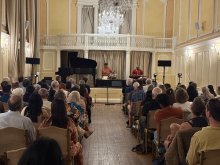
Raag Bageshri - Alap - Live from Kala Festival 2025
Debasis Chakroborty
Raag Bageshri - Drut Gat - Teental (with Akram Khan) - Live from Kala Festival 2025
Debasis Chakroborty
Raag Bageshri - Madhyalaya Gat - Teental (with Akram Khan) - Live from Kala Festival 2025
Debasis Chakroborty
Raag Bageshri - Vilambit Gat - Teental (with Akram Khan) - Live from Kala Festival 2025
Debasis Chakroborty
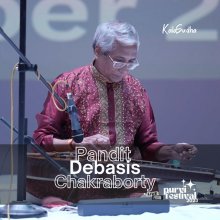
Raag Bageshwari – Jhala
Debasis Chakroborty
Raag Bageshwari – Madhya Laya
Debasis Chakroborty
Master Performers
Artists renowned for their renditions of Bageshri

Debasis Chakroborty
Indian Slide Guitar

Sandipan Mukherjee
Tabla
Classifiers
Swara geometries, relationships, and classifications
Swara Geometries
Struttura
Around the World
Global connections and equivalent scales
Bageshri si allinea con gli ibridi "minore-maggiore" dell'Occidente, perfetto per il jazz della tarda notte.
Dorian Mode
C−D−Eb−F−G−A−Bb−C
A "minor" mode with a "major" 6th; evokes soulful, non-melancholic depth.
Domande frequenti
Where can I hear Raag Bageshri played live in concert?
You can hear Raag Bageshri live at KalaSudha's concerts in the UK, Europe and India, and Pandit Debasis Chakroborty has played it at Kala Festival, a touring festival. He has also played it on Indian slide guitar at Purvi Festival in Motihari, Bihar. The AUTRIM project of the National Centre for the Performing Arts and the University of Amsterdam places Bageshri in the late night. Coming concerts are on the events page.
Which recordings of Raag Bageshri should I listen to first?
KalaSudha's recordings of Raag Bageshri include a solo alap recorded live at Kala Festival, where Pandit Debasis Chakroborty sets out the raga on Indian slide guitar with no tabla and no fixed beat. On the album Norwich Ragas, gats in Tintal with the tabla player Ustad Akram Khan follow it, each faster than the last. Pandit Debasis Chakroborty's Purvi Festival performance, with the tabla player Sandipan Mukherjee, is also out as a video release.
What is the difference between Raag Bageshri and Raag Rageshri?
Raag Bageshri uses komal Ga, the lowered form, and keeps Pa, while Raag Rageshri takes shuddha Ga, the natural form, and leaves Pa out. The AUTRIM project gives Bageshri seven notes, with komal Ga and komal Ni, and writes that Pa is left out going up and used sparingly. It finds their upper halves alike apart from Pa. Turns such as Ma, Dha, komal Ni, Dha, Ma belong to both, but Bageshri's oscillated komal Ni makes it very distinct.
What is the Carnatic equivalent of Raag Bageshri?
Carnatic music has its own Raag Bageshri, which George Howlett describes as imported from Hindustani music and retaining many of its original features; he gives the era as unclear. He lists it under Kharaharapriya, the 22nd melakarta, or parent scale. Among other Carnatic ragas, Howlett pairs Bageshri with Sriranjani, which he sums up as Bageshri with no Pa.
Which bandishes are sung in Raag Bageshri?
Bandishes, or set compositions, in Raag Bageshri include Gunde Lavo Ri Malaniya, a chhota khayal sung by Padma Talwalkar for the AUTRIM project of the National Centre for the Performing Arts. A chhota khayal is a shorter khayal composition, and this one is set in Tintal at a fast tempo. In its words a woman asks the flower girl for garlands as she prepares to welcome her loved one. She wonders how the night will pass without him.
How can I learn a raga online?
You can learn a raga online with the KalaSudha Academy, in live one-to-one lessons with a teacher or in a structured course, from foundation to advanced. Learners book lessons in their own time zone, and teachers teach live in their own language. Instructors and touring artists also lead in-person workshops and summer camps where enough learners register interest.
Is Raag Bageshri a good raga for a beginner to learn?
Raag Bageshri is a Class XII raga in the Hindustani vocal course that India's Central Board of Secondary Education (CBSE) sets for schools, the last class the course covers. Before it, students learn ragas such as Yaman and Kafi in Class IX, Bhupali in Class X and Bhairavi in Class XI. In Class XII, students sing Bageshri as a drut, or fast, khayal beside Bhairav and Malkauns.
Which film songs are based on Raag Bageshri?
Hindi film songs that David Courtney lists in Raag Bageshri include Aja Re, Paradesi, from Madhumati, and Bedardi Dagabaz Ja Tu Nahin Balma Mora, from Bluff Master. Courtney calls the Bluff Master song a "pretty good example" of the raga, and Bolo Na, from Chittagong, "quite a good approach to Bageshri".
Have more questions? Contact our support team and we'll be happy to help!