

Madhuvanti
मधुवंती
.N S g M# P N S' | S' N D P M# g M# g R S .N S
Origini e contesto
Il raga Madhuvanti è un raga hindustani esterno ai dieci thaat, eseguito nel tardo pomeriggio, che usa Ga komal e Ma tivra con Re, Pa, Dha e Ni shuddha. Komal significa abbassato e tivra alzato, mentre shuddha significa naturale. Un thaat è una scala madre. Si scrive anche Raag Madhuwanti o Raga Madhuvanti, e tra i suoi nomi più antichi c'è Ambika.
Nella notazione usata qui, la minuscola indica una nota komal, M# è Ma tivra, un punto indica l'ottava bassa e un apostrofo quella alta. L'aroha, o ascesa, è .N S g M# P N S'. Omette Re e Dha, che tornano nella discesa. L'avaroha, o discesa, è S' N D P M# g M# g R S .N S. Il vadi, la nota più in evidenza, è Pa, e il samvadi, il suo partner, è Sa. Altre fonti abbinano invece Pa a Re, e aggiungono che c'è chi prende Ma tivra come vadi, con Sa come samvadi. Il progetto AUTRIM del National Centre for the Performing Arts e dell'Università di Amsterdam lo colloca fuori dal sistema dei thaat. Viene anche classificato sotto Todi.
Mostra altroMostra meno
Madhuvanti è vicino a Multani. AUTRIM trova movimenti simili nei due, ma Multani abbassa Re e Dha, mentre Madhuvanti li mantiene naturali. George Howlett indica come equivalente approssimativo il melakarta carnatico Dharmavati, il 59°, che ha le stesse sette note.
KalaSudha vede in Madhuvanti un ponte tra complessità intellettuale e bellezza melodica, un raga che chiede meend precisi, cioè glissati, e un Pa pieno e tenuto. KalaSudha pubblica registrazioni di Madhuvanti, come Madhuvanti, Pt. 1. La sua accademia insegna i raga online e in workshop locali.
Le fonti divergono su quando sia apparso Madhuvanti e su chi lo abbia creato. Il progetto AUTRIM lo attribuisce a Wamanrao Padhye, allievo di V. D. Paluskar. George Howlett cita Rajan Parrikar su una paternità condivisa: Vilayat Khan lo avrebbe concepito negli anni '40, mentre Padhye sviluppava un raga simile che chiamava Ambika. Esistono due tesi: un raga antico con un nome nuovo, o un raga ascoltato per la prima volta intorno agli anni '30.
Howlett collega il nome al miele o al nettare, e AUTRIM indica Ambika e Madhumalati come altri nomi.
Il progetto AUTRIM presenta un chhota khayal in tala Sitarkhani, cantato da Ashwini Bhide, e un bada khayal in ektal lento, cantato da Aslam Khan, entrambi sul desiderio della persona amata.
Dettagli tecnici
Struttura melodica e schemi di movimento
Aroha (salita)
.N S g M# P N S'
Avroh (discesa)
S' N D P M# g M# g R S .N S
Pakad (frase caratteristica)
.N S M# g M# P, M# g S R S
Chalan (Movement)
N(o)SgM#P ∣ gM#PNS′ ∣ S′NDPM#gRS
Tanpura Tuning
P - S - S - .S
Additional Notes
Phraseologies
Chiave di queste frasi: g indica Ga komal, M# Ma tivra, e un punto colloca una nota nell'ottava bassa.
La frase caratteristica .N S M# g M# P parte dal Ni basso e oscilla tra Ma tivra e Ga komal prima di raggiungere Pa. M# g S R S torna a Sa passando per Re. Pa è una nota di riposo, mentre Ga e Ni hanno peso, con un leggero andol, cioè un'oscillazione, su Ga.
Il progetto AUTRIM osserva che c'è chi aggiunge Ni komal accanto a Ni shuddha. Vi sente anche sfumature di Patdeep e Bhimpalasi, da cui lo distingue un Ma tivra deciso.
Common Phrases
- g M# P N S'
Registrazioni ed esibizioni
Ascolta grandi maestri eseguire questo raga
Video

Raag Madhuvanti Alaap | Debasis Chakroborty & Giuliano Modarelli
Debasis Chakroborty
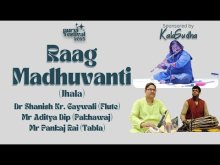
Raag Madhuvanti Jhala | Flute | Tabla | Pakhawaj | Music of India | Purvi Festival 2023
Shanish Kumar

Raag Madhuvanti | Flute | Pakhawaj | Tabla | Music of India | Purvi Festival 2023

Raag Madhuvanti Alap | Flute | Music of India | Shanish Kumar Gaywali | Purvi Festival 2023
Shanish Kumar
Tracks
Master Performers
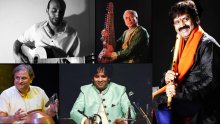
Artists renowned for their renditions of Madhuvanti

Deepak Shah
Piano

Shanish Kumar
Bansuri (Flute)

Debasis Chakroborty
Indian Slide Guitar

Giuliano Modarelli
Guitar
Classifiers
Swara geometries, relationships, and classifications
Swara Geometries
Struttura
Around the World
Global connections and equivalent scales
Con il Sa sul do, le note di Madhuvanti sono do re mi bemolle fa diesis sol la si, la scala che George Howlett chiama lidio bemolle 3. Ascesa e discesa usano le stesse note occidentali.
Lidio bemolle 3
C D Eb F# G A B
George Howlett chiama la scala di Madhuvanti lidio bemolle 3. Con il Sa sul do, corrisponde nota per nota a Madhuvanti.
Domande frequenti
Where can I hear Raag Madhuvanti played live in concert?
You can hear Raag Madhuvanti at KalaSudha's concerts in the UK, Europe and India. Pandit Debasis Chakroborty and the guitarist Giuliano Modarelli opened their set with it at the Raga Unison concert in the Assembly Rooms, Edinburgh, with the tabla player Ustad Shahbaz Hussain. The AUTRIM project calls Madhuvanti popular among musicians, especially instrumentalists. Coming concerts are on the events page.
Which recordings of Raag Madhuvanti should I listen to first?
KalaSudha's recordings of Raag Madhuvanti include Madhuvanti, Pt. 1, a live performance by the raga pianist Deepak Shah with the tabla player Durjay Bhaumik. Deepak Shah also plays the alap, the unmetered opening, and a gat in Tintal on piano in KalaSudha studio recordings. Dr Shanish Kumar's bansuri performance at Purvi Festival in Motihari and the Edinburgh alap of Pandit Debasis Chakroborty and Giuliano Modarelli are out as video releases.
What is the difference between Raag Madhuvanti and Raag Multani?
Raag Madhuvanti and Raag Multani move in similar phrases, but Multani lowers Re and Dha, where Madhuvanti keeps them shuddha, or natural. Both use komal Ga and tivra Ma, the raised fourth, with shuddha Ni. In Multani, the AUTRIM project writes, Re and Dha are weak and left out going up, and most movements start from the lower Ni.
What is the Carnatic equivalent of Raag Madhuvanti?
The Carnatic counterpart of Raag Madhuvanti's scale is Dharmavati, the 59th melakarta, or parent scale, with the same seven notes, in George Howlett's table. Howlett adds that Madhuvanti itself was taken into Carnatic music over the past half-century, keeping its shape, with Re and Dha left out going up.
Which film songs are based on Raag Madhuvanti?
George Howlett names two film settings of Raag Madhuvanti: Rasm-E-Ulfat, sung by Lata Mangeshkar, and Muskurahat, sung by Arijit Singh. Madhuvanti is a modern raga: the AUTRIM project credits its creation to Wamanrao Padhye, a disciple of V. D. Paluskar.
Which bandishes are sung in Raag Madhuvanti?
Bandishes, or set compositions, in Raag Madhuvanti include Main Aavun Tore Mandarva, a chhota khayal in Sitarkhani tala sung by Ashwini Bhide for the AUTRIM project. A chhota khayal is a shorter khayal composition, and in this one a lover promises to come to the beloved's home. AUTRIM also presents E Ho More Sai, a bada khayal in slow Ektal sung by Aslam Khan, a song of longing, day and night.
How can I learn a raga online?
You can learn a raga online with the KalaSudha Academy, in live one-to-one lessons with a teacher or in a structured course, from foundation to advanced. Learners book lessons in their own time zone, and teachers teach live in their own language. Instructors and touring artists also lead in-person workshops and summer camps where enough learners register interest.
Have more questions? Contact our support team and we'll be happy to help!