

バゲーシュリー
बागेश्री
.n S g M D n S' | S' n D M P D m G R S
起源と背景
夜の第二プラハルの深い静寂の中、世界が静まり返ったとき、ラーグ・バゲーシュリーは魂とその愛する人との対話のように現れます。これは「ヴィラハ」(切望)と「シュリンガール」(ロマンス)のラーガであり、伝統的には恋人の帰りを待つ女性として描かれています。
カーフィー・タートの作曲であるバゲーシュリーは、感情的な傑作であり、その力は「ヴァクラ」(曲がった)幾何学にあります。直線的には動きません。代わりに、低いオクターブと中間オクターブを蛇行し、マディヤマ (M)を優しく、ほとんど痛々しいほど繊細に周回します。その美しさは壮大な速度にあるのではなく、「留まる」能力にあります。それは影と柔らかい月明かりのメロディーであり、すべての音符が優しく、ほとんど痛々しいほど繊細に扱われます。
もっと見る表示を減らす
ラーグ・バンガラと同様に、バゲーシュリーはマディヤマ(マ)に莫大な重みを置きます。しかし、バンガラがマを使用して「風通しの良い」朝の祈りを作成するのに対し、バゲーシュリーはそれを使用して深い感情的な深さを呼び起こします。歌手がコマル・ニからマにアプローチする方法は、何世紀にもわたってインド音楽のロマンティックなサウンドスケープを定義してきた独特の「フック」を作成します。
KalaSudhaでは、バゲーシュリーを究極の「夜の詩」と見なしています。これは、演奏者に高度な成熟度を要求するラーガです。それはあなたが演奏する音符についてではなく、それらの間に残す沈黙についてです。それは満ちているが待っている心の音です。
技術的な詳細
旋律の構造と動きのパターン
アーロハ(上行)
.n S g M D n S.
アヴァローハ(下行)
S. n d , M P D , M g R S
パカッド(特徴的なフレーズ)
S .n .D S , M g , M D n D , M g , M g R S
Chalan (Movement)
.n .D S M
Tanpura Tuning
M — S — S — Sa
Additional Notes
Phraseologies
Bageshri is defined by a "Vakra" (Crooked) grammar that avoids linear paths. The movement is a diagonal reach from the lower register to the Madhyama (M). It omits R and P in the ascent to create tension, resolving them through heavy, soulful glides (Meends) in the descent. The melody is "suspended," never settling too quickly on the tonic.
Common Phrases
- .n .D S m
録音と演奏
名演奏家によるこのラーガをお聴きください

Tracks
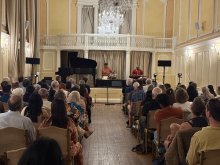
Raag Bageshri - Alap - Live from Kala Festival 2025
デバシス・チャクロボルティ
Raag Bageshri - Drut Gat - Teental (with Akram Khan) - Live from Kala Festival 2025
デバシス・チャクロボルティ
Raag Bageshri - Madhyalaya Gat - Teental (with Akram Khan) - Live from Kala Festival 2025
デバシス・チャクロボルティ
Raag Bageshri - Vilambit Gat - Teental (with Akram Khan) - Live from Kala Festival 2025
デバシス・チャクロボルティ
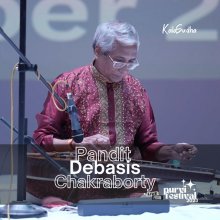
ラーグ・バゲシュワリ – ジャーラー
デバシス・チャクロボルティ
ラーグ・バゲーシュワリー – マディヤ・ラヤ
デバシス・チャクロボルティ
Master Performers
Artists renowned for their renditions of バゲーシュリー

デバシス・チャクロボルティ
Indian Slide Guitar

サンディパン・ムカルジー
Tabla
Classifiers
Swara geometries, relationships, and classifications
Swara Geometries
サイト構築
Around the World
Global connections and equivalent scales
Bageshri aligns with the "minor-major" hybrids of the West, perfect for late-night jazz.
Dorian Mode
C−D−Eb−F−G−A−Bb−C
A "minor" mode with a "major" 6th; evokes soulful, non-melancholic depth.
よくあるご質問
Where can I hear Raag Bageshri played live in concert?
You can hear Raag Bageshri live at KalaSudha's concerts in the UK, Europe and India, and Pandit Debasis Chakroborty has played it at Kala Festival, a touring festival. He has also played it on Indian slide guitar at Purvi Festival in Motihari, Bihar. The AUTRIM project of the National Centre for the Performing Arts and the University of Amsterdam places Bageshri in the late night. Coming concerts are on the events page.
Which recordings of Raag Bageshri should I listen to first?
KalaSudha's recordings of Raag Bageshri include a solo alap recorded live at Kala Festival, where Pandit Debasis Chakroborty sets out the raga on Indian slide guitar with no tabla and no fixed beat. On the album Norwich Ragas, gats in Tintal with the tabla player Ustad Akram Khan follow it, each faster than the last. Pandit Debasis Chakroborty's Purvi Festival performance, with the tabla player Sandipan Mukherjee, is also out as a video release.
What is the difference between Raag Bageshri and Raag Rageshri?
Raag Bageshri uses komal Ga, the lowered form, and keeps Pa, while Raag Rageshri takes shuddha Ga, the natural form, and leaves Pa out. The AUTRIM project gives Bageshri seven notes, with komal Ga and komal Ni, and writes that Pa is left out going up and used sparingly. It finds their upper halves alike apart from Pa. Turns such as Ma, Dha, komal Ni, Dha, Ma belong to both, but Bageshri's oscillated komal Ni makes it very distinct.
What is the Carnatic equivalent of Raag Bageshri?
Carnatic music has its own Raag Bageshri, which George Howlett describes as imported from Hindustani music and retaining many of its original features; he gives the era as unclear. He lists it under Kharaharapriya, the 22nd melakarta, or parent scale. Among other Carnatic ragas, Howlett pairs Bageshri with Sriranjani, which he sums up as Bageshri with no Pa.
Which bandishes are sung in Raag Bageshri?
Bandishes, or set compositions, in Raag Bageshri include Gunde Lavo Ri Malaniya, a chhota khayal sung by Padma Talwalkar for the AUTRIM project of the National Centre for the Performing Arts. A chhota khayal is a shorter khayal composition, and this one is set in Tintal at a fast tempo. In its words a woman asks the flower girl for garlands as she prepares to welcome her loved one. She wonders how the night will pass without him.
How can I learn a raga online?
You can learn a raga online with the KalaSudha Academy, in live one-to-one lessons with a teacher or in a structured course, from foundation to advanced. Learners book lessons in their own time zone, and teachers teach live in their own language. Instructors and touring artists also lead in-person workshops and summer camps where enough learners register interest.
Is Raag Bageshri a good raga for a beginner to learn?
Raag Bageshri is a Class XII raga in the Hindustani vocal course that India's Central Board of Secondary Education (CBSE) sets for schools, the last class the course covers. Before it, students learn ragas such as Yaman and Kafi in Class IX, Bhupali in Class X and Bhairavi in Class XI. In Class XII, students sing Bageshri as a drut, or fast, khayal beside Bhairav and Malkauns.
Which film songs are based on Raag Bageshri?
Hindi film songs that David Courtney lists in Raag Bageshri include Aja Re, Paradesi, from Madhumati, and Bedardi Dagabaz Ja Tu Nahin Balma Mora, from Bluff Master. Courtney calls the Bluff Master song a "pretty good example" of the raga, and Bolo Na, from Chittagong, "quite a good approach to Bageshri".
Have more questions? Contact our support team and we'll be happy to help!