

Jog
जोग
S G m P n S' | S' n P m g S
Origens e contexto
Raag Jog mostra a complexidade emocional encontrada na música clássica hindustani. Em vez de se encaixar em apenas um humor, este raga é difícil de categorizar. É parte do Kafi Thaat, e o que o torna único é o uso de ambos Gandharas: Shuddha Ga (G) e Komal g (g). Esta mistura cria um tipo especial de tensão, capturando o equilíbrio sutil entre alegria e tristeza, e entre estabilidade e inquietação. Enquanto muitos ragas usam notas duplas apenas como tons de passagem, Jog as torna centrais ao seu som. Shuddha Ga geralmente aparece nas notas ascendentes, dando uma sensação de brilho e resolução. Komal Ga é mais comum nas notas descendentes, adicionando uma profundidade blues-like e cheia de alma à melodia. Jog é geralmente tocado nas primeiras horas da noite (2º Prahar), quando suas frases repetitivas e hipnóticas podem colocar os ouvintes em um estado de transe.
Para entender plenamente Jog, ajuda olhar para outros ragas na família Kafi:
Mostrar maisMostrar menos
- Jog e Tilang ambos usam uma escala pentatônica (SGMPnS′) e compartilham a dualidade Ni-Ni. No entanto, Jog inclui o Komal Ga (g), enquanto Tilang não. Esta nota muda o humor do sentimento leve e brincalhão de Tilang para a qualidade blues mais profunda e contemplativa de Jog.
- Jog e Bageshri são ambos parte do Kafi Thaat, e ambos expressam um sentido de saudade. A melodia de Bageshri foca no Madhyama (M), enquanto Jog centra-se na tensão entre os dois Gandharas. Bageshri parece um sentido silencioso de separação, mas Jog parece mais uma reflexão sobre os altos e baixos da vida.
A Conexão "Blues": Estudiosos de música frequentemente dizem que Jog é o raga indiano mais semelhante à Escala de Blues Ocidental. A "Blue Note" no blues combina com o pequeno intervalo entre o Shuddha e Komal Gandhar em Jog. Isso torna Jog uma ponte para músicos em todos os lugares que querem encontrar terreno comum na música.
Detalhes técnicos
Estrutura melódica e padrões de movimento
Aroha (subida)
S G m P n S'
Avroh (descida)
S' n P m g S
Pakad (frase característica)
n(o) S G m, g S, G m P m g S
Chalan (Movement)
S, Gm, gS, .nSGm, mP, mgS, GmPnS′, nPmgS
Tanpura Tuning
m—S—S—Sa
Additional Notes
Phraseologies
O movimento de Jog é "curvilíneo" ao redor do Gandhara. Ele usa um "solavanco" ou Khatka específico ao se mover entre os dois Gas.
- O Deslize da Terça Dupla: S−G−m−g−S
- O Alcance da Meia-Noite: n(o)−S−G−m−P−n−S′
- A Resolução da Descida: S′−n−P−m−g−S
- Chalan: S, Gm, gS, .nSGm, mP, mgS, GmPnS′, nPmgS
Common Phrases
- S−G−m−g−S
Gravações e apresentações
Ouça grandes músicos interpretarem este raga

Tracks
Albums

Master Performers
Artists renowned for their renditions of Jog

Debasis Chakroborty
Indian Slide Guitar

Deepak Shah
Piano

Dr Lovely Sharma

Durjay Bhaumik
Tabla
Classifiers
Swara geometries, relationships, and classifications
Swara Geometries
Estrutura
Around the World
Global connections and equivalent scales
The Blues Scale
C−Eb−E−F−G−Bb
The Eb to E transition mirrors Jog’s g to G friction.
Perguntas frequentes
Where can I hear Raag Jog played live in concert?
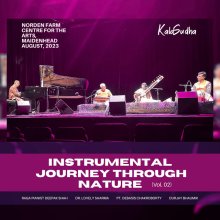
You can hear Raag Jog at KalaSudha's concerts in the UK, Europe and India. Pandit Debasis Chakroborty, Dr Lovely Sharma, the raga pianist Deepak Shah and the tabla player Durjay Bhaumik played it at Kala Festival, a touring festival. Their concert was at Norden Farm Centre for the Arts in Maidenhead. Coming concerts are on the events page.
Which recordings of Raag Jog should I listen to first?
KalaSudha's recordings of Raag Jog include Raag Jog, Pt. 1, the first of two parts recorded live at Kala Festival. Pandit Debasis Chakroborty plays Indian slide guitar with the sitar player Dr Lovely Sharma, the raga pianist Deepak Shah and the tabla player Durjay Bhaumik. The same performance is also out as a video release.
What is the difference between Raag Jog and Raag Jogkauns?
Raag Jogkauns adds komal Dha and shuddha Ni to the notes of Raag Jog, which leaves out Re and Dha. The AUTRIM project of the National Centre for the Performing Arts and the University of Amsterdam calls Jogkauns a modern raga that combines Jog and Malkauns. It attributes the raga to Jagannathbua Purohit, known as Gunidas, of the Agra gharana. AUTRIM finds a slight element of Jog in Jogkauns but calls it more complex.
Is Raag Jog a good raga for a beginner to learn?
Raag Jog is one of the more straightforward ragas to learn, in George Howlett's view. He writes that its character rests more on its scale than on set phrases. Its unusual feature is its pair of Ga: shuddha, or natural, going up and komal, or lowered, coming down. The AUTRIM project of the National Centre for the Performing Arts and the University of Amsterdam notes that some musicians sing both forms of Ga one after the other in the descent.
Which film songs are based on Raag Jog?
Hindi film songs that David Courtney lists in Raag Jog include Poore Se Zara Sa Kam Hai, from Mausam, which he calls "a fairly good example of Jog". He calls Naina Dwara Se, from Sawan, only "Jog-ish". George Howlett notes that Jog is popular in light-classical forms such as bhajan, thumri and ghazal.
Which bandishes are sung in Raag Jog?
The AUTRIM project of the National Centre for the Performing Arts and the University of Amsterdam presents a chhota khayal, a short khayal, in Raag Jog. Ashwini Bhide sings it in medium Ektal. It opens Ja Re Ja Ja Kagava, and in it a woman asks a bird to carry a message to her beloved.
How can I learn a raga online?
You can learn a raga online with the KalaSudha Academy, in live one-to-one lessons with a teacher or in a structured course, from foundation to advanced. Learners book lessons in their own time zone, and teachers teach live in their own language. Instructors and touring artists also lead in-person workshops and summer camps where enough learners register interest.
Have more questions? Contact our support team and we'll be happy to help!