

Kirwani
किरवानी
S R g m P d N S' | S' N d P m g R S
Origens e contexto
Raag Kirwani mostra como a música indiana pode fluir entre tradições. Começou como uma escala parental importante na música carnática do sul da Índia. Mais tarde, músicos no norte da Índia também começaram a usá-la, adicionando novas nuances e profundidade ao raga. Kirwani é geralmente tocado tarde da noite, por volta da meia-noite, porque seu som faz as pessoas pensarem silenciosamente e sentirem uma tristeza gentil. Este raga é um lembrete para nós de que a música pode cruzar fronteiras e tocar corações em todos os lugares. Como diz um ditado bem conhecido, "Onde as palavras falham, a música fala."
Kirwani é notável por sua simetria, já que ambas as metades da escala espelham uma à outra com precisão matemática. Este equilíbrio lhe dá um caráter ocidental e o torna popular em colaborações interculturais. Na KalaSudha, consideramos Kirwani como um raga de emoção pura, confiando na qualidade expressiva de seus intervalos menores em vez de movimentos complexos.
Detalhes técnicos
Estrutura melódica e padrões de movimento
Aroha (subida)
S R g m P d N S'
Avroh (descida)
S' N d P m g R S
Pakad (frase característica)
g m P, d P, m g R S, .N R S
Tanpura Tuning
P—S—S—Sa
Additional Notes
Phraseologies
O movimento é fluido e lírico, movendo-se suavemente através de oitavas sem voltas tortuosas.
- O Gancho Melancólico: g m P, d P, m g R S
- O Alcance Ascendente: m P d N S'
- A Resolução Assinatura: .N R S (A nota principal N resolvendo para S).
- Chalan: S R g m P, d P, m P d N S', S' N d P m g R S, .N R S
Gravações e apresentações
Ouça grandes músicos interpretarem este raga
Vídeos


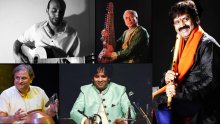
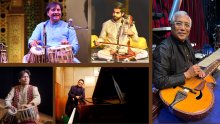
Master Performers
Artists renowned for their renditions of Kirwani

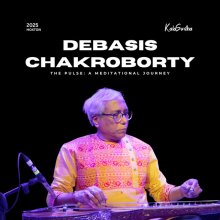
Debasis Chakroborty
Indian Slide Guitar

Deepak Shah
Piano

Giuliano Modarelli
Guitar

Hanif Khan
Tabla

Shahbaz Hussain
Tabla
Classifiers
Swara geometries, relationships, and classifications
Swara Geometries
Estrutura
Around the World
Global connections and equivalent scales
Kirwani é indiscutivelmente o raga indiano mais reconhecível para ouvidos ocidentais.
Harmonic Minor
C−D−Eb−F−G−Ab−B
The quintessential scale for drama and tension in Western classical music.
Perguntas frequentes
Where can I hear Raag Kirwani played live in concert?
You can hear Raag Kirwani at KalaSudha's concerts in the UK, Europe and India. The raga pianist Deepak Shah played it at Kala Festival, a touring festival, at The Great Hall of the University of Reading, with the tabla player Hanif Khan. Pandit Debasis Chakroborty and the guitarist Giuliano Modarelli played it at the Assembly Rooms in Edinburgh, with Ustad Shahbaz Hussain on tabla. Coming concerts are on the events page.
Which recordings of Raag Kirwani should I listen to first?
KalaSudha's recordings of Raag Kirwani include Meditative Vibe, on which Pandit Debasis Chakroborty plays the raga on solo Indian slide guitar. Video releases show the raga pianist Deepak Shah's Kirwani at Kala Festival in Reading and Pandit Debasis Chakroborty's duet with the guitarist Giuliano Modarelli in Edinburgh.
What is the difference between Raag Kirwani and Raag Charukesi?
Raag Kirwani and Raag Charukesi both use all seven notes with komal, or lowered, Dha, but they swap two notes. Kirwani takes komal Ga with shuddha, or natural, Ni, while Charukesi takes shuddha Ga with komal Ni. Both came from Carnatic music: George Howlett traces Kirwani to Keeravani, the 21st melakarta, or parent scale, and Charukesi to the 26th.
What is the Carnatic equivalent of Raag Kirwani?
Raag Kirwani comes from the Carnatic raga Kiravani, also written Keeravani, the 21st melakarta, or parent scale, with the same seven notes. George Howlett writes that Kirwani was popularised in Hindustani music chiefly through Pandit Ravi Shankar's borrowings from the South. With Sa on C, the scale is the Western harmonic minor, which Howlett notes as congruent with Kirwani.
Which film songs are based on Raag Kirwani?
Hindi film songs that David Courtney lists in Raag Kirwani include Ankhon Se Jo Utari, from Phir Wohi Dil Laaya Hoon, which he calls "a surprisingly good example". His list also includes Anewala Pal, Janewala Hai, from Golmaal, and Ek Radha Ek Meera, from Ram Teri Ganga Maili.
How can I learn a raga online?
You can learn a raga online with the KalaSudha Academy, in live one-to-one lessons with a teacher or in a structured course, from foundation to advanced. Learners book lessons in their own time zone, and teachers teach live in their own language. Instructors and touring artists also lead in-person workshops and summer camps where enough learners register interest.
Have more questions? Contact our support team and we'll be happy to help!