

Megh
मेघ
S R m P n S' | S' n P m R S
Origens e contexto
Raag Megh é uma invocação sonora da monção. Como um dos ragas centrais do Kafi Thaat, pertence à prestigiosa família "Malhar". No entanto, enquanto outros Malhars, como Mian Ki Malhar, são intrincados e cortesãos, Megh é cru, poderoso e majestoso.
É tradicionalmente executado durante a estação chuvosa a qualquer hora do dia, embora carregue uma gravidade especial quando cantado tarde da noite enquanto as nuvens se reúnem. O raga é uma obra-prima pentatônica, utilizando apenas cinco notas para criar uma atmosfera de imensidão vasta. Ao omitir o Gandhar (G) e Dhaivat (D), Megh cria uma geometria "oca" e ressonante que imita o estrondo profundo do trovão.
Mostrar maisMostrar menos
A alma de Megh reside em seu Rishabh oscilante pesado (R) e seu poderoso Pancham (P). Quando um vocalista desliza do Madhyama ao Rishabh com um Andolan pesado (oscilação), diz-se que se assemelha ao raio que precede a chuva. Na KalaSudha, vemos Megh como o estudo final em "Poder através da Simplicidade". É um raga que exige controle de respiração e uma voz profunda e ressonante para fazer justiça ao seu caráter pesado e encharcado de chuva.
Detalhes técnicos
Estrutura melódica e padrões de movimento
Aroha (subida)
S R m P n S'
Avroh (descida)
S' n P m R S
Pakad (frase característica)
S R n(o) P, m R, n(o) S
Chalan (Movement)
S, R n(o) P, n(o) S, S R m, m R, R m P, n P, m R, S R n(o) P, S
Tanpura Tuning
P — S — S — Sa
Additional Notes
Phraseologies
O movimento é grave e lento, usando saltos largos e deslizamentos profundos e ressonantes.
- O Salto Trovejante: S R m P
- O Andolan Assinatura: m R (oscilação pesada em R)
- A Descida Chuvosa: n P, m R, S
- Exemplo de Frase: R n(o) P, m R, S
Gravações e apresentações
Ouça grandes músicos interpretarem este raga

Tracks

Master Performers
Artists renowned for their renditions of Megh

Debasis Chakroborty
Indian Slide Guitar

Deepak Shah
Piano

Dr Lovely Sharma

Durjay Bhaumik
Tabla
Classifiers
Swara geometries, relationships, and classifications
Swara Geometries
Estrutura
Around the World
Global connections and equivalent scales
Raag Megh é o equivalente clássico indiano à "Escala de Poder" Pentatônica Menor encontrada em culturas guerreiras antigas e no Blues inicial. Sua evitação do 3º e 6º cria uma paisagem sonora dominada por "Quarta/Quinta Perfeita" que é universalmente reconhecida como majestosa e inflexível. Na musicologia ocidental, esta é a "Escala de Intervalos Abertos", usada para denotar vastas paisagens e o poder bruto dos elementos.
Suspended Pentatonic
C - D - F - G - Bb
An "open" scale that avoids the emotional bias of major or minor thirds.
Minor Pentatonic (Skeleton)
1 - b3 - 4 - 5 - b7
Megh uses the Natural 2nd instead of b3, giving it a more heroic, less "blue" feel.
Perguntas frequentes
Where can I hear Raag Megh played live in concert?
You can hear Raag Megh live at KalaSudha's concerts in the UK, Europe and India, and the ensemble of Pandit Debasis Chakroborty has played it at Kala Festival, a touring festival. Megh is a raga of the rainy season. The AUTRIM project of the National Centre for the Performing Arts and the University of Amsterdam gives its time as any time during the rains. Coming concerts are on the events page.
Which recordings of Raag Megh should I listen to first?
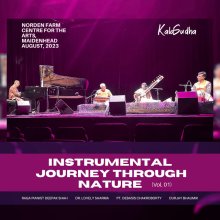
KalaSudha's recordings of Raag Megh include Raag Megh, Pt. 1, which opens a performance recorded live at Kala Festival. Pandit Debasis Chakroborty plays Indian slide guitar with the sitar player Dr Lovely Sharma, the raga pianist Deepak Shah and the tabla player Durjay Bhaumik. Parts 2 and 3 complete the raga, and all three parts are on the album Instrumental Journey Through Nature, Vol. 1; the concert is also out as a video release.
What is the difference between Raag Megh and Raag Miyan Ki Malhar?
In its common form, Raag Megh uses five notes, Sa, Re, Ma, Pa and komal, or lowered, Ni, and leaves out Ga and Dha. Raag Miyan Ki Malhar adds komal Ga, Dha and shuddha, or natural, Ni. The AUTRIM project writes that its komal Ga comes only in descent and its two forms of Ni follow one another. Both belong to the Malhar family and share its rising glide, Re up to Pa.
What is the Carnatic equivalent of Raag Megh?
The Carnatic raga with the same notes as Raag Megh is Madhyamavati, and George Howlett pairs the two as approximate counterparts. Madhyamavati uses Sa, Re, Ma, Pa and komal, or lowered, Ni, in both ascent and descent. Howlett lists it under Kharaharapriya, the 22nd melakarta, or parent scale, of Carnatic music, and also pairs it with Raag Madhumad Sarang, which shares Megh's notes.
Which bandishes are sung in Raag Megh?
Bandishes, or set compositions, in Raag Megh include Ghanana Ghanana, in the 16-beat Tintal, sung by Vijay Rajput in David Clarke's book Rāgs Around the Clock. Its second part, the antara, carries the pen name Sadarang, which Clarke says may or may not be authentic. The AUTRIM project of the National Centre for the Performing Arts presents a chhota khayal, a shorter khayal composition, in Ektal. It opens Garaj Ghata Ghan Kare and is sung by Veena Sahasrabuddhe.
How can I learn a raga online?
You can learn a raga online with the KalaSudha Academy, in live one-to-one lessons with a teacher or in a structured course, from foundation to advanced. Learners book lessons in their own time zone, and teachers teach live in their own language. Instructors and touring artists also lead in-person workshops and summer camps where enough learners register interest.
Does Raag Megh bring rain?
The idea that Raag Megh brings rain comes from legend. Nikhil Inamdar, in Live History India, retells how Tansen taught his daughter to sing Megh Malhar to bring down rain and douse the fire of Raga Deepak. He calls it an allegory that has come to be read literally. George Howlett's version has two sisters, Tana and Riri, sing Megh. Howlett also writes that Tansen is said to have sung Miyan Ki Malhar to summon the monsoon.
Which film songs are based on Raag Megh?
Hindi film songs that David Courtney lists in Raag Megh include Kahan Se Aye Badra, from Chashme Buddoor. Courtney keeps a separate list for Megh Malhar, which includes Baraso Re, from Tansen, and Dukha Bhare Din Bite Re Bhaiya, from Mother India. David Clarke writes that Megh is often known as Megh Malhar, while the khayal singer Vijay Rajput keeps that name for a form with a subtle komal, or lowered, Ga.
Have more questions? Contact our support team and we'll be happy to help!