

Багешри
बागेश्री
.n S g M D n S' | S' n D M P D m G R S
Истоки и контекст
В глубокой тишине второго прахара ночи, когда мир замирает, Рааг Багешри возникает как разговор между душой и её возлюбленным. Это рага "Вираха" (тоски) и "Шрингар" (романтики), традиционно описываемая как женщина, ожидающая возвращения своего возлюбленного.
Композиция Тхаата Кафи, Багешри - это эмоциональный шедевр, чья сила заключается в её "Вакра" (кривой) геометрии. Она не движется по прямым линиям; вместо этого она блуждает по нижним и средним октавам, кружась вокруг Мадхьямы (M) с нежной, почти болезненной деликатностью. Её красота заключается не в большой скорости, а в её способности "задерживаться". Это мелодия теней и мягкого лунного света, где каждая нота обрабатывается с нежной, почти болезненной деликатностью.
Показать большеСвернуть
Как и Рааг Бангала, Багешри придает огромное значение Мадхьяме (Ma). Однако там, где Бангала использует Ma для создания "воздушной" утренней молитвы, Багешри использует её для вызова глубокой эмоциональной глубины. То, как певец приближается к Ma от Komal Ni, создает характерный "крючок", который определял романтический звуковой ландшафт индийской музыки на протяжении веков.
В KalaSudha мы рассматриваем Багешри как окончательную "Ночную поэму". Это рага, требующая высокой степени зрелости от исполнителя. Дело не в нотах, которые вы играете, а в тишине, которую вы оставляете между ними. Это звук сердца, которое полно, но ожидает.
Технические подробности
Мелодическая структура и движение
Ароха (подъём)
.n S g M D n S.
Аврох (спуск)
S. n d , M P D , M g R S
Пакад (характерная фраза)
S .n .D S , M g , M D n D , M g , M g R S
Chalan (Movement)
.n .D S M
Tanpura Tuning
M — S — S — Sa
Additional Notes
Phraseologies
Багешри определяется "Вакра" (Кривой) грамматикой, избегающей линейных путей. Движение представляет собой диагональное достижение из нижнего регистра к Мадхьяме (M). Она опускает R и P в восхождении, чтобы создать напряжение, разрешая их через тяжелые, душевные скольжения (Мээнды) в нисхождении. Мелодия "подвешена", никогда не оседая слишком быстро на тонике.
Common Phrases
- .n .D S m
Записи и выступления
Послушайте эту рагу в исполнении мастеров

Tracks
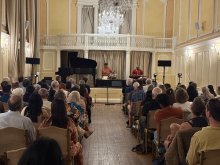
Raag Bageshri - Alap - Live from Kala Festival 2025
Дебасис Чакроборти
Raag Bageshri - Drut Gat - Teental (with Akram Khan) - Live from Kala Festival 2025
Дебасис Чакроборти
Raag Bageshri - Madhyalaya Gat - Teental (with Akram Khan) - Live from Kala Festival 2025
Дебасис Чакроборти
Raag Bageshri - Vilambit Gat - Teental (with Akram Khan) - Live from Kala Festival 2025
Дебасис Чакроборти
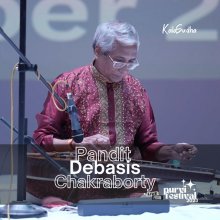
Раага Багешвари – Джхала
Дебасис Чакроборти
Раг Багешвари – Мадхья Лая
Дебасис Чакроборти
Master Performers
Artists renowned for their renditions of Багешри

Дебасис Чакроборти
Indian Slide Guitar

Сандипан Мукхерджи
Tabla
Classifiers
Swara geometries, relationships, and classifications
Swara Geometries
Структура
Around the World
Global connections and equivalent scales
Багешри соответствует "минорно-мажорным" гибридам Запада, идеальным для позднего ночного джаза.
Dorian Mode
C−D−Eb−F−G−A−Bb−C
A "minor" mode with a "major" 6th; evokes soulful, non-melancholic depth.
Часто задаваемые вопросы
Where can I hear Raag Bageshri played live in concert?
You can hear Raag Bageshri live at KalaSudha's concerts in the UK, Europe and India, and Pandit Debasis Chakroborty has played it at Kala Festival, a touring festival. He has also played it on Indian slide guitar at Purvi Festival in Motihari, Bihar. The AUTRIM project of the National Centre for the Performing Arts and the University of Amsterdam places Bageshri in the late night. Coming concerts are on the events page.
Which recordings of Raag Bageshri should I listen to first?
KalaSudha's recordings of Raag Bageshri include a solo alap recorded live at Kala Festival, where Pandit Debasis Chakroborty sets out the raga on Indian slide guitar with no tabla and no fixed beat. On the album Norwich Ragas, gats in Tintal with the tabla player Ustad Akram Khan follow it, each faster than the last. Pandit Debasis Chakroborty's Purvi Festival performance, with the tabla player Sandipan Mukherjee, is also out as a video release.
What is the difference between Raag Bageshri and Raag Rageshri?
Raag Bageshri uses komal Ga, the lowered form, and keeps Pa, while Raag Rageshri takes shuddha Ga, the natural form, and leaves Pa out. The AUTRIM project gives Bageshri seven notes, with komal Ga and komal Ni, and writes that Pa is left out going up and used sparingly. It finds their upper halves alike apart from Pa. Turns such as Ma, Dha, komal Ni, Dha, Ma belong to both, but Bageshri's oscillated komal Ni makes it very distinct.
What is the Carnatic equivalent of Raag Bageshri?
Carnatic music has its own Raag Bageshri, which George Howlett describes as imported from Hindustani music and retaining many of its original features; he gives the era as unclear. He lists it under Kharaharapriya, the 22nd melakarta, or parent scale. Among other Carnatic ragas, Howlett pairs Bageshri with Sriranjani, which he sums up as Bageshri with no Pa.
Which bandishes are sung in Raag Bageshri?
Bandishes, or set compositions, in Raag Bageshri include Gunde Lavo Ri Malaniya, a chhota khayal sung by Padma Talwalkar for the AUTRIM project of the National Centre for the Performing Arts. A chhota khayal is a shorter khayal composition, and this one is set in Tintal at a fast tempo. In its words a woman asks the flower girl for garlands as she prepares to welcome her loved one. She wonders how the night will pass without him.
How can I learn a raga online?
You can learn a raga online with the KalaSudha Academy, in live one-to-one lessons with a teacher or in a structured course, from foundation to advanced. Learners book lessons in their own time zone, and teachers teach live in their own language. Instructors and touring artists also lead in-person workshops and summer camps where enough learners register interest.
Is Raag Bageshri a good raga for a beginner to learn?
Raag Bageshri is a Class XII raga in the Hindustani vocal course that India's Central Board of Secondary Education (CBSE) sets for schools, the last class the course covers. Before it, students learn ragas such as Yaman and Kafi in Class IX, Bhupali in Class X and Bhairavi in Class XI. In Class XII, students sing Bageshri as a drut, or fast, khayal beside Bhairav and Malkauns.
Which film songs are based on Raag Bageshri?
Hindi film songs that David Courtney lists in Raag Bageshri include Aja Re, Paradesi, from Madhumati, and Bedardi Dagabaz Ja Tu Nahin Balma Mora, from Bluff Master. Courtney calls the Bluff Master song a "pretty good example" of the raga, and Bolo Na, from Chittagong, "quite a good approach to Bageshri".
Have more questions? Contact our support team and we'll be happy to help!