

Hindustani VocalPrepared by KalaSudha
Advanced Hindustani Vocal
Advanced Hindustani vocal, prepared by KalaSudha: the bada khayal, taans and tihais, gharana study, composition, supervised teaching and a judged concert.
- موڈیولز
- 3A–3C
- Lessons
- One-to-one or in a group
- Ends in
- A KalaSudha certificate

جائزہ
About Advanced
Advanced Hindustani vocal prepares you for a judged 30-minute concert, with composition and supervised teaching alongside. You enter after Intermediate or a placement session that confirms the same skills. It is the third level of the Hindustani Vocal course prepared by KalaSudha. As a typical guide, Advanced takes 12–30 months, and you agree the pace with your teacher.
Module 3A builds the bada khayal, the slow khayal in a vilambit cycle such as the suggested vilambit Ektal. You sing a brief aochar, land the mukhda on sam and develop the raga step by step inside the cycle, then move into the chhota khayal. A fifth raga comes with its allied raga for comparison. The module ends with a 15-minute bada and chhota khayal.
Read the full overviewکم دکھائیں
Module 3B covers taan and layakari: akar, sapat, gamak and bol taans, tihais from three starting beats and layakari against the cycle. You transcribe a recorded taan passage, analyse gharana evidence and choose four of six gharana studies, such as Jaipur-Atrauli or Rampur-Sahaswan.
Module 3C prepares the concert: work with concert accompanists, a sound check, pitch recovery, programme notes with sources, a bandish of your own and one Foundation topic taught under supervision. In a cohort, you rehearse the concert in front of fellow learners before the judged performance. A judging assessor other than your teacher reviews the concert, and the level leads to a KalaSudha award (see certificates). Ask about Advanced in the Academy.
موڈیولز
The three Advanced modules
-
3A
Module 3A: The bada khayal
8 core + 4 teacher-setfrom 14 topics
Review endurance and plan preparation. Keep the suggested vilambit Ektal, sing the aochar and mukhda, and develop the raga slowly inside the cycle. Move from bada to chhota khayal, compare a fifth raga with its allied raga and present a 15-minute khayal.-
Review endurance and preparationکور
Review your Intermediate recordings and plan practice for a fifteen-minute vilambit presentation.
-
Vilambit Ektal and the slow cycleکور
Keep the suggested vilambit Ektal by hand and hear its theka at slow tempo.
-
Aochar and the mukhdaکور
Sing a brief unmetred aochar, then the mukhda of the bada khayal into sam.
-
Slow development in the cycleکور
Develop the raga step by step inside the vilambit cycle, in akar and bol-alap.
-
From bada to chhota khayalکور
Move from the bada khayal to a drut bandish in the same raga and a different tala.
-
A fifth raga and its allied ragaکور
Render a teacher-selected raga and tell it apart from an allied raga by its phrases.
-
Guided rehearsal: the bada khayalکور
Rehearse your fifteen-minute bada and chhota khayal and correct one fault using teacher feedback.
-
Review and presentation: the bada khayalکور
Present your fifteen-minute bada and chhota khayal and discuss your preparation and corrections with the assessor.
-
Tilwada or Jhumraاختیاری
Sing the bada khayal mukhda in the suggested Tilwada or Jhumra in place of Ektal.
-
Pacing at a very slow tempoاختیاری
Pace a development at a very slow tempo without losing the cycle.
-
A second bada khayalاختیاری
Learn a vilambit bandish in a second raga with its sthayi and antara.
-
Bol-alap on the antaraاختیاری
Develop the antara's words in the upper register in bol-alap.
-
Sing with a melodic accompanistاختیاری
Sing with a harmonium or sarangi accompanist and leave space for their responses.
-
Transcribe a recorded bada khayalاختیاری
Transcribe the mukhda and one development cycle from an attributed recording.
Your teacher fills 4 slots from the electives, their own topics or both.
-
-
3B
Module 3B: Taan, layakari and gharana study
8 core + 4 teacher-setfrom 14 topics
Keep clarity at speed and sing the four taan types. Sing tihais from different beats and layakari against the cycle. Transcribe a recorded taan passage, analyse gharana evidence and choose four of six gharana studies.-
Review clarity at speedکور
Record your fastest clean taan and set a tempo ladder for the module.
-
Taan typesکور
Sing akar, sapat, gamak and bol taans in the raga, each one clearly distinct.
-
Tihais from different beatsکور
Construct and sing tihais that start from different beats and land on sam.
-
Layakari against the cycleکور
Sing a phrase in dugun and tigun against a steady vilambit or madhya cycle.
-
Transcribe a recorded taan passageکور
Transcribe a taan passage from an attributed recording and identify its type.
-
Analyse gharana evidenceکور
Compare attributed recordings from at least three gharanas in alap, taan and use of the words, citing sources.
-
Guided rehearsal: taan, layakari and gharana studyکور
Rehearse your taan and layakari presentation and correct one fault using teacher feedback.
-
Review and presentation: taan, layakari and gharana studyکور
Present your taan and layakari presentation and discuss your preparation and corrections with the assessor.
-
Gwalior: bol-bant and sapat taansاختیاری
Practise bol-bant that keeps the words in order, and sapat taans, through a Gwalior teacher-approved example.
-
Agra: nom-tom opening and layakariاختیاری
Practise a nom-tom opening and layakari with the text through an Agra teacher-approved example.
-
Kirana: note-by-note vilambitاختیاری
Practise slow swara-by-swara development and sargam taans through a Kirana teacher-approved example.
-
Jaipur-Atrauli: oblique phrasing in a compound ragaاختیاری
Practise oblique phrasing and gamak taans in a compound raga through a Jaipur-Atrauli teacher-approved example.
-
Patiala: fast taans and layakariاختیاری
Practise fast, rhythmic taans and layakari through a Patiala teacher-approved example.
-
Rampur-Sahaswan: medium-slow tempo and bol taansاختیاری
Practise medium-slow development with bol taans and sargam taans through a Rampur-Sahaswan teacher-approved example.
Your teacher fills 4 slots from the electives, their own topics or both.
-
-
3C
Module 3C: Concert, composition and teaching
8 core + 4 teacher-setfrom 14 topics
Plan concert preparation and work with concert accompanists. Run a sound check, recover pitch and write programme notes with sources. Compose a bandish, teach a Foundation topic under supervision, then sing a judged 30-minute concert.-
Plan concert preparationکور
Review the programme, voice care and practice log, then schedule rehearsal and rest before assessment.
-
Work with concert accompanistsکور
Agree tempo, raga, pitch and cues with tabla and harmonium accompanists before the concert.
-
Sound check and pitch recoveryکور
Set microphone balance with the drone and recover pitch after a deliberate disturbance.
-
Programme notes and sourcesکور
Prepare a programme with timings, notation and attribution for inherited and adapted bandishes.
-
Compose a bandishکور
Compose a short drut bandish with sthayi and antara in a taught raga and notate it.
-
Teach a Foundation topic under supervisionکور
Plan and teach one Foundation topic, diagnose a learner's error and check their improvement.
-
Guided rehearsal: concert, composition and teachingکور
Rehearse your thirty-minute judged concert and correct one fault using teacher feedback.
-
Review and presentation: concert, composition and teachingکور
Present your thirty-minute judged concert and discuss your preparation and corrections with the assessor.
-
Close with a thumriاختیاری
Prepare a thumri with bol banao to close the concert programme.
-
Close with a bhajanاختیاری
Prepare a raga-based bhajan to close the concert programme.
-
A dhrupad or dhamar itemاختیاری
Prepare a short dhrupad or dhamar with alap and bol-bant for the programme.
-
A tarana in the programmeاختیاری
Prepare a drut tarana to follow the chhota khayal.
-
Compose a sargam piece or taranaاختیاری
Compose a short sargam passage or tarana in a taught raga and notate it.
-
Teach a group warm-upاختیاری
Lead a short group warm-up and alankar session for Foundation learners under supervision.
Your teacher fills 4 slots from the electives, their own topics or both.
-
Why Advanced
What Advanced builds
-
The slow khayal
Keep a vilambit cycle by hand, sing the aochar and develop the raga in order, widening the range and returning to the mukhda on sam. -
Taans you can name
Sing akar, sapat, gamak and bol taans in the raga, and name the type when your teacher sings an example. -
Composer and teacher
Compose a bandish of your own. Then teach a Foundation topic while a supervisor records your correction and the learner's response.
Lessons
Ways to learn
One-to-one
Learn at your own pace. You book online lessons through KalaSudha in your own time zone.
Register interest in 1:1 lessonsIn a group
Learn in a group on a timetable.
Ask about group lessonsTeachers
Teachers for Advanced
-
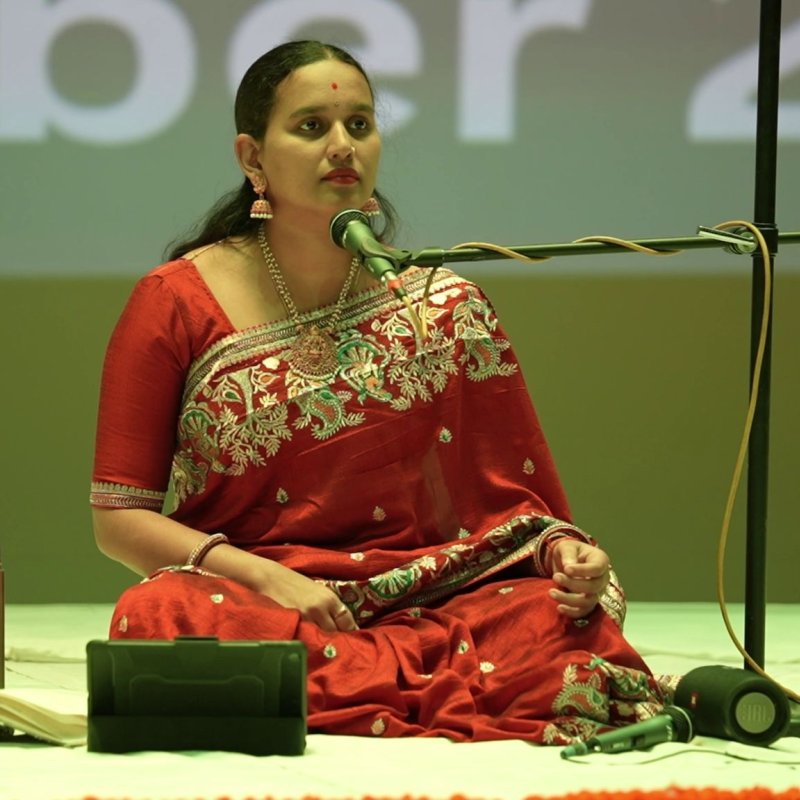
تیجسونی ورنیکر ہندوستانی کلاسیکی موسیقی کی ممتاز گلوکارہ ہیں، بی ایچ یو کی طلائی تمغہ یافتہ اور آل انڈیا ریڈیو کی گریڈ یافتہ فنکار۔ وہ کئی اسٹیجوں پر گا چکی ہیں، ممتاز گروؤں سے تربیت پائی ہے اور راگ کی اپنی گہری سمجھ طرح طرح کے سامعین کے سامنے رکھتی ہیں۔
Teaches
Hindustani Vocal

Questions
Questions about Advanced
Entry, pace, assessment and what you show to finish the level.
The bada khayal, the slow khayal in a vilambit cycle, comes in module 3A of Advanced Hindustani vocal. You keep the suggested vilambit Ektal by hand, sing a brief aochar and land the mukhda on sam three times in a row.
You then develop the raga step by step inside the cycle and move into the chhota khayal. Tilwada or Jhumra is an elective.
Advanced Hindustani vocal teaches four taan types: akar, sapat, gamak and bol taans. You sing two of each in the raga, each one clearly distinct, and name the type in four examples your teacher sings.
Gharana studies in the same module add taan work, such as sapat taans in the Gwalior study or fast taans in the Patiala study.
Yes. Advanced Hindustani vocal includes one Foundation topic that you plan and teach while a supervisor observes. You submit a lesson plan, diagnose a learner's error and show one useful correction.
The supervisor records the correction and the learner's response. An elective adds teaching a group warm-up.
The Advanced level of the Hindustani Vocal course ends with a 30-minute concert to an audience. A judging assessor other than your teacher reviews cycle accuracy, pitch, development, partner response and recovery; a failed criterion needs correction and reassessment.
You also submit an original composition, an observed Foundation lesson and a written theory portfolio with a viva. All 18 Advanced skills must be met.
اگلے مراحل
کیا آپ Advanced شروع کرنے کے لیے تیار ہیں؟
Tell us what you want to learn and where you are today. An academy advisor will help you find a good next step.