BK
Bundu Khan
c. 1880 to 1955
Born in Old Delhi, he was a sarangi accompanist whom The Asian Age reports carried the compositions of Kunwar Shyam.
सारंगी
Connect sustained bowing with pitch movement and the detail of a sung phrase.
The sarangi is a bowed, fretless Hindustani instrument. Learners train bow control, fingernail glides between pitches and phrasing taken from song, to accompany or play solo.
Explore its sound, construction and care in the instrument guide.
The first known description of the sarangi appears in the Ain-i-Akbari, a Mughal court encyclopedia of 1588 to 1589. The scholar Joep Bor argues that the instrument won a place in Hindustani classical music only in the later seventeenth century, and that it took over from an enlarged rabab as the khayal singer’s accompaniment during the eighteenth. The large classical sarangi took shape in the nineteenth century, probably in or near Delhi. Where the instrument first came from remains disputed.
Sarangi players shaped vocal music as teachers. Abdul Karim Khan and Abdul Wahid Khan of the Kirana gharana, a school of singing passed down through teachers and families, began as sarangi players. Solo playing has a long history too, at home and in musicians’ gatherings, and solo recordings survive from the early twentieth century. Bor names Mamman Khan, Bundu Khan, Gopal Mishra and Ram Narayan among the players who won it recognition as a solo instrument. In the twentieth century the harmonium largely replaced the sarangi in vocal accompaniment, though the sarangi still plays in khayal ensembles.
The left hand stops the playing strings with the side of the fingernail, usually just under the cuticle; some players use the skin above it. Talcum powder helps the contact glide. Sliding it along the string produces meend, a continuous glide between notes. Fingering differs between schools, and Bor documents several systems.
The sympathetic strings (tarab) are never bowed; they vibrate in response to the playing strings. Bor describes three sets: a main set tuned chromatically and left unchanged between ragas (achal that), a right-hand set tuned to the raga or chromatically to follow a singer, and an upper set that varies with raga and player. A large sarangi usually has about 35, smaller ones 24 or fewer.
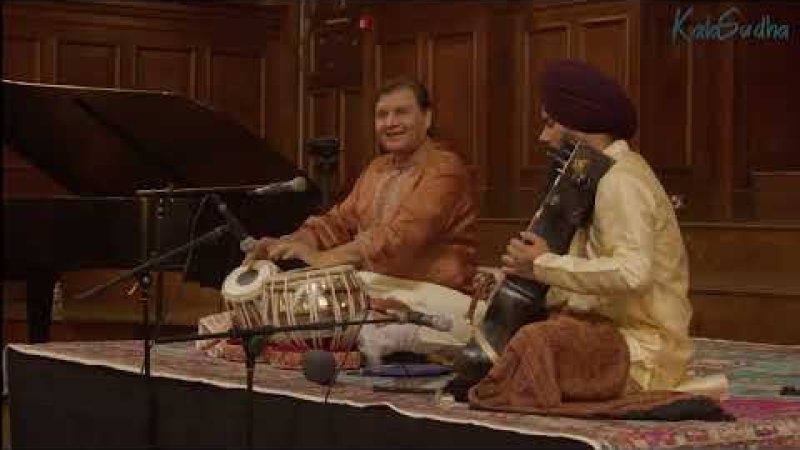
The seated player holds the sarangi upright and draws a heavy bow across the gut strings with an underhand grip, pressing with the first two fingers or the forefinger. Bowing near the bridge brings out the sympathetic response. The great players developed long strokes with inaudible bow changes. Rhythmic passages such as jhala, rapid repeated strokes, use the tip of the bow.
Follow this structured journey to master this discipline
Sit with the sarangi upright in front of you and let your teacher check your underhand bow hold. Draw slow, full-length strokes on one open playing string. At each change of direction, listen for a gap or a bump in the tone; good players make the change inaudible. If the tone will not settle, ask your teacher to check the bridge and strings.
Ask your teacher to show the contact with the side of the nail, just under the cuticle, on one playing string. Keep a steady bow stroke and slide between two neighbouring notes: a short meend. Listen for the arrival note before you lengthen the slide. Teachers use many paltas, set note patterns, to train this contact and its intonation; ask for one that suits you.
With your teacher, find the three sets of sympathetic strings and ask how each is tuned on your instrument. Bow one note, lift the bow and listen to which strings keep sounding. Repeat on another note and compare. Leave retuning to your teacher at first. Ram Narayan said that players retune several times a day, and that the work deepens their sense of intonation.
Choose a short sung phrase with your teacher and sing it back before you play it, keeping its pauses and the joins between notes. Then play it. Practise answering the phrase after the singer stops, and leave the silence between phrases clear. After that, agree an entry point for playing alongside the voice.
Take a short raga passage your teacher has given you and mark where each bow change falls. Ram Narayan taught a clear difference between up and down bows, and began each new phrase with an up bow; try his rule and hear what it changes. Play the passage, add one brief phrase of your own, then return to the learned line.
c. 1880 to 1955
Born in Old Delhi, he was a sarangi accompanist whom The Asian Age reports carried the compositions of Kunwar Shyam.
1916 to 1975
A sarangi player who received the Sangeet Natak Akademi Award for Hindustani instrumental music and the Padma Shri.
1920 to 1977
A Banaras sarangi player, he was known as both accompanist and soloist.
1927 to 2024
Trained by his father Nathuji Biawat and later by Udaylal, Madhav Prasad and Abdul Wahid Khan, he made solo sarangi records and gave up accompaniment for solo concerts.
20th century
The Sangeet Natak Akademi describes him as both accompanist and soloist on the sarangi and an All India Radio staff artist for about three decades.
Learn from the legends who shaped Sarangi
Audio and video performances
Renowned performers of this discipline
Patient, regular practice sets the pace on the sarangi, which the Metropolitan Museum of Art calls a particularly difficult instrument to master. You stop its strings with the fingernails, pulling them sideways on a short neck.
You begin at Foundation with the bow: slow, full-length strokes on one open string, until each change of direction leaves no gap in the tone. Our courses run in levels, and each level's award records your learning hours. KalaSudha teaches the sarangi in live one-to-one lessons online, with workshops and summer camps where enough learners sign up.
You can start the sarangi with KalaSudha online or in a workshop, at Foundation level. Foundation sets your posture and the sarangi's stop, made with the side of the fingernail, never the finger pads. We teach children and adults alike: ask us what age suits a child starting the sarangi, and about a size for a younger learner.
After a long break, you can return where you left off. Our courses run in levels, and your teacher first reviews where you stand.
To find a good sarangi teacher, or guru, look for one who can tell you who they learned from. From your first lesson, a good teacher checks your stop, made with the side of the fingernail, not the finger pads. On KalaSudha, each teacher's lineage is on their profile. Pick one yourself, or ask us to match you.
Lessons are live and online, from £30 / $30 an hour, set by each teacher. If you have played before, your teacher first reviews where you stand. Where enough learners sign up, we also bring workshops and summer camps near them. Ask about sarangi lessons in the Academy.
Sarangi lessons with KalaSudha are from £30 / $30 an hour, set by each teacher, and shown in your currency on the teacher's booking page. Every lesson is live and one-to-one, online, booked in your own time zone. Each teacher's lineage is on their profile: pick a teacher, or ask KalaSudha to match you, then choose a length and a time and pay at checkout.
You usually learn the sarangi in the gharana of your teacher, so you choose a gharana when you choose a teacher. Each KalaSudha teacher's profile names their lineage.
Sarangi fingering follows school systems, among them an older four-finger system and Ram Narayan's streamlined one. Ram Narayan's own style has a Kirana gharana core, and Joep Bor records that many sarangi players taught singers and founded vocal lineages. Ask us to match you in the Academy.
Have more questions? Contact our support team and we'll be happy to help!
Explore our archive of Sarangi performances


It seems that you are in
Visit KalaSudhaWe usually reply within a few hours
Loading article…
We could not load this article. Please try again later.
Was this helpful?
Thanks for the feedback
Still need help?
This conversation is resolved — reply to reopen
Topic
Answers come from KalaSudha.com. For anything else, talk to the team.
We email a six-digit code. Enter it here, never in a chat message.