HK
Habibuddin Khan
1899 to 1972
A twentieth-century master, he is the Ajrara gharana's representative in Robert Gottlieb's study of solo tabla drumming.
तबला
Hindustani classical music's leading drum: a tuned pair played with the fingers
The tabla is a pair of hand drums, the treble dayan and the bass bayan, and the main rhythmic accompaniment of Hindustani classical music, learnt through spoken bols.
Explore its sound, construction and care in the instrument guide.
Historians date the tabla to the 18th century. James Kippen traces it to the early 1700s, and Rebecca Stewart, in Kippen's account, used paintings and family lineages to date its emergence to the second quarter of that century, probably in the Punjab hill states. The name comes through Persian from the Arabic tabl, a drum.
Scholars read the tabla as a blend of earlier drums. Its tuned treble head matches the head of the pakhawaj, its bass draws on kettledrums such as the naqqara, and the dholak, a folk drum, contributed its bass technique. Gordon Thompson sees a meeting of a Central or West Asian kettledrum tradition with South Asian drums played with the fingers. Kippen notes that Muslim hereditary specialists traditionally played the tabla almost exclusively, and argues that writers after Independence recast its theory in Sanskritic and Hindu terms.
Players learn, remember and recite the tabla repertoire through bols, the syllables that name each stroke. Gordon Thompson notes a pattern in the sounds: dental syllables for right-hand strokes, guttural ones for the left hand, and aspirated ones for both drums struck together. Na, Ta, Tin and Tun sound on the dayan, Ghe and Ka on the bayan, and Dhin joins Tin with Ghe. Spellings and fingering vary between gharanas and teachers.
The strokes ring at a definite pitch because of the syahi, the black patch built up on each head. Accounts of it differ: C. V. Raman and Sivakali Kumar describe a composition with metallic iron as its main constituent, and Thompson calls the treble patch a specially prepared rice paste. In 1920 Raman and Kumar reported that a loaded head of this kind gives harmonic overtones like a string instrument. The player tunes the dayan to the soloist's tonic (Sa), sometimes the fifth or fourth; Thompson describes tuning an overtone of the head to the tonic. The bayan's pitch lies a fifth to an octave lower.
A taal (tala) is a repeating cycle of counts, each count a matra. The cycle divides into sections (vibhag). Claps (tali) mark the stressed sections and waves (khali, meaning empty) mark the unstressed ones. Phrases resolve on sam, the first count. On the tabla each taal is known above all by its theka, the fixed bol pattern that supports the music, and Kippen found that hereditary musicians identify a taal by its theka first.
Teentaal (also tintal or trital) has 16 counts in four groups of four, with khali on count 9; jhaptal has 10. Traditional accompaniment used a handful of cycles, of 6, 7, 8, 10, 12, 14 and 16 counts, and most solo repertoire sat in teentaal. Manuals list many more: Taranath Rao's compendium Pranava Tala Prajna gives 101 rare taals of 2 to 35 counts. Kippen traces many thekas to folk and light dance grooves of the North and North-West, which explains why their clap patterns follow no single rule.
Laya means tempo, in three broad grades: vilambit (slow), madhya (medium) and drut (fast). Layakari is playing at a set density against that pulse. Students train single density (thah or barabar), double (dugun) and fourfold (chaugun), and ad laya, at one and a half times the pulse.
The Ajrada gharana is known for kaydas in ad laya and other triple-based ratios, which players of every gharana now use.
Six tabla gharanas (schools or stylistic lineages) are commonly recognised: Delhi (Dilli), Ajrada (Ajrara), Lucknow, Farrukhabad, Benares (Banaras) and Punjab. Two historical styles (baj) group them. The Dilli baj covers Delhi and Ajrada; the purab, or eastern, baj covers Lucknow, Farrukhabad and Benares. Punjab developed apart, on a pakhawaj base, and shares features of both.
Delhi, traced to Siddhar Khan Dhadi, favours light, precise strokes, a restrained bayan and a two-finger technique, and is the home of the kayda and peshkar. Lucknow came from the Delhi line through Mian Bakhshu and took bolder, open strokes from kathak and pakhawaj. Farrukhabad, from Haji Vilayat Ali Khan, is known for gat, rela and chalan. Benares, from Ram Sahai, has a powerful, resonant sound and a strong solo tradition. Ajrada, from Kallu Khan and Miru Khan, stresses bayan work. In India, Punjab now centres on the line of Alla Rakha and Zakir Hussain. Most players today perform material from several gharanas while keeping roots in one.
Follow this structured journey to master this discipline
Sit on the floor behind the drums, usually cross-legged, with the right hand on the dayan and the left on the bayan. Learn single strokes and say their bols aloud: Na and Tin on the dayan, Ghe and Ka on the bayan. Then play the theka of teentaal, the fixed bol pattern of the 16-count cycle.
Learn a kayda, a word meaning rule: a theme built from a few bols, then varied through paltas (variations) that reuse only those bols. Each kayda closes with a tihai, a phrase played three times so its last stroke lands on sam, the first count of the cycle. Recite it while keeping taal on the hands.
Train the left hand on the bayan, the bass drum. Strike Ghe, then press the heel of the hand into the head and slide it while the note sounds, so the pitch rises or falls. Practise it in time until the left hand shapes the bass without losing the count.
Move on to the fixed or cadential forms, played as composed: tukra, chakradar, paran and gat. A chakradar is a tihai of tihais. Learn the two kinds of tihai the national syllabus names, dumdar and bedam, from your teacher. The Lucknow gharana is credited with many of these forms, and Benares adds its own, such as uthan and farad.
Learn to tune the dayan and keep the theka steady behind a singer, instrumentalist or folk ensemble. Then build a solo. The CBSE senior secondary syllabus works towards a 10 to 15 minute solo, usually in teentaal, moving through forms such as peshkar, kayda, rela, tukra, chakradar and paran. It stresses face-to-face teaching from guru to pupil.
1899 to 1972
A twentieth-century master, he is the Ajrara gharana's representative in Robert Gottlieb's study of solo tabla drumming.
1891 or 1892 to 1976
A soloist of the Farrukhabad gharana and disciple of Munir Khan, he was a court musician at Rampur.
1923 to 2008
A soloist and accompanist of the Benares gharana, he learned from Kanthe Maharaj.
1919 to 2000
A soloist and teacher of the Punjab gharana, he accompanied Ravi Shankar.
1951 to 2024
The son and pupil of Alla Rakha, he began training at seven, co-founded the group Shakti and received the Padma Vibhushan.

20th and 21st century
A present-day exponent of the Ajrara gharana, he learned from his father Hashmat Ali Khan.
Learn from the legends who shaped Tabla
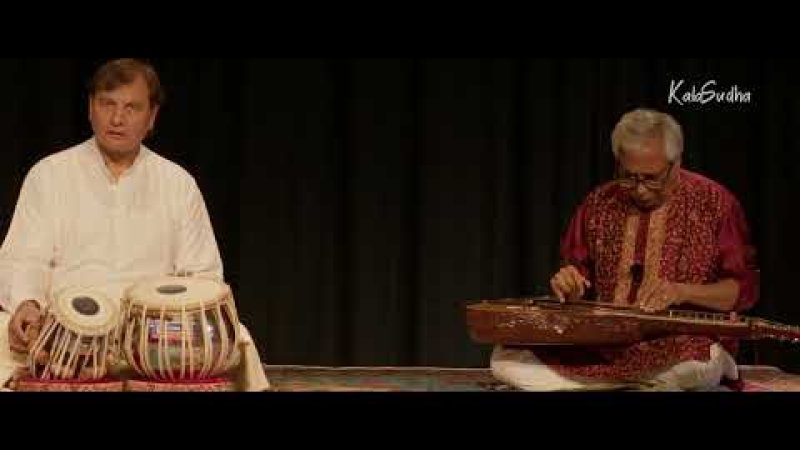
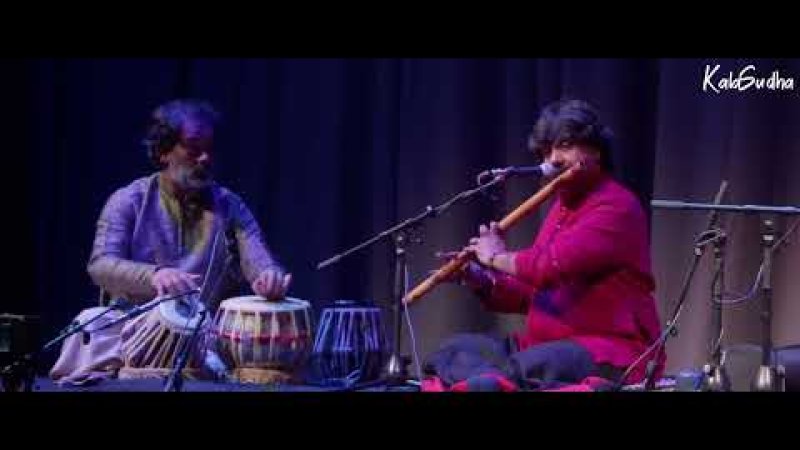
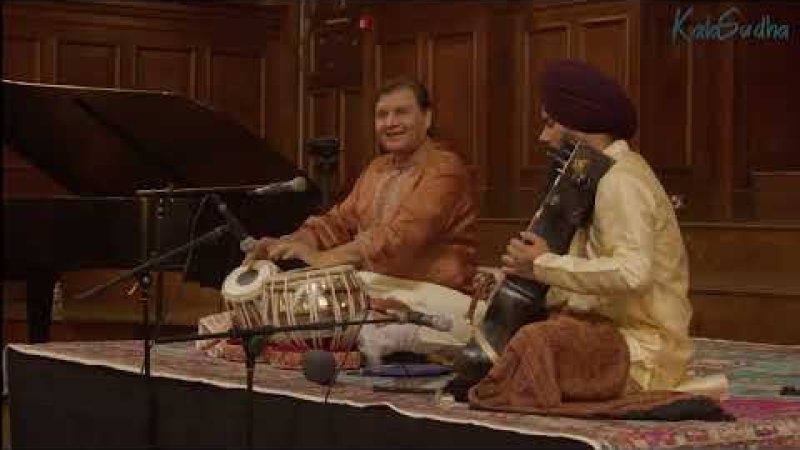
Audio and video performances
Renowned performers of this discipline
Comprehensive courses to master Tabla

KalaSudha teaches tabla online in live one-to-one lessons with a vetted teacher, in HD video with stereo audio built for music.
At Foundation, you speak each bol, the syllable for a stroke, as you play it. Na and Tin sound on the dayan, the treble drum; Ghe and Ka sound on the bayan, the bass drum. Then you learn the theka of teentaal, the fixed bol pattern of its 16-beat cycle. Our courses run in levels, and where enough learners sign up, we bring workshops and summer camps near them.
Learning the tabla on the KalaSudha tabla course typically takes 9–12 months for Foundation, 9–15 months for Intermediate and 12–30 months for Advanced. The pace depends on regular practice and on training each hand for its own drum. The right hand plays the treble dayan; the left shapes the bass on the bayan, pressing the heel of the hand into the head to bend the pitch.
The months are a guide you agree with your teacher. You start at Foundation with the bols, the spoken stroke syllables, and each level's award records your learning hours. Where enough learners sign up, we bring workshops and summer camps near them.
Start the tabla with KalaSudha at Foundation level, online or in a workshop. The first stage covers hand placement and the basic bols, the spoken syllables for each stroke. Children learn with us as well as adults: ask us what age suits a child starting the tabla, and about a size for a younger learner.
Returning learners pick up where they left off after a long break. Our courses run in levels, and your teacher reviews where you stand first.
Ustad Akram Khan teaches tabla through KalaSudha's online academy. The academy offers classes in every discipline of Indian classical music and keeps adding specialised courses and teachers. The courses are hybrid: KalaSudha brings physical workshops and summer camps where enough learners sign up, so you can learn online and in person. For him the tabla is a voice that carries the spirit of his gurus and of the Ajrara gharana.
For one-to-one lessons with him, register interest with KalaSudha. KalaSudha's tabla course runs in three levels, Foundation, Intermediate and Advanced, with live lessons online.
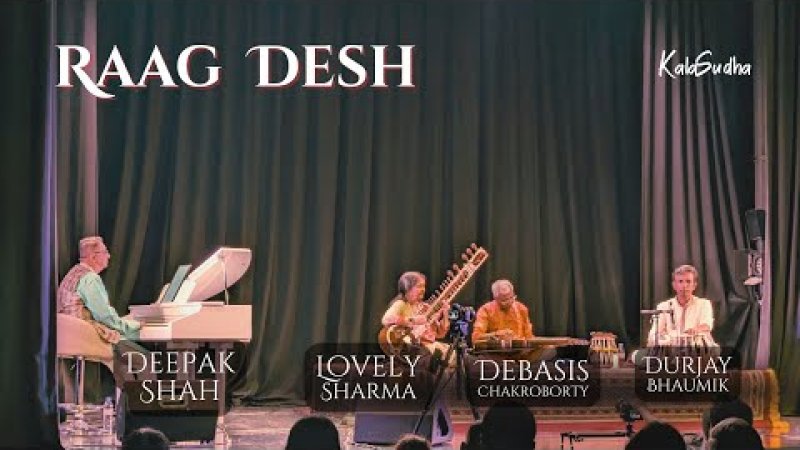
Durjay Bhaumik teaches tabla through KalaSudha's online academy. The academy offers classes in every discipline of Indian classical music and keeps adding specialised courses and teachers. The courses are hybrid: KalaSudha brings physical workshops and summer camps where enough learners sign up, so you can learn online and in person.
For one-to-one lessons with him, register interest with KalaSudha. You can also learn through KalaSudha's tabla course, which runs in three levels, Foundation, Intermediate and Advanced, with live lessons online.
Ustad Shahbaz Hussain teaches tabla through KalaSudha's online academy. The academy offers classes in every discipline of Indian classical music and keeps adding specialised courses and teachers. The courses are hybrid: KalaSudha brings physical workshops and summer camps where enough learners sign up, so you can learn online and in person.
For one-to-one lessons with him, register interest with KalaSudha. He also teaches tabla across the north of England, from his home in Manchester.
To find a good tabla teacher, or guru, look for one who can tell you who they learned from. From your first lesson, a good teacher checks your hand placement and the basic bols, the spoken syllables for each stroke. On KalaSudha, each teacher's lineage is on their profile. Pick one yourself, or ask us to match you.
Lessons are live and online, from £30 / $30 an hour, set by each teacher. If you have played before, your teacher first reviews where you stand. Where enough learners sign up, we also bring workshops and summer camps near them. Our courses include a tabla course in three levels. Ask about tabla lessons in the Academy.
A beginner on the KalaSudha tabla course does not need to choose a gharana first. The shared core has no single lineage, and Foundation introduces the Delhi, Ajrada, Lucknow, Farrukhabad, Benares and Punjab gharanas through labelled listening.
From Intermediate you can take electives in one school, such as Farrukhabad or Benares, with a teacher who teaches that material. You can complete every award without a speciality.
Tabla lessons with KalaSudha cost from £30 / $30 an hour, set by each teacher. One-to-one lessons are live and online, booked in your own time zone, and you see the price in your currency when you book.
To ask what a teacher charges, visit the Academy, press Talk to an Advisor and tell us you want to learn the tabla. The tabla course pages show the same starting fee.
Have more questions? Contact our support team and we'll be happy to help!
Explore our archive of Tabla performances
It seems that you are in
Visit KalaSudhaWe usually reply within a few hours
Loading article…
We could not load this article. Please try again later.
Was this helpful?
Thanks for the feedback
Still need help?
This conversation is resolved — reply to reopen
Topic
Answers come from KalaSudha.com. For anything else, talk to the team.
We email a six-digit code. Enter it here, never in a chat message.