

Bhairav
भैरव
S r G M P d N S' | S' N d P M G r S
Origins & Context
Raag Bhairav is a Bhairav thaat raga of Hindustani music, performed in the early morning, that uses komal Re and komal Dha with shuddha Ga, Ma, Pa and Ni. Komal means lowered, shuddha means natural, and a thaat is a parent scale. It is also written Raag Bhairav, Raga Bhairav or Bhairava.
In the notation here, lowercase marks a komal note and an apostrophe the upper octave. The aroha, or ascent, is S r G M P d N S', and the avaroha, or descent, is S' N d P M G r S. In David Courtney's account, the vadi, the most prominent note, is komal Dha, and the samvadi, its partner, is komal Re. The AUTRIM project of the National Centre for the Performing Arts and the University of Amsterdam treats both as predominant. It hears a slow oscillation, andolan, on each.
Show MoreShow Less
Bhairav and Bhairavi are different ragas, each with its own thaat. Both lower Re and Dha, but Bhairav keeps Ga and Ni shuddha, while Bhairavi lowers them too. In Carnatic music the Bhairav scale is Mayamalavagowla, the 15th melakarta, in George Howlett's table, and Courtney gives the same name. AUTRIM counts Ahir Bhairav and Nat Bhairav in Bhairav's family.
KalaSudha releases Bhairav recordings and presents Hindustani musicians in concert. Its academy teaches ragas online and in local workshops, and each course is built by its instructor with KalaSudha.
In mythology, David Courtney writes, Bhairav was the first raga and came from the face of Shiva. A review of Rag-O-Rup in the Journal of the Music Academy, volume XXV (1954), reports the traditional title adi-raga, or first raga. The name points to Rudra, Shiva in anger, and the raga belongs to early-morning practice.
The Los Angeles County Museum of Art holds Bhairava Raga, a ragamala painting dated about 1650 to 1660, in which Shiva appears with his consort.
The AUTRIM project presents a chhota khayal in medium Tintal, in which a devotee calls on Krishna to wake because the sun has risen. Arunoday Neeko Bhayo is a chhota khayal in fast Ektal on the same sunrise theme.
Technical Details
Melodic structure and movement patterns
Aroha (Ascent)
S r G M P d N S'
Avroh (Descent)
S' N d P M G r S
Pakad (Catch Phrase)
r r S, d d P, G M d d P, G M r r S, .N S
Tanpura Tuning
P - S - S - .S
Additional Notes
Phraseologies
Key for these phrases: r and d are komal Re and Dha, and a dot puts a note in the lower octave.
The catch phrases r r S and d d P lean on komal Re before Sa and on komal Dha before Pa. In G M d d P and G M r r S, the line reaches those notes from Ga and Ma. .N S closes from lower Ni.
The rise G M d N S' passes over Re and Pa, and AUTRIM notes that some artists avoid both in ascending passages. AUTRIM also hears Re and Dha change their intonation with the musical context.
Common Phrases
- G M d N S'
Recordings & Performances
Listen to master musicians perform this raga
Videos
Master Performers
Artists renowned for their renditions of Bhairav

Rekesh Chauhan
Piano

Shahbaz Hussain
Tabla
Classifiers
Swara geometries, relationships, and classifications
Structure
Frequently Asked Questions
Where can I hear Raag Bhairav played live in concert?
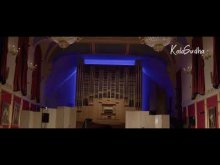
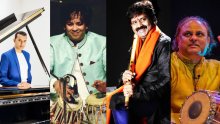
You can hear Raag Bhairav at KalaSudha's concerts in the UK, Europe and India. The pianist Rekesh Chauhan and the tabla player Ustad Shahbaz Hussain have played it in the Duke's Hall of the Royal Academy of Music, London. Bhairav is a raga of dawn and early morning. David Clarke notes that its hour keeps it rare in live performance, though it lives on in recordings and in musicians' morning practice. Coming concerts are on the events page.
Which recordings of Raag Bhairav should I listen to first?
KalaSudha's recordings of Raag Bhairav include a live video of the pianist Rekesh Chauhan and the tabla player Ustad Shahbaz Hussain. It was filmed in the Duke's Hall of the Royal Academy of Music, London. Rekesh Chauhan uses touch and voicing on the piano to suggest the fine inflections of pitch that Bhairav asks for. Ustad Shahbaz Hussain's tabla holds the metre and answers the melody. The performance opens slowly and settles into a pulse that grows more insistent.
What is the difference between Raag Bhairav and Raag Ahir Bhairav?
Raag Bhairav uses komal, or lowered, Re and Dha with shuddha Ni, while Raag Ahir Bhairav keeps komal Re but takes shuddha Dha and komal Ni. The AUTRIM project writes that Ahir Bhairav's lower half reflects Bhairav, so it is often placed in the Bhairav group. AUTRIM adds, citing Bhatkhande, that some musicians hear it as Bhairav below and Kafi above. Bhairav's own mark is a slow oscillation on komal Re and komal Dha.
What is the Carnatic equivalent of Raag Bhairav?
The Carnatic counterpart of Raag Bhairav's scale is Mayamalavagowla, the 15th melakarta, or parent scale, with the same seven notes. George Howlett pairs the two and calls Bhairav the most prominent Hindustani raga on this scale, with all seven notes in both directions. In Carnatic teaching, the first exercises are set in Mayamalavagowla, after the method credited to Purandara Dasa.
Which bandishes are well known in Raag Bhairav?
Well-known bandishes, or set compositions, in Raag Bhairav include Jago Mohan Pyare, a traditional composition that the AUTRIM project calls popular among musicians. In it a devotee asks Krishna to wake because the sun has risen. David Clarke's book Rāgs Around the Clock sets Dhana Dhana Murata, a devotional song to Krishna whose probable composer is Ustad Bade Ghulam Ali Khan, who wrote as Sabrang.
How can I learn a raga online?
You can learn a raga online with the KalaSudha Academy, in live one-to-one lessons with a teacher or in a structured course, from foundation to advanced. Learners book lessons in their own time zone, and teachers teach live in their own language. Instructors and touring artists also lead in-person workshops and summer camps where enough learners register interest.
What is the difference between Raag Bhairav and Raag Bhairavi?
Raag Bhairav and Raag Bhairavi are different ragas, each with its own thaat, or parent scale. Both lower Re and Dha, but Bhairav keeps Ga and Ni shuddha, or natural, while Bhairavi lowers them too. The AUTRIM project calls Bhairav a dignified and sober raga, with a slow oscillation on komal Re and Dha. Both are morning ragas, though Bhairavi is also sung at any hour to close a concert.
Is Raag Bhairav a good raga for a beginner to learn?
Raag Bhairav belongs to Class XII, the last class of the Hindustani vocal course that India's Central Board of Secondary Education (CBSE) sets for schools. Earlier classes set ragas such as Yaman and Kafi in Class IX, Bhupali in Class X and Bhairavi in Class XI. Class XII students then sing a drut, or fast, khayal in Bhairav, Bageshri and Malkauns.
Which film songs are based on Raag Bhairav?
Hindi film songs that David Courtney lists in Raag Bhairav include Jago Mohan Pyare Jago, from Jagte Raho, and Amma Roti De, from Sansar. Courtney calls Amma Roti De a "pretty good example of Bhairav". He also lists Mohe Bhul Gaye Sanvariya, from Baiju Bawra, and notes that some argue it belongs to Kalingada, a closely related raga.
Have more questions? Contact our support team and we'll be happy to help!