

Bhairavi
भैरवी
S r g M P d n S' | S' n d P M g r S
Origins & Context
Raag Bhairavi is a Bhairavi thaat raga of Hindustani music, performed in the early morning, that uses komal Re, Ga, Dha and Ni with shuddha Sa, Ma and Pa. Komal means lowered, and shuddha means natural. Bhairavi also gives its name to its thaat, the parent scale it belongs to. It is also written Raag Bhairavi or Raga Bhairavi.
In the notation here, lowercase marks a komal note and an apostrophe the upper octave. The aroha, or ascent, is S r g M P d n S', and the avaroha, or descent, is S' n d P M g r S. The vadi, the most prominent note, is Ma, and the samvadi, its partner, is Sa. David Courtney gives this as the usual pair and marks both as disputed.
Show MoreShow Less
Courtney writes that musicians perform Bhairavi at any hour as the closing piece of a concert. The AUTRIM project of the National Centre for the Performing Arts and the University of Amsterdam finds it mostly in thumri and dadra. The project also presents a dhrupad and a khyal in Bhairavi. Mishra Bhairavi adds notes beyond the basic scale. Bilaskhani Todi shares its basic notes and differs in treatment. In Carnatic music the same scale is Hanumatodi, the 8th melakarta, in George Howlett's table. Carnatic Bhairavi is a different raga, a janya of the 20th melakarta, with shuddha Re and shuddha Dha in its ascent.
KalaSudha releases recordings of Bhairavi, such as Bhairavi, Pt. 1, and presents Hindustani musicians in concert. Its academy teaches ragas online and in local workshops, and each course is built by its instructor with KalaSudha.
The Metropolitan Museum of Art holds Bhairavi Ragini, a painting from Mandi dated about 1640 to 1650. It shows a woman at a Shiva shrine. She offers flowers and keeps time with hand cymbals.
The AUTRIM project presents Jagat Janani, a dhrupad praising Sarasvati, in medium-tempo Rupak. Its analysis finds shuddha Re beside komal Re in rising lines. AUTRIM also presents Karam Karo More Sayi, a khyal addressed to Rama in slow Jhumra, as an example of the basic, shuddha Bhairavi.
Technical Details
Melodic structure and movement patterns
Aroha (Ascent)
S r g M P d n S'
Avroh (Descent)
S' n d P M g r S
Pakad (Catch Phrase)
g S r S, g M P
Tanpura Tuning
P - S - S - .S
Additional Notes
Phraseologies
Key for these phrases: lowercase letters are komal notes, and an apostrophe after a note puts it in the upper octave.
Two short catch phrases mark the raga. g S r S returns to Sa through komal Re, and g M P rises from komal Ga through Ma to Pa. In d M d n S', the line reaches upper Sa through komal Dha and Ni. Two further turns, P d n d M and d P g M, fall back to Ma.
Common Phrases
- d M d n S'
Recordings & Performances
Listen to master musicians perform this raga
Videos


Tracks

Master Performers
Artists renowned for their renditions of Bhairavi

Debasis Chakroborty
Indian Slide Guitar

Deepak Shah
Piano

Dr Lovely Sharma

Durjay Bhaumik
Tabla

Akram Khan
Tabla
Classifiers
Swara geometries, relationships, and classifications
Swara Geometries
Structure
Around the World
Global connections and equivalent scales
Bhairavi's seven notes match the Phrygian mode: with Sa on E, they are E F G A B C D. The scale gives the pitches only, and Bhairavi's movement and ornaments sit outside it.
Phrygian mode
E F G A B C D E
Berklee PULSE gives these notes for E Phrygian. With Sa on E, they match the basic Bhairavi scale note for note.
Diatonic Dorian octave species
E D C B A G F E
John Chalmers presents the ancient Greek diatonic Dorian octave species from E to E in a natural-note transcription. The descending letters shown here reverse that octave. With Sa on E, its notes match basic Bhairavi. Ancient Greek Dorian and the later Western Dorian mode use different naming systems.
Frequently Asked Questions
Where can I hear Raag Bhairavi played live in concert?
You can hear Raag Bhairavi live at KalaSudha's concerts in the UK, Europe and India, and its musicians have played it at Kala Festival, a touring festival. Bhairavi often closes a Hindustani concert. David Courtney writes that musicians perform it at any hour as the closing piece, and Rajan Parrikar calls it the customary conclusion of a mehfil, a gathering for music. Coming concerts are on the events page.
Which recordings of Raag Bhairavi should I listen to first?
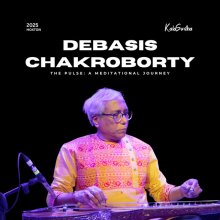
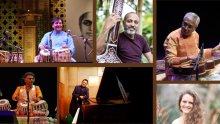
KalaSudha's recordings of Raag Bhairavi include Bhairavi, Pt. 1, an ensemble performance by Pandit Debasis Chakroborty, Dr Lovely Sharma, Deepak Shah and Durjay Bhaumik. Pandit Debasis Chakroborty also plays Bhairavi on solo Indian slide guitar in Bhairavi - Awakening, from the album The Pulse. The Trinity Trio's live Bhairavi joins his slide guitar with the raga pianist Deepak Shah and the tabla player Ustad Akram Khan.
What is the difference between Raag Bhairavi and Raag Bilaskhani Todi?
Raag Bhairavi and Raag Bilaskhani Todi use the same seven notes, komal Re, Ga, Dha and Ni with Sa, Ma and Pa, but Bilaskhani Todi moves in Todi phrases and glides. Rajan Parrikar writes that the kinship ends at the notes, and that a step into Bhairavi can spoil it. George Howlett notes that its ascending lines tend to leave out shuddha Ma and komal Ni, and that it closes on the Todi phrase komal Re, Ga, Re, Sa.
Is Hindustani Raag Bhairavi the same as Carnatic Bhairavi?
Hindustani Raag Bhairavi is a different raga from Carnatic Bhairavi. Its scale, komal Re, Ga, Dha and Ni with shuddha Sa, Ma and Pa, matches Carnatic Hanumatodi, the 8th melakarta, or parent scale, in George Howlett's table. Carnatic Bhairavi is a janya, or derived raga, of the 20th melakarta, Natabhairavi, and uses shuddha Re and shuddha Dha in its ascent.
Which film songs are based on Raag Bhairavi?
Hindi film composers have set many songs in Raag Bhairavi, and Rajan Parrikar writes that they cultivated it extravagantly. His examples include Ghar Aaya Mera Pardesi from Awara, Yeh Zindagi Ke Mele from Mela, Sanware Sanware from Anuradha and Chingari Koi Bhadke from Amar Prem.
Which bandishes are well known in Raag Bhairavi?
Well-known compositions in Raag Bhairavi include the thumri Babul Mora Naihar Chhuto Hi Jaayee. Aneesh Pradhan, writing in Scroll, calls it a famous thumri composed by Nawab Wajid Ali Shah. The AUTRIM project of the National Centre for the Performing Arts and the University of Amsterdam documents two more, each in one performance. It gives the dhrupad Jagat Janani, in medium-tempo Rupak, from Uday Bhawalkar's performance, and the bada khayal Karam Karo More Sayi, in slow Jhumra, from Ajoy Chakrabarty's.
How can I learn a raga online?
You can learn a raga online with the KalaSudha Academy, in live one-to-one lessons with a teacher or in a structured course, from foundation to advanced. Learners book lessons in their own time zone, and teachers teach live in their own language. Instructors and touring artists also lead in-person workshops and summer camps where enough learners register interest.
Is Raag Bhairavi a good raga for a beginner to learn?
India's Central Board of Secondary Education (CBSE) sets Raag Bhairavi in Class XI of its Hindustani vocal course for schools, after six ragas in Classes IX and X. Class IX starts with Alhaiya Bilawal, Yaman and Kafi, and Class X adds Bhupali, Khamaj and Brindavani Sarang. In Class XI, students sing Bhairavi as a drut, or fast, khayal beside Bihag and Bhimpalasi.
Have more questions? Contact our support team and we'll be happy to help!