Image

Hindustani classical instrumental music is North Indian raga music played on instruments such as sitar, sarod, sarangi, bansuri and tabla, each with its own technique.
The first known description of the sarangi appears in the Ain-i-Akbari, a Mughal court encyclopedia of 1588 to 1589. The scholar Joep Bor argues that the instrument won a place in Hindustani classical music only in the later seventeenth century, and that it took over from an enlarged rabab as the khayal singer’s accompaniment during the eighteenth. The large classical sarangi took shape in the nineteenth century, probably in or near Delhi. Where the instrument first came from remains disputed.
Sarangi players shaped vocal music as teachers. Abdul Karim Khan and Abdul Wahid Khan of the Kirana gharana, a school of singing passed down through teachers and families, began as sarangi players. Solo playing has a long history too, at home and in musicians’ gatherings, and solo recordings survive from the early twentieth century. Bor names Mamman Khan, Bundu Khan, Gopal Mishra and Ram Narayan among the players who won it recognition as a solo instrument. In the twentieth century the harmonium largely replaced the sarangi in vocal accompaniment, though the sarangi still plays in khayal ensembles.
The Metropolitan Museum of Art dates its sarangi, object 1982.143.2, to about 1900, within a range of 1890 to 1910. The museum classes it as a bowed, unfretted lute made of wood, ivory, parchment and metal.
The National Centre for the Performing Arts (NCPA), Mumbai, published Joep Bor’s The Voice of the Sarangi as a special issue of its Quarterly Journal. NCPA’s own account dates the issues to September and December 1986 and March 1987.
Bhopal hosted a Sarangi Mela in 1989. Nicolas Magriel's archive shows stills credited to Daniel Neuman and short clips from recordings held in the Bharat Bhavan archive. In 1997 Magriel credited the Mela with helping a partial revival of teaching in sarangi families.
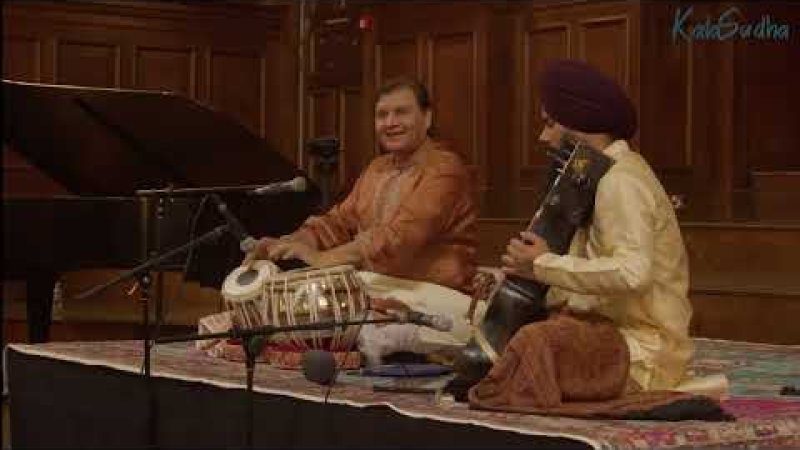
Darbar’s festival record lists a khayal performance of Raga Multani at Kings Place, London, by Venkatesh Kumar with Murad Ali on sarangi. Tofail Ahmed played harmonium in the same ensemble, with tabla and two tanpuras.
The left hand stops the playing strings with the side of the fingernail, usually just under the cuticle; some players use the skin above it. Talcum powder helps the contact glide. Sliding it along the string produces meend, a continuous glide between notes. Fingering differs between schools, and Bor documents several systems.
The sympathetic strings (tarab) are never bowed; they vibrate in response to the playing strings. Bor describes three sets: a main set tuned chromatically and left unchanged between ragas (achal that), a right-hand set tuned to the raga or chromatically to follow a singer, and an upper set that varies with raga and player. A large sarangi usually has about 35, smaller ones 24 or fewer.
The seated player holds the sarangi upright and draws a heavy bow across the gut strings with an underhand grip, pressing with the first two fingers or the forefinger. Bowing near the bridge brings out the sympathetic response. The great players developed long strokes with inaudible bow changes. Rhythmic passages such as jhala, rapid repeated strokes, use the tip of the bow.
Follow this structured journey to master this discipline


Renowned performers of this discipline
It seems that you are in
Visit KalaSudhaWe usually reply within a few hours
Loading article…
We could not load this article. Please try again later.
Was this helpful?
Thanks for the feedback
Still need help?
This conversation is resolved — reply to reopen
Topic