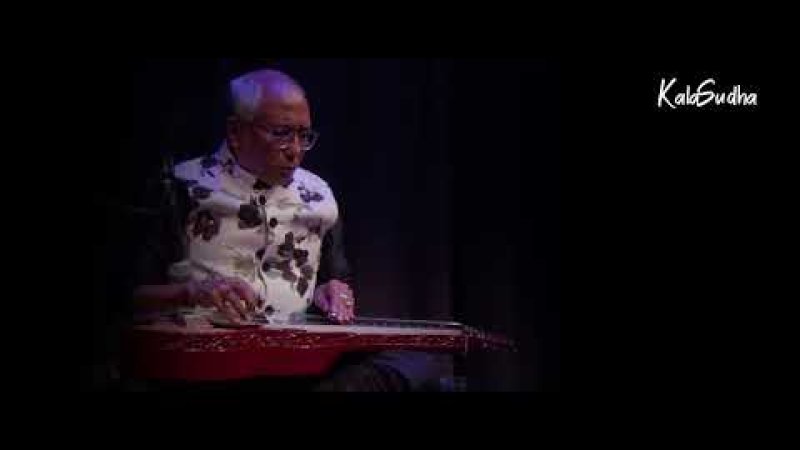
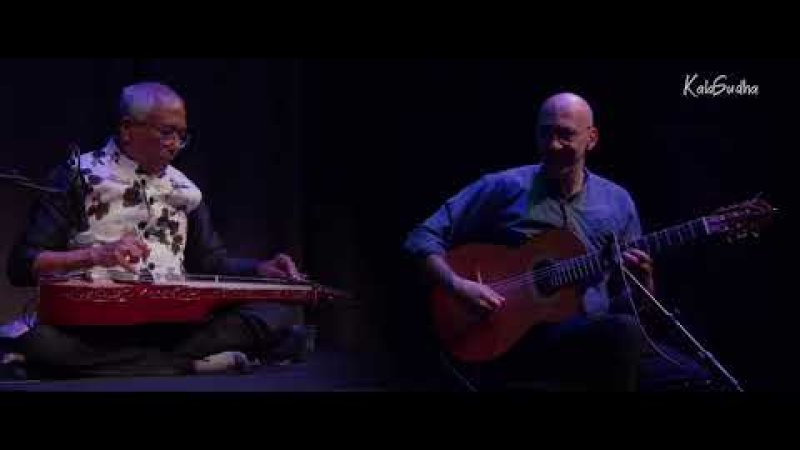
RP
R. Prasanna
born 1970
Raised in Chennai and known as Guitar Prasanna, he is credited by Andre Elias with considerable advances in bringing the electric guitar into Carnatic music.
गिटार
The standard electric guitar, playing the gamakas of Carnatic ragas
Carnatic guitar is South Indian classical music played on a standard electric guitar, introduced by Sukumar Prasad in the 1970s and carried forward by R. Prasanna.
Explore its sound, construction and care in the instrument guide.
Sukumar Prasad introduced the guitar to Carnatic music in the 1970s. R. Prasanna took the electric guitar further into the tradition, and the ethnomusicologist Andre Elias credits him with considerable advances there.
Prasanna began by ear. He worked out Carnatic pieces on the guitar while listening to his sister's vocal and veena lessons. Her veena teacher, Tiruvarur Balasubramaniam, had never seen Carnatic music played on a guitar and doubted the idea at first, then took him on as a student. His longest training came from the Carnatic violinist A. Kanyakumari, whom he names as his guru for 26 years. Neither teacher played the guitar, so Prasanna learned the music from voice, veena and violin.
In 1999 he wrote that senior musicians (vidwans), critics and discerning listeners (rasikas) had come to accept his playing.
A 2016 Vintage Guitar review of a fusion album describes microtonal bends and slides in R. Prasanna's playing. He plays fretted and fretless guitars, electric and acoustic, and draws on jazz, blues and rock technique.
Carnatic guitarists play the gamakas of each raga on ordinary frets. A guitar's frets follow Western equal temperament, twelve even semitones to the octave. R. Prasanna argued in 1999 that Carnatic music uses more than twelve pitches to the octave, and that every Carnatic instrument reaches the extra ones through gamaka. For this reason he named Todi, Varali and Bhairavi as ragas that are hard to play on the guitar. He held that a player who commands the authentic gamakas will find Todi no more impossible than Mohanam.
Andre Elias takes a narrower view. He argues that fixed frets and a flat fingerboard hold most guitars to the twelve-tone system, with string bending allowing slight deviation, and he notes scalloped-fret models from the 1970s that allow more bending.
Sukumar Prasad and the Carnatic guitarists who followed him adopted the standard electric guitar without significant modification, according to R. Prasanna's 1999 paper. Prasanna's own position is that neither Carnatic music nor the guitar needs changing to suit the other.
Hindustani musicians took a different route. They play forms of modified guitar, among them the Indian slide guitar, and Prasanna suggests the changes aim to bring the sound closer to the sitar and sarod. Elias finds that slide has made little headway in South Indian music, and the slide guitarist Poly Varghese told him he senses little interest in it, even among players of the gottuvadhyam, a South Indian instrument also played with a slide.
The standard guitar has limits of its own. Elias observes that it lacks the long sustain and the open-string drone chord valued in Indian music.
In his 1999 paper R. Prasanna described colouring his tone with digital effects such as chorus, reverb and delay, along with compression and gating. He drew on technique from jazz, blues and rock, and held that what came out was still Carnatic music. He urged musicians to keep up with advances in instruments, sound processing and recording, pointing out that without technology Carnatic music could not be heard in large concert halls.
His fusion work goes further. On All Terrain Guitar, a jazz and Indian fusion album reviewed by Vintage Guitar in 2016, he plays fretted and fretless guitars, electric and acoustic. A fretless neck lets pitch move without steps under the finger. That album sits outside Carnatic concert practice, which for Prasanna rests on the standard electric guitar.
Follow this structured journey to master this discipline
Carnatic training begins with the graded exercises credited to Purandara Dasa: sarali and janta varisai, then the tala alankaras, set in the main talas, or rhythmic cycles. Much of this material is in the raga Mayamalavagowla. Students spend many months on it while the teacher checks each pitch, phrase and ornament.
Learn each raga's gamakas by listening to singers. R. Prasanna advises Carnatic guitarists to hear as much Carnatic vocal music as they can. He asks the same of guitar music across genres, from Django Reinhardt to Paco de Lucía, and suggests playing it too. Only then, he argues, does a player learn what the guitar can offer Carnatic music.
Move from exercises to compositions. Gitams, simple songs used in teaching, come first, and the beginners' sequence ends with swarajatis and varnams. The tana varnam presents its raga in full, its ornaments and characteristic phrases, and often opens a concert.
Build a repertoire of kritis, the three-part song of pallavi, anupallavi and charanam, the main concert item since the early 20th century. Prasanna holds that a Carnatic musician should play heavy ragas such as Todi and Bhairavi with the same ease as lighter ones. In a 2012 interview he named Yadukula Kambhoji, Dhanyasi, Ritigowla, Kedaragowla and Sahana among those he finds hard on guitar, for the same reasons they are hard in general.
Prepare a kutcheri, a Carnatic concert. A tana varnam often opens it, and composed pieces alternate with improvisation: raga alapana (unmetred exposition of the raga), niraval (variations on a line of text) and kalpanaswaram (improvised sol-fa passages). The tani avartanam, the percussion solo, is a conspicuous feature. The lead guitarist plays with a violinist and percussionists, the mridangam (barrel drum) leading them.
born 1970
Raised in Chennai and known as Guitar Prasanna, he is credited by Andre Elias with considerable advances in bringing the electric guitar into Carnatic music.
Audio and video performances
Renowned performers of this discipline
To start Indian classical music on the guitar, learn with KalaSudha online or in a workshop, beginning at Foundation level. The first stage settles your sitting position and right-hand technique, whether you fingerpick or use a plectrum. We teach children as well as adults: ask us about a starting age and about a guitar size for a younger learner.
Guitarists returning after a long break start again where they left off. Our courses run in levels, so your teacher reviews where you stand first.
Yes, a Western guitarist, violinist or pianist can learn Indian classical music; KalaSudha teaches it online in live one-to-one lessons from Foundation. We add workshops and summer camps where enough learners sign up. The new part is the raga, a melodic framework of set notes, stressed notes and characteristic phrases.
On the Hindustani violin, fingering and bowing join the notes. On Indian slide guitar, a bar glides between them. The piano cannot glide, so pianists learn to suggest meend, the glide between notes. In South Indian music, Ludwig Pesch writes, each note's ornament, its gamaka, depends on its melodic context.
To find a good Carnatic guitar teacher, or guru, look for one who can tell you who they learned from. From your first lesson, a good teacher checks your sitting position and right-hand technique, whether you fingerpick or use a plectrum. On KalaSudha, each teacher's lineage is on their profile. Pick one yourself, or ask us to match you.
Lessons are live and online, from £30 / $30 an hour, set by each teacher. If you have played before, your teacher first reviews where you stand. Where enough learners sign up, we also bring workshops and summer camps near them. Ask about Carnatic guitar lessons in the Academy.
Carnatic guitar lessons with KalaSudha are from £30 / $30 an hour, set by each teacher, and shown in your currency on the teacher's booking page. Every lesson is live and one-to-one, online, booked in your own time zone. Each teacher's lineage is on their profile: pick a teacher, or ask KalaSudha to match you, then choose a length and a time and pay at checkout.
On the guitar, building a Carnatic repertoire of varnams and kritis typically takes three to five years of steady training. About 15 to 20 minutes of practice a day is a typical start.
The graded exercises come first, and you learn the gamakas of each raga by ear from singers. Our courses run in levels, and your teacher agrees the pace with you.
Most Carnatic musicians learn the guitar in the bani, or style, of their teacher, so you usually choose a bani when you choose a teacher. Each KalaSudha teacher's profile names their lineage.
R. Prasanna, a Carnatic guitarist, draws on jazz, blues and rock technique while playing Carnatic music. Hear several, then pick a teacher whose playing you want to learn. Ask us to match you in the Academy.
Have more questions? Contact our support team and we'll be happy to help!
Explore our archive of Guitar performances


It seems that you are in
Visit KalaSudhaWe usually reply within a few hours
Loading article…
We could not load this article. Please try again later.
Was this helpful?
Thanks for the feedback
Still need help?
This conversation is resolved — reply to reopen
Topic
Answers come from KalaSudha.com. For anything else, talk to the team.
We email a six-digit code. Enter it here, never in a chat message.