
Beyond the Video Call: KalaSudha Academy Booking System Evolves Online Indian Classical Music

In Indian classical music, the relationship between teacher and student has always been intimate and sustained. Apart from delivering theoretical and practical lessons, a guru listens, adjusts, and guides a learner through years of disciplined practice. The student, in turn, absorbs not just technique but temperament, phrasing, and the unspoken grammar of a raga's emotional arc. That kind of exchange has been nurtured across centuries in physical proximity, in the same room, often in the same household. It doesn't translate easily to a generic scheduling link and a video call.
At KalaSudha, we've spent the past several months building something that does justice to this tradition: a fully integrated session booking and live-lesson system, purpose-built for music instruction on our platform. It's now live and available to learners and instructors across the KalaSudha Academy. This article walks through what we've built, what it means for learners and teachers, and where we're taking it next.
Finding the right time, without the back-and-forth
One of the most common frustrations in private music tuition, whether online or offline, is scheduling. Emails, WhatsApp messages, timezone miscalculations, double bookings. It's a distraction from the music, and it places an administrative burden on instructors who would rather spend that time practising or teaching.
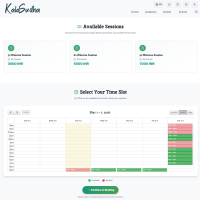
Our booking system eliminates that friction. Every instructor on KalaSudha sets their availability, working hours, preferred session lengths, buffer time between lessons, and how far in advance a learner can book. The system then dynamically generates open calendar slots, considering existing bookings, blocked times, and the instructor's daily limits. What a learner sees is always accurate, current, and respectful of the instructor's boundaries.
The experience for a learner is straightforward: browse an instructor's profile, view their calendar, pick a slot, and book. A minimum 24-hour notice period, adjustable by each instructor, ensures no one is caught off guard by a last-minute request. Daily booking caps prevent instructor burnout and protect session quality. Everything respects time zones automatically. A learner in Toronto booking a session with a tabla maestro in Varanasi does not need to do any mental arithmetic; the platform handles the conversion and displays everything in the learner's local time, including availability and alerts.
There's also built-in protection against spam and misuse. Flood control on booking submissions ensures the system remains clean, fair, and usable as the number of learners on the platform grows.
A booking flow that respects both sides
Not every instructor wants to auto-accept bookings from any learner. Some prefer to know who they'll be working with before committing their time, particularly for advanced instruction where foundational level matters, or for specialised masterclasses where places are limited. Others are happy to let the system confirm immediately and keep their calendar filling up.
Our system supports both approaches through a configurable approval workflow. Each instructor can choose between automatic confirmation, where a booking is locked in the moment a learner submits it, and manual approval, where the instructor reviews each request before approving it.
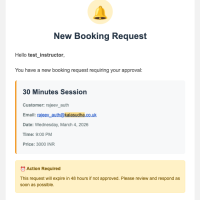
In the manual flow, the instructor receives a notification and can view the learner's profile, the requested time, and any notes the learner has included. They can then approve or decline, optionally providing a reason. This gives instructors the agency they need without burdening learners with uncertainty: declined requests come with context, and approved ones proceed instantly.
Once a session is confirmed, whether automatically or by the instructor, the system takes care of everything downstream. It creates a dedicated, secure video meeting room. It sends confirmation emails to both parties with all the relevant details: time, date, session title, and a direct join link. It queues up reminders in the lead-up to the session so neither side forgets. The entire chain, from the moment a learner clicks "book" to the moment both parties join the call, is handled seamlessly.
Payment, invoicing, and a proper commerce pipeline
Learning from a master shouldn't come with billing confusion. Our session booking system is backed by a full commerce pipeline, so payments are handled cleanly and transparently.
When a learner books a session, they're guided through a secure checkout process. Each session type is set up as a dedicated product, meaning instructors can offer different pricing for different kinds of lessons: a one-hour raga introduction, a 30-minute technique check-in, an extended masterclass. Pricing, currency, and session descriptions are all managed per instructor, giving each teacher full control over how their offerings are presented.
After a successful booking, the system generates a proper invoice, not just a payment receipt, but a structured document that learners can use for their own records, institutional reimbursement, or tax purposes. This is especially important for international learners and for those whose music education is supported by grants, scholarships, or cultural organisations.
The commerce system is transaction-safe, meaning that if something goes wrong mid-checkout (a network drop, a browser crash), a slot isn't accidentally held or double-booked. The booking is only confirmed once the entire transaction completes cleanly.
Staying connected: Emails, alerts, and what’s coming next
Communication around a session should not depend on either party remembering to check a dashboard. Our system sends automated email notifications at key moments in the booking lifecycle: confirmation when a session is booked, a prompt when an instructor needs to approve a pending request, reminders 24 hours before the session starts and again 15 minutes before, and a follow-up once the session is complete, including recording access details.
Each notification includes the specific session details: title, instructor or learner name, date, time in the recipient's timezone, and a direct link to join or manage the session. Instructors who manage multiple students across different time zones can rely on these alerts to keep their teaching schedule running smoothly without constantly checking the platform.
We're also building towards richer communication channels beyond email. WhatsApp and SMS notifications are coming soon, so learners and instructors can receive session reminders and booking updates on the devices and apps they already use throughout the day. For many of our users, especially those in India and across South Asia, WhatsApp is the primary communication channel, and meeting them there is a natural next step.
Ticketed support: Help when you need it
With any platform that handles bookings, payments, and live sessions, things occasionally need attention: a scheduling conflict, a question about a recording, or a payment query. Rather than leaving users to send emails into a void, we've built a proper ticketed support system directly into the platform. We will have a chat system along with supported desk tickets to make you feel at home.
Learners and instructors can raise a support ticket from within their dashboard or chat with us. Each ticket is tracked, assigned, and followed through to resolution with full visibility for the user who raised it. There's no ambiguity about whether a concern has been seen. You can check the status of your ticket at any time, and you'll receive email notifications as it progresses.
This is especially important as the platform scales. A growing community of learners and instructors, spread across time zones and with varying levels of technical comfort, needs a support system that's responsive, transparent, and integrated, not bolted on as an afterthought. Our ticketed system ensures that every query gets the attention it deserves.
Live lessons in HD, built for music practice
This is where most general-purpose platforms fall short, and where we've invested the most care and continue to invest.
Generic video calling tools like Zoom, Google Meet, or Teams were designed for business meetings and 1:1 or 1:many conferences. They compress audio aggressively, prioritise speech frequencies, strip out stereo information, and introduce latency that's barely noticeable during a sales call but deeply disruptive when there is Tanpura in the background, a teacher is demonstrating a meend on a sitar, or a teacher is correcting a student's intonation on a single swara, or giving oral feedback while the student plays. For a tradition where the difference between two shrutis can define the mood of an entire raga, that kind of audio degradation isn't just inconvenient; it undermines the instruction itself.
Our video system is built on enterprise-grade WebRTC infrastructure, the same kind of real-time communication backbone used by large-scale streaming by big platforms. Sessions stream in high-definition video at 720p resolution (1280×720), which is sharp enough to see finger placement on a fretboard, hand positioning on a tabla, or the subtle movements of a vocalist's throat and diaphragm.
But the real difference is in the audio. Our system transmits in stereo, using professional-grade AAC codecs, the same audio standard used in music streaming and broadcast production. That means that when a teacher plays a phrase on the Indian slide guitar or demonstrates a complex taan, the learner hears it with the clarity, warmth, and spatial dimension it deserves. The tonal richness of a tanpura drone in the background, the crisp attack of a tabla stroke, the way a sustained vocal note gently decays: none of it is flattened or clipped by a codec designed for conference-room speech.
Connection stability is automatically managed through the largest global CDN network with regional optimisation. If a network hiccup occurs mid-lesson, the system reconnects seamlessly without requiring anyone to fumble with a new link or rejoin a room. Real-time connection-state monitoring runs quietly in the background, and automatic reconnection ensures the lesson continues with minimal interruption.
Security is baked in at every layer. All API communication uses SSL verification. Access to each session is restricted to verified participants through attendee-based encrypted checks. Guest tokens are scoped to individual sessions and cannot be reused or shared to gain access to other meetings. Permission-based access control means each participant's role (host, participant, or viewer) is enforced from the moment they enter the room.
Automatic session recording
Every lesson is automatically recorded, capturing high-quality audio and video using the same AAC stereo audio and H.264 video as the live session. There's no need for anyone to remember to press a record button; the system handles it from the moment the session begins.
Recordings are securely stored in the cloud and made available for access after the session ends. This is an especially valuable feature for music learners. Unlike a maths tutoring session where the content can be summarised in notes, a music lesson is full of moments that only make sense when you can hear and see them again: the way a teacher shaped a particular phrase, the exact fingering they used for an ornament, the tonal correction they offered when a student's pitch drifted on a komal Re.
Recordings are retained for a year, giving learners enough time to revisit, practise, and absorb before the next session. Access is permission-controlled: only the participants of that session can view and download the recording, and the system verifies this each time a download is requested.
For instructors, recordings also serve as a lightweight teaching archive. They can review past sessions to track a student's progress over time, reference a particular demonstration they gave, or use a recording as a starting point for planning the next lesson.
A dashboard for learners
Once you've booked sessions, enrolled in courses, or started exploring the platform, you need a single place to manage it all. The learner dashboard is that place.
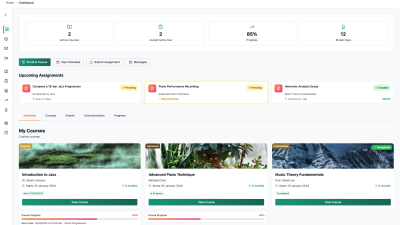
At a glance, you'll see your upcoming and past sessions, each with its timing, status, instructor name, and a direct join link. The join button activates five minutes before a session starts, early enough to test your audio and settle in, but designed to keep the meeting room purposeful and distraction-free. If you try to join too early, or after a session has ended, the system handles it gracefully with a clear message rather than dropping you into an empty or expired room.
The dashboard also surfaces your broader engagement with the KalaSudha ecosystem. You can see the courses you're enrolled in, upcoming events you've registered for, the number of premium content hours available to you, and your connection to the wider community. It's designed to feel like a home base, not just for session bookings, but for your entire learning journey on the platform.
Session details are always accessible: title, date and time (in your timezone), session status (confirmed, pending approval, completed), and any relevant links. Past sessions include access to recordings where available, with the same permission checks described above.
A dashboard for instructors
Instructors get a dedicated management view that goes well beyond a simple calendar. It's designed for the working teacher: someone juggling multiple students across time zones, managing both regular weekly sessions and occasional masterclasses, and needing at-a-glance clarity without administrative overhead.
The instructor dashboard opens with key analytics: total meetings held, currently active sessions, upcoming bookings, total participants taught, and total recordings available. They help instructors understand their teaching load, plan their week, and track their engagement on the platform over time.
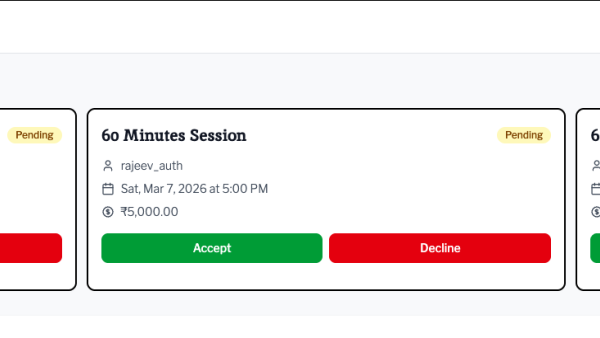
Pending booking requests are surfaced prominently. Instructors can review each request, see the learner's details and preferred time, and approve or decline with a single action. Approved bookings automatically trigger the full downstream chain: meeting room creation, confirmation emails to the learner, and reminder scheduling.
An upcoming sessions block shows the next six lessons at a glance, complete with student names, approval status, and join links. For instructors who teach daily, this block becomes the most-used part of their dashboard. A quick scan each morning tells them exactly what the day looks like.
Attendance management is built in for more structured sessions. Instructors can add or remove participants, assign roles (host, participant, or viewer), and invite guest attendees for special occasions. This is useful for masterclasses, collaborative lessons, or situations where a visiting musician joins a session. Guest invitations use one-time access tokens, keeping the system secure even when ad hoc attendees are involved.
The dashboard also includes host-level analytics: which instructors on the platform are most active, meeting frequency trends, and participant counts. For KalaSudha as an organisation, this helps us understand how the Academy is growing and where to invest in supporting our teaching community.
Reliable, even at scale
A platform that handles live sessions, payments, and real-time scheduling can't afford to feel sluggish or unreliable. Behind the scenes, we've invested heavily in performance and resilience to keep the experience smooth as the platform grows.
Session creation, email dispatch, booking reminders, and recording processing all run asynchronously through a queue-based system. This means that when a learner books a session, the confirmation appears instantly. The heavier tasks, such as creating the video room, sending the email, and scheduling reminders, run in the background without blocking the user's experience.
Intelligent caching keeps the platform responsive. Instructor availability data, calendar views, and dashboard content are cached with carefully tuned refresh intervals, so pages load quickly while still reflecting recent changes. When something changes (a new booking, a cancelled session, an updated availability window), cache invalidation ensures stale data doesn't linger.
Database operations are optimised with composite indexes on the fields that matter most: date ranges for availability queries, session and meeting identifiers for quick lookups, and approval status for the instructor queue. The result is a system that returns results quickly, even as the volume of bookings, sessions, and users increases.
All of this adds up to a platform that feels fast and trustworthy, because a teacher about to start a lesson, or a student rushing to join five minutes before a session, shouldn't have to wait for a page to load.
What's next: Cohort courses and Community batches
Everything described so far supports one-on-one sessions between an instructor and a learner. But Indian classical music education has always had a communal dimension too: students learning alongside each other, observing a senior student's lesson, practising together under a guru's guidance. We're building towards that.
Our next major milestone is integrating the session booking system with cohort-based courses in our learning management system (LMS). Here's what that will look like in practice.
An instructor, or KalaSudha itself, will be able to design a structured, multi-module course: say, a 12-week introduction to Raga Yaman, or an advanced Tabla rhythm cycle workshop. Each module within the course can include pre-recorded video to set the context for the lessons, reading materials, notation exercises, and, critically, scheduled live sessions booked directly through the same system described in this article. The booking engine will be wired in at the module level, meaning a learner enrolled in a course will see their upcoming live sessions as part of the course flow, not as a separate calendar to manage.
We're also building support for community batches: groups of learners who enrol together and progress through a course as a cohort. This mirrors the traditional batch system in Indian music education, where a guru might teach a small group of students at the same level, rotating between individual attention and collective practice. Community batches will share a group schedule, have access to batch-specific sessions, and eventually, a shared space for discussion and peer feedback.
The first cohort courses are now being designed under the guidance of Pandit Debasis Chakroborty, and we expect to open enrolment in the coming months.
Composing, practising, and learning are all connected
Earlier this year, we introduced KalaSudha Composer, our cloud-based notation editor built specifically for Hindustani classical music. It lets musicians write and edit compositions in traditional Bhatkhande notation directly in the browser, with support for eight Indian scripts, raga and taal management, MIDI playback, and the ability to share or fork compositions within the community.
As the session booking system and the LMS mature, Composer will become a natural part of the learning workflow. Imagine an instructor assigning a bandish as homework after a live session, the student opening it in Composer to study and annotate it, and then returning to the next session with questions grounded in their own hands-on engagement with the notation. Or a cohort course where each module includes a composition exercise in Composer that builds towards a recital-ready piece by the end of the programme.
This kind of integration, where the notation tool, the live session, the course material, and the learner's personal library all talk to each other, is core to what we're building. It's not about adding more features for the sake of it; it's about making the entire learning journey feel cohesive, purposeful, and deeply connected to the art form.
The bigger picture: A dashboard that grows with you
The learner and instructor dashboards described in this article are the foundation, not the finished product. As new capabilities come online, the dashboard will become a richer, more personalised home for everyone on the platform.
Here's a glimpse of what's on the horizon:
Messaging and communication. We're working on an integrated messaging system within the dashboard for direct communication between learners and instructors, for support conversations, and for course-specific discussions. Rather than scattering conversations across email, WhatsApp, and the platform, we want to give users a single, searchable thread for each relationship and context.
Premium video library and tutorials. KalaSudha already hosts a growing collection of performance recordings, masterclass excerpts, and tutorial content. We plan to surface this directly within the dashboard, with personalised recommendations based on your learning path, your instructor's suggestions, and your own browsing history. Premium content hours, already tracked in the learner dashboard, will become a gateway to a deeper catalogue of curated educational material.
Richer analytics and progress tracking. For learners, this means being able to see your session history, recording library, course completion, and practice patterns in one view: a musical learning journal that builds over time. For instructors, it means more detailed insights into student engagement, attendance trends, and the effectiveness of different teaching formats.
Deeper Composer integration. Beyond the course-level integration described above, we envision Composer becoming a shared workspace between instructor and student, where a guru can annotate a student's composition, suggest variations, or demonstrate alternative phrasing, all within the notation itself. Each of these enhancements is designed to make the dashboard not just a management tool but a creative and educational space that reflects the richness and depth of the music it serves.
Why this matters for Classical Music
There are plenty of platforms where you can book a video call with a tutor. But music, especially Indian classical music, demands more. It demands audio fidelity that preserves the subtlety of a raga's mood. It demands a booking experience that mirrors the mutual respect between guru and student. It demands a commerce system that treats the exchange fairly and transparently. And it demands a digital environment that feels like a practice room, not a conference call.
That's what we've set out to build. The session booking system is one piece of a larger vision at KalaSudha: to give classical artists and their students the digital tools they deserve, without asking them to compromise on what makes their art form extraordinary.
We believe that the guru–shishya tradition doesn't need to be abandoned for the digital age. It needs to be supported by technology that understands what makes it special. That's the work we're doing, one feature, one session, one raga at a time.
The session booking system is available now on the KalaSudha platform. If you're an instructor interested in offering live sessions or a learner looking to study with one of our Academy artists, contact us via our contact form to get started.
To learn more about KalaSudha Composer, read our intro

We are the internal engineering core of KalaSudha, managing our dot-com, Indian Classical Network websites, and are focused on building cutting-edge digital architecture for the Indian classical music ecosystem.
Continue Reading

Booking Direct, Made Simple: KalaSudha Tickets Are Now Live
This month we start something steadier than a festival season: a KalaSudha concert every month, with workshops and more to follow. That rhythm changes what we need. When you put on shows all year roun...

KalaSudha Composer: The First Release Is Open for Testing
KalaSudha Composer is open for testing. Earlier this year, we shared a first look at our browser-based notation editor for Hindustani classical music. Since then, we rebuilt large parts of it and adde...

Decoding the Ragas and Rhythms of the Indian Holi Season
In the world of IT, we live by “release cycles” and “sprint cycles”. In the rural heartlands, where Holi is a way of life, things run on an older, more robust operating system. Here, the seasons dicta...
