

The Mastery of the Sitar and the Indian Violin
Sitar and Violin mimic the voice using Meend and Gamaka. This craft requires hard physical labor and years of practice to turn wood and wire into the soulful music of the North and South.

Director of Art, KalaSudha
The moments preceding the raga rendition are characterised by intense stillness. For the artist, seated before the tanpura’s initial resonance, this marks the commencement of an inward journey. Years of riyaz, solitary mornings, and patient repetition converge into a single breath. The body must become steady, the mind must clear, and the ego must recede. What follows is an act of tapasya, a disciplined trial of stamina, surrender, and genuineness. Every tone emerges anew, yet bears the mark of musical lineage.
In this third article, we move beyond the historical stories of the North and South to examine the instruments themselves. The Sitar and the Indian Violin are two of the most significant tools used today to articulate the particular musical identities of these regions, and mastery of them demands more than technical ability.
Instruments as an Extension of the Human Voice
The relationship between an Indian classical musician and their instrument is governed by a singular, non-negotiable objective: the emulation of the human voice. To comprehend the design and function of the Sitar and the Violin, it is necessary to first understand the vocal aesthetic they seek to replicate.
The Concept of Gayaki Ang
In Indian classical music, the human voice serves as the ultimate standard. Every instrument is made to emulate vocal expression, a theory known as Gayaki Ang. This approach requires that, when a string instrument articulates a sequence of notes within the framework of a raga, it must capture the glides, microtones, and sustained "breath" characteristic of vocal performance. The Sitar and the Indian Violin address this challenge via different mechanisms. Proficiency with these instruments centres on Meend (the glide) and Gamaka (the oscillation), which are necessary techniques that enable the performer to sustain a continuous thread of sound. Without these movements, the music loses the fluid, breathing quality that defines the tradition.
Physics of Resonance
Skill with these instruments is physically demanding. Both the Sitar and the Indian Violin function as resonant chambers, generally constructed out of seasoned teak wood or sun-dried gourd. However, the quality of sound produced depends entirely on the performer’s physical control over these organic materials. In live performance, this craft is clear in subtle details. Thick callouses on the fingertips and the performer’s absolute stillness are necessary for precisely locating the Shruti, the twenty-two microtonal shades within a single octave. Achieving such accuracy is not accidental; it results from thousands of hours of repetitive practice focused on the exact tension of a Sitar string or the precise pressure applied to a Violin bow. This intense physical discipline ultimately produces the music that defines the soul of both the North and the South.
The Sitar: The Resonant Icon of the North
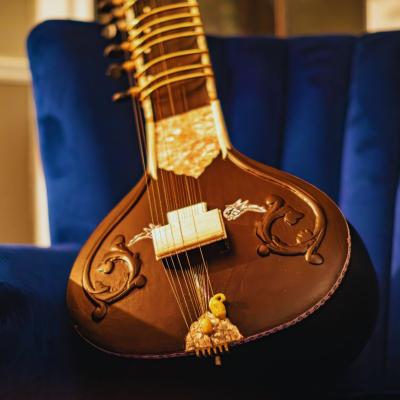
The Sitar is the most recognised instrument of the Hindustani tradition. Its design is a fine balance of wood, gourd, and wire, all focused on creating a sound that stays long after a string is plucked. This resonance is what allows the North Indian musician to explore the atmospheric depths of a raga.
Anatomy of the Infinite
The sound of the Sitar depends on three specific components that distinguish it from other string instruments.
The Jawari (The Bridge): This is a wide, sloping bridge made of bone or synthetic material. Unlike the narrow bridge of a guitar, which produces a clean, short note, the Jawari has a slight curve. As the string vibrates against this slope, it creates a rich, buzzing harmonic texture known as the "shimmer." Retaining the correct angle of the Jawari is a specialised craft; even a microscopic shift in the slope can deaden the instrument's voice.
The Pardas (The Frets): The Sitar uses curved brass frets tied to the neck with silk or nylon thread. These are not fixed. A performer can slide them to adjust the tuning for specific ragas. Because the frets are raised and curved, there is space between the string and the wooden neck, which is essential for the "pulling" technique used in melodic glides.
The Tarabtar (Sympathetic Strings): Located underneath the main playing strings is a second tier of thirteen to nineteen thinner strings. These are never plucked. They are tuned to the specific notes of the raga being played. When the main strings are struck, these Tarabtar strings begin to vibrate on their own through sympathetic resonance, providing a continuous acoustic backdrop.
The Legend of the Lute
The history of the Sitar is a record of cultural combination. Legend credits Amir Khusrau, the 13th-century Sufi poet and musician, with its invention. He is said to have adapted the three-stringed Persian Sehtar (literally "three strings") by combining it with indigenous Indian lutes like the Veena. Over the following centuries, the instrument developed from a simple, three-stringed device into the elaborate, multi-stringed version used today.
In the 20th century, the Sitar’s development was defined by two distinct schools of thought. Ustad Vilayat Khan refined the "Gayaki Ang," modifying the instrument’s design to better mimic the subtle transitions of the human voice. In contrast, Pandit Ravi Shankar emphasised "Tantrakari," focusing on the instrument's percussive and rhythmic capabilities. These masters proved that the Sitar could be both a meditative tool and a high-speed rhythmic engine.
The Art of the Pull
The most difficult technical aspect of the Sitar is the "pull." While a Western guitarist moves their fingers along different frets to change pitch, a Sitar player often stays on a single fret and pulls the string downward across the curve of the Parda.
This horizontal pull increases the string's tension, raising its pitch. A master can pull the string far enough to cover a range of five or six notes from a single position. This is how the Meend (the glide) is achieved. It is a gruelling physical process that requires considerable finger strength and care. If the pull is too fast, the melody loses its vocal quality; if it is too slow, the note dies before reaching its destination. This technique is the primary way the Sitar replicates the fluid, unbroken lines of a singer.
The Indian Violin: The Chameleon of the South
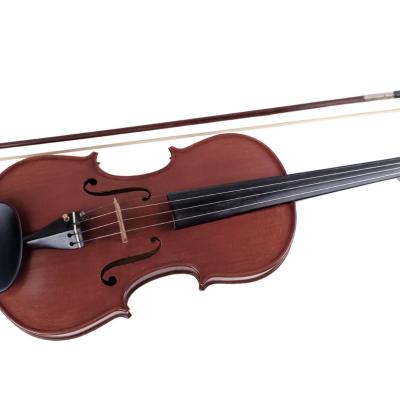
If the Sitar is the metallic voice of the North, the Indian Violin is the lyrical soul of the South. It is perhaps the most successful example of cultural adaptation in musical history. While the instrument’s physical frame remains identical to its Western counterpart, the way it is held, tuned, and played has been completely reimagined to serve the poetic needs of the Carnatic tradition.
A Global Migration
The history of the violin in India is a story of "re-birth." It arrived in the late 18th century, likely through the military bands of the East India Company and the French at Pondicherry. However, it was the visionary Baluswami Dikshitar (brother of the legendary composer Muthuswami Dikshitar) who recognised that the violin’s fretless neck was the perfect tool for the Gamakas (oscillations) of the South.
Unlike the harmonium or the piano, which have fixed tuning, the violin enables the musician to slide between notes with the smoothness of a vocalist. By the mid-19th century, the violin transitioned from colonial courts to the centre of temple music, replacing traditional instruments such as the Veena as the primary melodic accompaniment in Carnatic music. This shift represented not simply the migration of an object, but a complete transformation of its musical identity.
The Sitting Posture
The most striking difference between a Western and an Indian violinist is the posture. An Indian violinist sits sitting cross-legged on the floor, holding the instrument in a downward-sloping position. The scroll of the violin is firmly braced against the right ankle or the heel of the foot, while the chin rest is tucked against the chest.
This posture is a technical requirement rather than a mere cultural preference. Since Carnatic music depends on frequent, rapid, and complex Gamakas, the left hand must be entirely free to slide and oscillate along the strings at high speed. Bracing the instrument against the foot creates a third point of contact, stabilising the violin. This arrangement enables the left hand to move vertically without supporting the neck’s weight, enabling the clarity necessary for the rapid-fire Kritis of the South.
Masters of the Bow
The mastery of the Indian violin is defined by the "bowing" technique. To replicate the human voice, the bow must be used to create the illusion of a continuous breath. This requires a level of micro-control over the pressure and speed of the horsehair against the string.
Baluswami Dikshitar: The pioneer who first adapted the Western violin to the Carnatic system, setting the standard for the Sampradaya (tradition).
M.S. Gopalakrishnan: A titan of the 20th century, he was famous for his "Parur style," which blended Northern and Southern techniques. His playing was known for its incredible speed and the way he could make the violin sound like a flute or a human voice with equal ease.
L. Subramaniam: A modern legend who has taken the Indian violin to the global platform. His mastery lies in his capacity to maintain the traditional "purity" of the Carnatic sound while collaborating across styles, proving the instrument's status as a true "chameleon."
Meend vs. Gamaka
To an untrained listener, both the Sitar and the Indian violin may appear to "slide" between notes. However, the physical mechanics and musical intent underlying these movements are fundamentally distinct. This distinction defines the "linear" sound of the North and the "cyclical" sound of the South, representing a contrast between horizontal stretching and vertical pulsing.
The Linear vs. The Cyclical
In the Hindustani tradition, the Sitar’s primary movement is the Meend. This is a linear progression. When the player pulls the string, they are essentially stretching a single note across a horizontal plane to reach another. The result is a smooth, unbroken curve of sound. This "blending" of notes creates the atmospheric, sometimes melancholy, quality of the North. The Sitar is designed to let a note dissolve slowly into the next, emulating the long, sustained breaths of a Dhrupad or Khayal singer.
The Indian violin in the Carnatic tradition is used to "shape" the note through Gamaka. This is a cyclical movement. Instead of a single, long slide, the violinist uses rapid, controlled oscillations. The finger moves back and forth, or "shakes", around a central pitch. This doesn't just connect two notes; it creates a rhythmic texture within individual notes. This "cyclical" approach is what gives South Indian music its architectural feel. While the Sitar paints a horizon, the Violin carves a detailed relief.
The "Humane" Experience
The differences between these techniques produce distinct emotional realms. When one listens to a Sitar, the resonance of the Jawari and the sympathetic strings generates a sound that remains, persisting even after the player ceases plucking. This "shimmer" creates a music of reflection and spaciousness, where silence following a note possesses equal significance to the note itself.
In contrast, the Indian violin produces a sound that is more immediate and physical. The constant, rapid Gamakas impart a pulsing quality reminiscent of a heartbeat. This urgency resembles the human pulse during moments of intense devotion or intellectual engagement. In live performance, the Sitar encourages immersion in its echoes, while the Violin draws attention through its vibrant, continuous motion. The former invites meditation; the latter, the witnessing of a rigorous spiritual exercise.
The Craft of the Strings
Command of these instruments goes beyond musical proficiency. It involves a prolonged and demanding physical transformation within the student’s body. At the KalaSudha Academy, training highlights this physical reality as much as the study of ragas.
Preserving the Lineage
Learning the Sitar or the Indian Violin is a slow process of building endurance. In the early years, the student must deal with the "Sitarist’s callous." Because the Sitar strings are made of steel and brass, and because the "pull" technique requires a lot of force, the skin on the index and middle fingers of the left hand eventually thickens and hardens. This is a badge of honour in the Gharana. Without this physical change, a player cannot achieve the precision and richness of a five-note Meend.
Similarly, the "Violinist’s bowing technique" requires a specific kind of muscle memory in the right arm. The bow must be held with a firm grip, though also extremely sensitive to the tension of the strings. In the Southern tradition, the focus is on the "full bow," which mimics a long vocal breath. The KalaSudha Academy guarantees that these tiny details of posture and grip are passed down exactly as they were hundreds of years ago. This is the core of the Guru-Shishya relationship: a direct transfer of physical discipline from teacher to student.
Global Strings in 2026
In 2026, the field of these instruments has expanded. We now see the integration of electric Sitars and Violins in global collaborations. These modern versions allow for greater volume and a wider range of sound effects, making it easier for our musicians to play in jazz or orchestral settings.
Nevertheless, despite advancements in technology, the instrument's essential character remains unchanged. An electric Sitar still requires the traditional "pulling" technique, and an electric Violin must employ the same Gamakas to maintain its Carnatic authenticity. At the Academy, we emphasise to students that digital pickups or amplifiers are merely tools for performance. The substantive work continues during the peaceful hours of Sadhana (practice), where the student refines their craft. While technology develops, the core of the tradition endures.
The Eternal Vibration
In the end, whether it is the Sitar or the Indian Violin, these instruments are more than merely wood and wire. They are the physical result of a thousand-year-old obsession with the human voice. The Sitar gives the North its ambient shimmer, and the Violin gives the South its driving, pulsing heart. They differ in construction and technique, but both aim for the same spiritual truth.
In our next article, I will move from the "Mastery of the Strings" to the "Beat of the Earth." We will look at the Tabla and the Mridangam, the two great drums that provide the driving life for all this melody.

Rajeev Kumar is Co-founder and Director of Art at KalaSudha. Since establishing the organisation in 2023, he has focused on building the future of classical heritage at the intersection of digital technology and Indian Classical Music, Arts, and Dance.
Continue Reading

Booking Direct, Made Simple: KalaSudha Tickets Are Now Live
This month we start something steadier than a festival season: a KalaSudha concert every month, with workshops and more to follow. That rhythm changes what we need. When you put on shows all year roun...


KalaSudha Composer: The First Release Is Open for Testing
KalaSudha Composer is open for testing. Earlier this year, we shared a first look at our browser-based notation editor for Hindustani classical music. Since then, we rebuilt large parts of it and adde...

Decoding the Ragas and Rhythms of the Indian Holi Season
In the world of IT, we live by “release cycles” and “sprint cycles”. In the rural heartlands, where Holi is a way of life, things run on an older, more robust operating system. Here, the seasons dicta...