

Sarangi
(सारंगी)The sarangi is a short-necked bowed instrument of North India, close to the human voice. It has three gut strings and up to 37 sympathetic strings that ring with each note.
1
2
£400 - £8,000
Student models start around £400; mid-range sarangis cost £1,500–£3,000; master-made concert sarangis from Meerut or Delhi makers reach £4,500–£8,000. Many players favour instruments 50 to 100 years old, and a new sarangi needs about two years to settle.

Explore the discipline
Meet the musical tradition, its practitioners and ways to learn.
History & Origins
What is a sarangi?
The sarangi is the short-necked, fretless bowed instrument of Hindustani classical music, and ours suits the accompanist and the soloist. Sarangi players call it the instrument closest to the human voice. Makers carve body, neck and head from one block of tun wood (Toona ciliata) and stretch skin over the belly. Three gut playing strings run over a wide, flat bridge, above 35 to 40 sympathetic strings of fine steel or brass that ring with every note and never meet the bow.
The player sits with the sarangi upright on the lap and stops the strings with the side of the fingernail, sliding between pitches for meend and the exact microtones of a raga. The skin gives a warm, soft fundamental, and the sympathetic strings, retuned to each raga, ring on around the melody. This is the gayaki ang, the vocal style: for centuries the sarangi shadowed khayal and thumri singers as their chief accompanist in North Indian music, and carried the melody for Kathak dance. The accompanist listens and answers the singer's improvisation in the moment, often in a raga met for the first time on stage, which takes deep knowledge of raga and sharp ears, with fine control of bow and nail.
Ram Narayan, born in 1927, began as an All India Radio studio accompanist and in the 1950s made the sarangi a solo concert instrument; Sultan Khan followed him onto the solo stage.
The A'in-i Akbari of 1588-89 first describes the sarangi, and Mughal paintings show bowed instruments at court. Its modern form had developed by the 17th century. Older, smaller folk sarangis live in Rajasthan, where the Langa musicians' Gujaratan sarangi is the classical prototype, and in the Punjab hills; the Nepali sarangi is a separate group.
By the 18th century it was the chief accompanist to khayal singers. Muslim hereditary players of Rajasthan and Uttar Pradesh, employed by nawabs and rajas, refined it over generations; sons began in childhood, as its demands and raga knowledge needed a long apprenticeship. Accompaniment kept them below singers. Around 1900 the anti-nautch movement and lost court patronage stripped players of work and standing.
Ram Narayan turned soloist in the 1950s and reversed the decline: HMV recordings in the 1950s and 1960s and albums and tours from the 1970s proved it could hold a solo recital. Sultan Khan, a Rajasthani film and fusion player, reached popular audiences with Ravi Shankar; he, Sabri Khan, Harsh Narayan and Murad Ali Khan took the solo form into cross-genre work. Concert players remain far fewer than violinists or sitarists; the sarangi survives on Ram Narayan's insistence on its solo voice.
Construction & Craftsmanship
Materials Used
Construction Process
Makers carve the sarangi from a single block of tun (Toona ciliata), a soft, light timber from North India and Nepal whose walls flex with the strings. They hollow the belly from the front and the neck and head from the back, leaving four chambers and walls 7 to 10 mm thick to carry string tension. One piece gives rigidity and a unified tone. Goat or camel skin, dampened, stretched and dried under tension, is glued over the belly; it gives a warm fundamental and fewer high overtones than wood. Rows of sympathetic pegs sit in the sides of the neck.
Five bridges carry the strings. The main bridge, the ghoraj, is elephant-shaped in bone, ivory, stag-horn or ebony and rests on a leather strap; a misplaced or tilted bridge wears out the skin early. The three playing strings are sheep gut, twisted and dried under tension; their texture under the bow gives the warmth of gut tone, and synthetic gut suits humid climates.
The bow, the gaz, is a round stick of about 70 cm in ebony, shisham, rosewood, pernambuco or brazilwood, its horsehair tied over a wooden nut with a fixed frog, so pressure sets the tone.
Maintenance & Care
- Humidity: Keep 45–60% relative humidity, checked with a hygrometer. Dry air tightens and cracks the skin; damp slackens it. Store the sarangi in a cloth bag, not a sealed case, with a small open water bowl nearby in a dry winter.
- Skin and bridge: Never oil or polish the skin, which changes how it vibrates, and wipe rosin dust off it after playing for the same reason. Check that the main bridge sits on its leather strap.
- Strings: The fine sympathetic strings, the highest above all, break often: keep spares and learn to restring them. Replace gut strings when they fray at the bridge or sound dull, and check tuning every session, as gut shifts with humidity and can snap in dry air.
- Pegs: Turn them regularly and use peg compound so they move smoothly and hold.
- Bow: Rosin before each session with light colophony, never dark double-bass rosin. Rehair once or twice a year, or when the hair thins, breaks or stops gripping despite fresh rosin.
- Hand: Talcum powder helps the nail slide.
Playing Techniques
Fingerboard Navigation
BeginnerMastering vertical and horizontal positioning across the fingerboard or neck to extend the instrument's melodic range.
Bowing Styles
BeginnerMastering the primary method of sound articulation, focusing on stroke direction, pressure, and rhythmic clarity.
Meend (Lateral Pulling)
IntermediateMastering the art of the continuous slide between notes to achieve vocal-like continuity and microtonal precision.
Vibrato Mastery
IntermediateDeveloping controlled oscillations of pitch to add emotional depth, resonance, and "weight" to sustained notes.
Gamaka (Oscillation)
AdvanceExecuting traditional microtonal oscillations and ornaments essential to the authentic character of a Raga.
Zamzama (Grace Notes)
AdvanceExecuting rapid, sharp clusters of notes in quick succession to add intricate texture and "sparkle" to a phrase.
Technical Specifications
Detailed specifications for the Sarangi
Physical dimensions
| Specification | Value |
|---|---|
| Overall length | 560–610mm (22–24 inches) |
| Body length | 430–460mm (17–18 inches) |
| Upper bout width | 130–145mm (5.1–5.7 inches) |
| Lower bout width | 180–200mm (7.1–7.9 inches) |
| Vibrating string length (playing) | 380–410mm (15–16 inches) |
| Total string count | 38–43 (3 playing strings + 35–40 sympathetic strings) |
Material composition
| Specification | Value |
|---|---|
| Body wood | Tun wood, Toona ciliata (single-block carved) |
| Resonating membrane | Goat skin or camel skin, stretched and glued over the lower chamber |
| Playing strings | Sheep gut or nylon synthetic (3 strings) |
| Sympathetic strings | Fine steel or brass wire, gauges 0.15–0.30mm |
| Bow stick | Pernambuco or brazilwood with fixed frog; also ebony, shisham or rosewood |
| Bow hair | Natural horsehair (unscreened, light colophony rosin) |
Acoustic characteristics
| Specification | Value |
|---|---|
| Pitch reference | Set to vocalist's Sa; no fixed concert pitch standard |
| Playing range (main strings) | Approximately C3 to C6 (two-plus octaves) |
| Sympathetic resonance | Strings retuned per raga at each performance; vibrate in unison and overtone series with played notes |
| Resonator type | Skin membrane: warm fundamental, less high-frequency content than a wooden soundboard |
| Tonal character | Gayaki ang (vocal style): voice-like timbre with sympathetic shimmer |
| Bridge | Elephant-shaped bone or ivory bridge on a leather strap over the skin; height and angle set for clearance and tone |
Your Journey to Sarangi Mastery
Follow this structured path from absolute beginner to accomplished performer
Foundation and posture
Bowing fundamentals
Pitch navigation
Meend and vocal ornamentation
Advanced solo art
Media Gallery
Watch performances, see details, and explore the Sarangi in action

Featured Artists
Renowned Sarangi players and performers
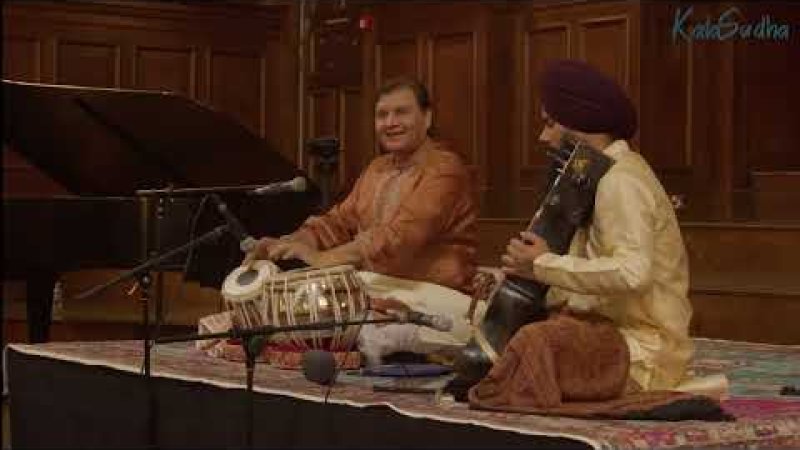
Satwinder Pal Singh

Past Events
Browse our archive of past performances


Reading Raga Resonance: Bow, Beat, and Breath

Norwich Ragas: Tabla Solo by Ustad Akram Khan
Frequently Asked Questions
What is a sarangi?
The sarangi is a short bowed instrument with three gut playing strings and around 35 sympathetic strings that resonate beneath them.
Players stop the strings from the side with the backs of their fingernails. Many musicians hold that, of all Indian instruments, the sarangi sits closest to the human voice.
What is a sarangi made of?
A classical sarangi's body, neck and head are carved from a single block of wood, usually tun (Toona ciliata), and the belly is covered with the thin skin of a young goat. The arched main bridge, carved as an elephant, is ivory, stag-horn, ebony or bone and carries three gut playing strings. Sympathetic strings were traditionally copper or brass, and steel had become common by the 1980s.
How many strings does a sarangi have?
A classical sarangi usually has three gut playing strings and about 35 sympathetic strings; some carry 39, and smaller ones 24 or fewer. Classical sarangis have never been standardised, so sizes and string counts vary. The bow never touches the sympathetic strings, which sound only by resonance with the bowed strings.
How is a sarangi tuned?
A sarangi can be tuned from C sharp to F sharp, sounding best with the first string at D sharp or E, but accompanists tune to the singer's pitch. The main strings take Sa-Pa-Sa or Sa-Ma-Sa, and the main sympathetic set is tuned chromatically. A full tuning, repeated several times, takes a skilled player 5 to 10 minutes.
Why do sarangi players stop the strings with their fingernails?
Sarangi players stop the strings with the fingernails pressed sideways, mostly with the part of the nail just below the cuticle; the pads of the fingers are not used. Talcum powder lubricates the left hand, and practice brings heavy callousing and grooves in the nails. The Cretan lyra and the Bulgarian gadulka also use nail-side stopping.
How old is the sarangi?
The word sarangi names a stringed instrument in Jain texts from 1052, but no early text describes it. The first descriptions come from Akbar's period: the A'in-i Akbari of 1588 to 1589 calls it smaller than the rabab. The earliest painting of a sarangi player dates from the early 17th century, and the large classical form developed in or around Delhi in about the mid-19th century.
How does the sarangi differ from the violin?
A sarangi has a skin table where the violin has a wooden top, and its player stops the strings with the side of the nail rather than the fingertip. It is held upright in front of the chest by a seated player. It also carries about 35 sympathetic strings that sound only by resonance with its three bowed gut strings.
Is the Nepali sarangi the same as the classical sarangi?
No: the Nepali sarangi belongs structurally to the sarinda group of the wider sarangi family. It has four playing strings of metal and gut and is played by the Gaine (Gandharva) community; modern instruments often use nylon or steel strings. The classical Hindustani sarangi usually has three gut playing strings and about 35 sympathetic strings.
Should I buy a new or an old sarangi?
Most players use sarangis 50 to 100 years old, often inherited, and a new instrument needs about two years to settle. Joep Bor warned that new sarangis made for export or tourists were usually of very poor quality, and that good old instruments and skilled repairers were scarce. Either way, tone depends on set-up: bridge, skin fitting, string height and peg fit.
What should I check before buying a sarangi?
Check the back of a sarangi behind the string holder, where most old sarangis are bent or cracked. Check the set-up too: bridge placement and contour, skin fitting, string thickness and height, and peg fit. Sizes vary, because players ordered larger sarangis to accompany male singers and smaller ones for women singers. Instruments by the Meerut makers Masita and Abdul Aziz Behra were the most prized.
Have more questions? Contact our support team and we'll be happy to help!
Ready to start learning Sarangi?
Get personalized quotes and explore courses