Video
HD

Raag Jog | Indian Slide Guitar, Piano, Sitar & Tabla | Music of India | Kala Festival 2023

KalaSudha Music 1 year ago
11:00

About This Video

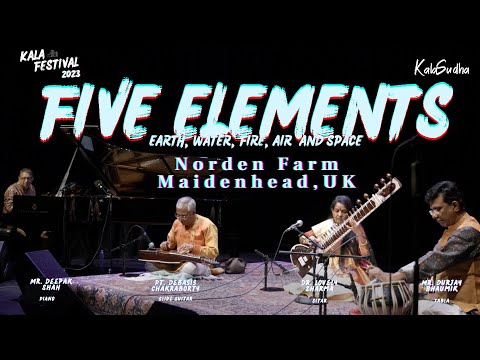
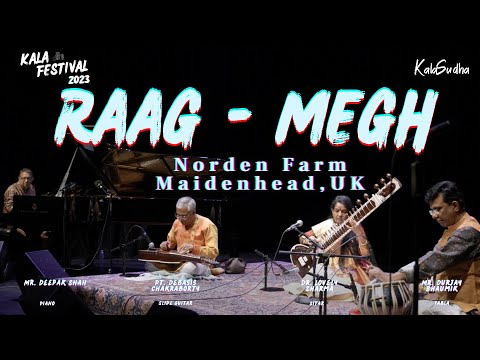
At Norden Farm Centre for the Arts in Maidenhead on 23 August 2023, four musicians performed Raag Jog as part of the Kala Festival: Pandit Debasis Chakroborty on Indian slide guitar, Deepak Shah on piano, Lovely Sharma on sitar, and Durjay Bhaumik on tabla.

Raag Jog belongs to the Kafi Thaat and uses a pentatonic scale with two Gandharas: Shuddha Ga in the ascent, Komal Ga in the descent. This dual-third produces a tension between brightness and depth that resists a single emotional category. Its vadi is Ma, its samay the late evening, and its characteristic movement circles back to the S-G-m cell in hypnotic, blues-adjacent phrases.

Across eleven minutes, slide guitar, piano, sitar, and tabla negotiate the raga's tonal ambiguity together. Chakroborty's glissandi exploit the natural slide between the two Gandharas; Shah's piano finds the raga's pentatonic framework in the Western instrument; Sharma's sitar carries the melodic core; and Bhaumik's tabla marks the rhythmic ground beneath all three.

Credits

Indian Slide Guitar Debasis Chakroborty
Sitar Dr Lovely Sharma
Piano Deepak Shah
Tabla Durjay Bhaumik

Ragas

Jog

जोग

Late evening

Raag Jog shows the emotional complexity found in Hindustani classical music. Instead of fitting into just one mood, this raga is hard to categorise. It is part of the Kafi Thaat, and what makes it unique is the use of both Gandharas: Shuddha Ga (G) and Komal g (g). This mix creates a special kind of tension, capturing the subtle balance between joy and sorrow, and between stability and restlessness. While many ragas use dual notes only as passing tones, Jog makes them central to its sound. Shuddha Ga usually comes up in the ascending notes, giving a sense of brightness and resolution. Komal Ga is more common in the descending notes, adding a soulful, blues-like depth to the melody. Jog is usually played in the early night hours (2nd Prahar), when its repeating, hypnotic phrases can put listeners into a trance-like state. To fully understand Jog, it helps to look at other ragas in the Kafi family: Jog and Tilang both use a pentatonic scale (SGMPnS′) and share the Ni-Ni duality. However, Jog includes the Komal Ga (g), whereas Tilang does not. This note changes the mood from Tilang’s light, playful feeling to the deeper, more thoughtful blues quality of Jog.Jog and Bageshri are both part of the Kafi Thaat, and both express a sense of longing. Bageshri’s melody focuses on the Madhyama (M), while Jog centres on the tension between the two Gandharas. Bageshri feels like a quiet sense of separation, but Jog feels more like a reflection on the ups and downs of life. The "Blues" Connection: Music scholars often say that Jog is the Indian raga most similar to the Western Blues Scale. The "Blue Note" in blues matches the small interval between the Shuddha and Komal Gandhar in Jog. This makes Jog a bridge for musicians everywhere who want to find common ground in music.

View Details

Video Info

Duration
11:00
Published
Category
Quality
HD
Resolution
1920x1080