
Raag Desh | Sitar | Tabla | Music of India | Purvi Festival 2023
About This Video
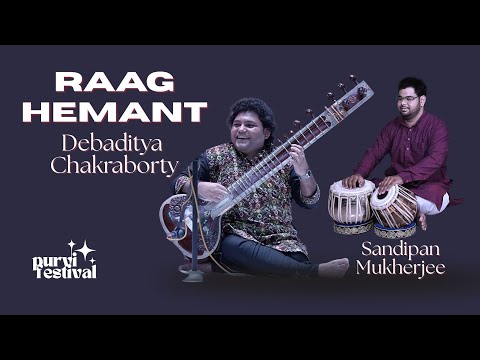
The second segment of Debaditya Chakraborty's recital at Purvi Festival 2023 in Motihari featured Raag Desh on sitar, with Sandipan Mukherjee on tabla. The segment runs eight minutes and follows the opening set from the same evening.
Raag Desh belongs to the Khamaj thaat and takes a late-evening samay. Its structure is asymmetric: a five-note ascent (S R m P N S') that skips Ga and Dha, and a seven-note descent (S' n D P m G R, G .N S) where Komal Nishad gives the return phrase its softened, rain-associated quality. The vadi is Re, the samvadi Pa, and the signature resolution G .N S anchors each phrase back to the tonic.
Chakraborty opens with an alap tracing the pakad (R m P n D P, m G R), then moves into a drut gat in Ektaal (12 beats). As the tempo rises, Sandipan Mukherjee shifts from marking the tala to active exchange, his kayda phrases tracking the sitar's tans. The segment closes on tihais that resolve the final beat with precision.
Credits
Featured In


Related Videos
Ragas
Desh
देश
Raag Desh is a cultural icon of the Indian sub-continent. Belonging to the Khamaj Thaat, it is a "Chanchal" (playful) and "Abhisarika" raga that captures the essence of the Indian landscape. Its structure is simple, but its emotional resonance is vast, ranging from the heroic fervour of patriotism to the tender yearning of a rainy evening. Usually performed in the second prahar of the night, Desh is often categorised as a "Megh-Pradhan" raga, sung during the monsoon season. Its defining characteristic is the dual use of Nishad: Shuddha Ni (N) in the ascent, which provides a sense of rising hope, and Komal Ni (n) in the descent, which evokes gentle, rain-like melancholy. Desh vs. Khamaj vs. Sorat Within the Khamaj Thaat family, Desh holds a unique middle ground: Desh and Khamaj: Both use the dual-Nishad. Khamaj is a Shadava-Sampurna raga that leans on Shuddha Ga (G). Desh often skips G in the ascent or gives it less weight, giving it a more open, soaring quality.Desh and Sorat are often confused. The key difference is the Gandhar (G). In Sorat, G is strictly avoided or used minimally as a grace note. In Desh, G is essential in the descent (PDmGRS) to provide its characteristic warmth and romantic flavour. vs. Tilak Kamod: Both share a similar note set, but the Chalan (movement) is reversed. Tilak Kamod is "Vakra" (crooked), while Desh is more linear and "Sanchari" (flowing).
View Details